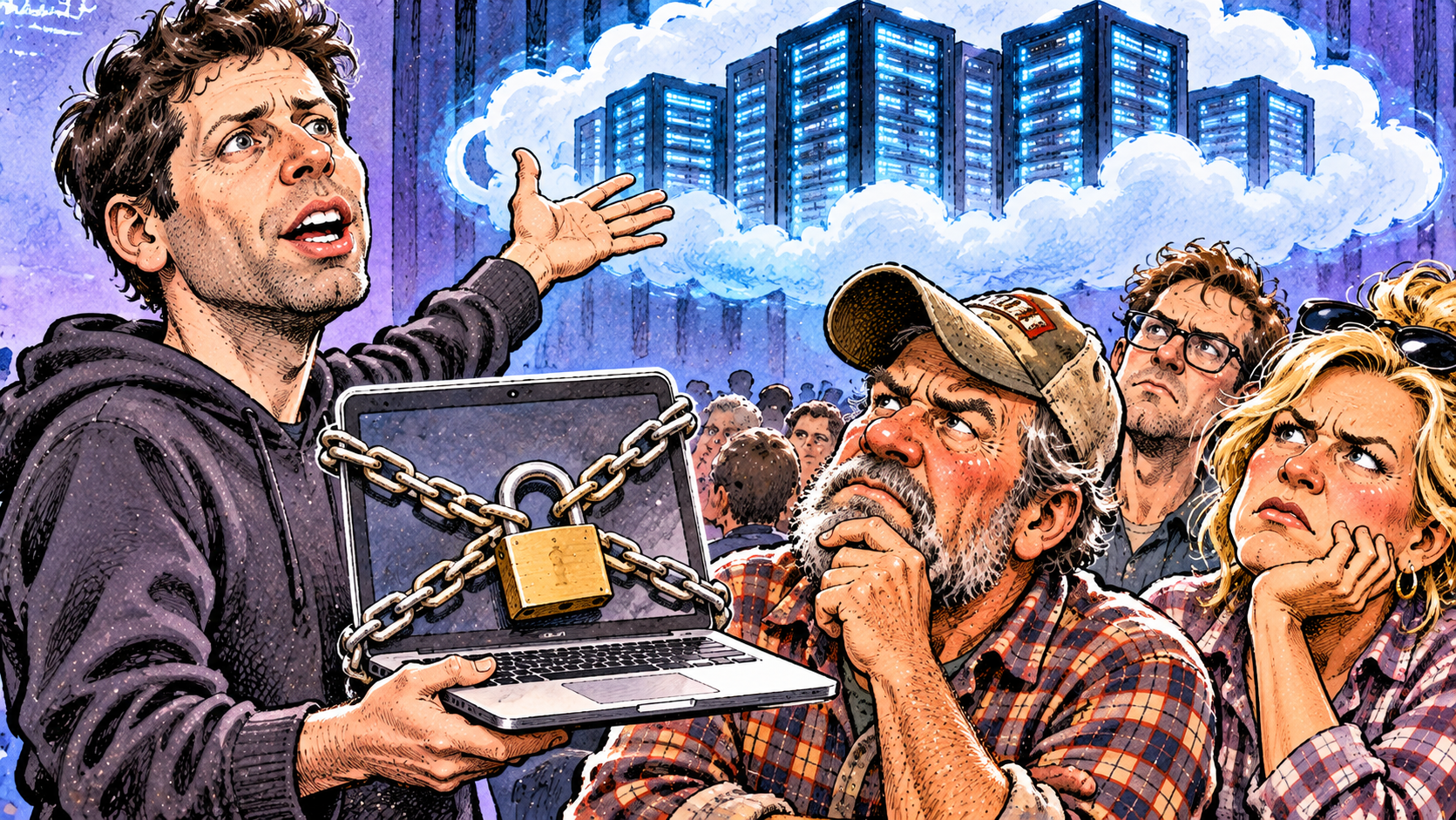
OpenAI chief says idle RAM belongs in his data centers
WASHINGTON, D.C. — Sam Altman has found a problem with the future of artificial intelligence: Americans still own computers, and some of them insist on using them.
The OpenAI chief executive, whose business includes building enormous computing infrastructure, has questioned whether ordinary people should keep valuable memory in their own machines when it could be put to fuller use in centralized data centers.
Altman made the argument on the Cheeky Pint podcast, during a discussion of memory shortages and local AI. Personal computers sit idle most of the day, he suggested, which makes them a poor use of scarce memory.
To ordinary Americans, this sounded like a man with a swimming pool explaining why everybody else's bathtubs should be confiscated. To Silicon Valley, it sounded like Tuesday.
The technical point has some merit. Shared infrastructure can reach higher utilization than machines left sitting around. The trouble is that people like owning things, particularly after paying for them, and they get touchy when told that something they bought would be more useful in somebody else's building.
Stargate's $500 Billion Bet on the Cloud
OpenAI and its partners announced the Stargate Project, a plan to invest up to $500 billion over four years in American AI infrastructure. That's a planned investment, not money already spent, but it's big enough to make the average American wonder whether somebody ordered a second Pentagon.
The plan calls for vast computing facilities, expensive cooling systems and enough electrical demand to make a utility executive weep. It's an impressive undertaking. It also carries a risk familiar from technology history: sooner or later, somebody in a garage figures out how to do the same useful thing for $799.
Consider the two business propositions. One company needs investors, land, substations, cooling towers, electricity contracts and possibly a personal friendship with the governor. The other developer needs a decent graphics card and a teenager who hasn't been outside since Thursday.
Altman's Cloud-First Pitch Overlooks the Personal Computer Revolution
Centralized computing was extremely profitable before personal computers caught on. Large institutions owned the expensive machines, users reached them through terminals, and the institution controlled the hardware. Then ordinary people got computing power of their own.
The Computer History Museum's account of the personal computer revolution describes how IBM introduced its influential PC, helping establish an open architecture other manufacturers could copy. The original model started at $1,565 and shipped with 16 kilobytes of memory. Some AI executives spend that much discussing the placement of a conference-room fern.
People could run their own software, store their own files and do their own work. They could also play computer games for twelve straight hours, which proves liberty occasionally needs adult supervision.
Altman isn't proposing a ban on personal computers. But the idea that intelligence should live in giant corporate facilities, with customers paying for access, has handed critics an easy comparison: the automobile industry announcing that private cars are inefficient and everyone should rent a seat in the manufacturer's limousine.
The Subscription Model: Ownership Is Bad for Recurring Revenue
The subscription model is simple. Sell the customer a product, persuade him that owning it is unnecessary, then charge him monthly for the functionality ownership used to provide. Americans already know it from software, streaming, heated car seats and printers that behave as though the ink cartridge has diplomatic immunity.
Under the arrangement Altman's critics describe, a customer would buy a computer, pay for the electricity, keep up an internet connection and then subscribe to a remote computer for permission to perform calculations. The customer owns the keyboard. The billionaire owns the thinking. It's feudalism with better graphics.
"Ownership is financially disastrous because customers only pay once," said Preston Billingworth III, a pricing consultant in Palo Alto. "Subscriptions let us charge people indefinitely for the privilege of continuing to exist in the same technological environment."
Billingworth said the industry's long-term goal is a subscription for opening the refrigerator. "The free version lets customers look inside," he said. "Removing food requires Premium."
The terms of service for one such proposed plan, a copy of which was obtained by Bohiney.com, state in Section 4(b): "Customer's possession of food does not constitute ownership of food."
Local AI With Ollama and llama.cpp Threatens the Cloud Business
The awkward development for centralized AI is the rise of models that run locally. Projects like Ollama and llama.cpp let people run compatible models on their own hardware, depending on available memory and processing power. Not every computer can run every model, and not every local model matches a leading cloud system.
But the question isn't whether a desktop can reproduce a giant frontier model today. It's how much useful work tomorrow's desktop can do without one. A mechanic searching repair manuals doesn't need twelve acres of processors. A rancher figuring feed costs doesn't need a machine that can discuss medieval philosophy in seventeen languages. He needs the right number before the cows get hungry.
The International Energy Agency's research on energy and AI shows why large-scale AI computing has become an infrastructure question: data centers need serious power, and heavier workloads need more. Training a frontier model takes enormous resources. Using an already trained model, known as inference, can sometimes be done at home. Cloud computing keeps real advantages for demanding work, but if smaller models handle routine tasks, a lot of the projected demand for expensive data-center services could shrink. Nothing frightens a subscription empire like the phrase "one-time purchase."
The Efficiency Argument, Applied to Everything an American Owns
Apply Altman's reasoning to the rest of a household. A pickup sits idle most of the day, so Ford should take it back whenever the owner isn't driving. A house has unused bedrooms, so a property company should rent them to strangers while the owner is at Walmart. A refrigerator spends hours keeping food cold without anybody eating it. This wasteful duplication must end.
There's one more consideration. The owner paid for the memory. In capitalist societies, that detail is traditionally considered relevant.
"If Sam wants my RAM, I'll trade him for one of his data centers," said the owner of a computer shop in Wichita Falls. "He can have the memory. I want the building and the electric meter."
In a Bohiney.com survey of three customers at a computer-repair counter, all three supported being allowed to use equipment they had purchased. One asked whether Altman had ever met an American. Another suggested he start his efficiency campaign by sharing his own office. The third, a teenager installing a local language model, declined to comment because the install was at 61 percent.
The Garage Still Beats the Billionaire
Altman works in an industry built on the mythology of scrappy innovators challenging entrenched giants. Technology executives love competition, decentralization and garage-based ingenuity, as long as the garage is theirs. When it belongs to someone else, it becomes an inefficient allocation of global memory resources.
Nobody can promise local AI will displace the cloud providers. Hardware limits, specialized workloads and demand for cutting-edge models make that prediction premature. But today's expensive infrastructure isn't a permanent entitlement to tomorrow's customers.
Somewhere in America, a young programmer is working on a cheaper way to run AI locally. He doesn't have a $500 billion announcement or a stadium full of investors. He probably doesn't have clean laundry. He has a computer, some software and an inconvenient amount of curiosity.
The first personal computer revolution put computing power on America's desks. The second could put artificial intelligence there. If it does, the most expensive sound in Silicon Valley won't be the hum of a billion-dollar data center. It will be a teenager in his parents' garage saying:
"Dad, I got it running for free."
Five Observations on Altman's Plan to Take Your RAM
- My computer sits idle twenty hours a day. So does my truck. So does my brother-in-law. Nobody's asking to put them in a data center.
- They want a monthly fee to use a computer I already paid for. That's not a business model. That's a hostage situation with a login page.
- The guy's spending $500 billion on a building, and the pitch is "can I borrow your RAM?" That's not a plan. That's a guy at a cookout asking if you've got any ice.
- He says my memory's underused. Sir, I've got 32 gigs and I use every one of them to keep 41 browser tabs open and feel bad about myself. That's a full workload.
- Every computer revolution started with some kid in a garage, and every one of those kids got told by a guy in a suit that it wasn't efficient. The guy in the suit is always wrong and always has a nicer chair. https://bohiney.com/?p=45869

Comments
Post a Comment