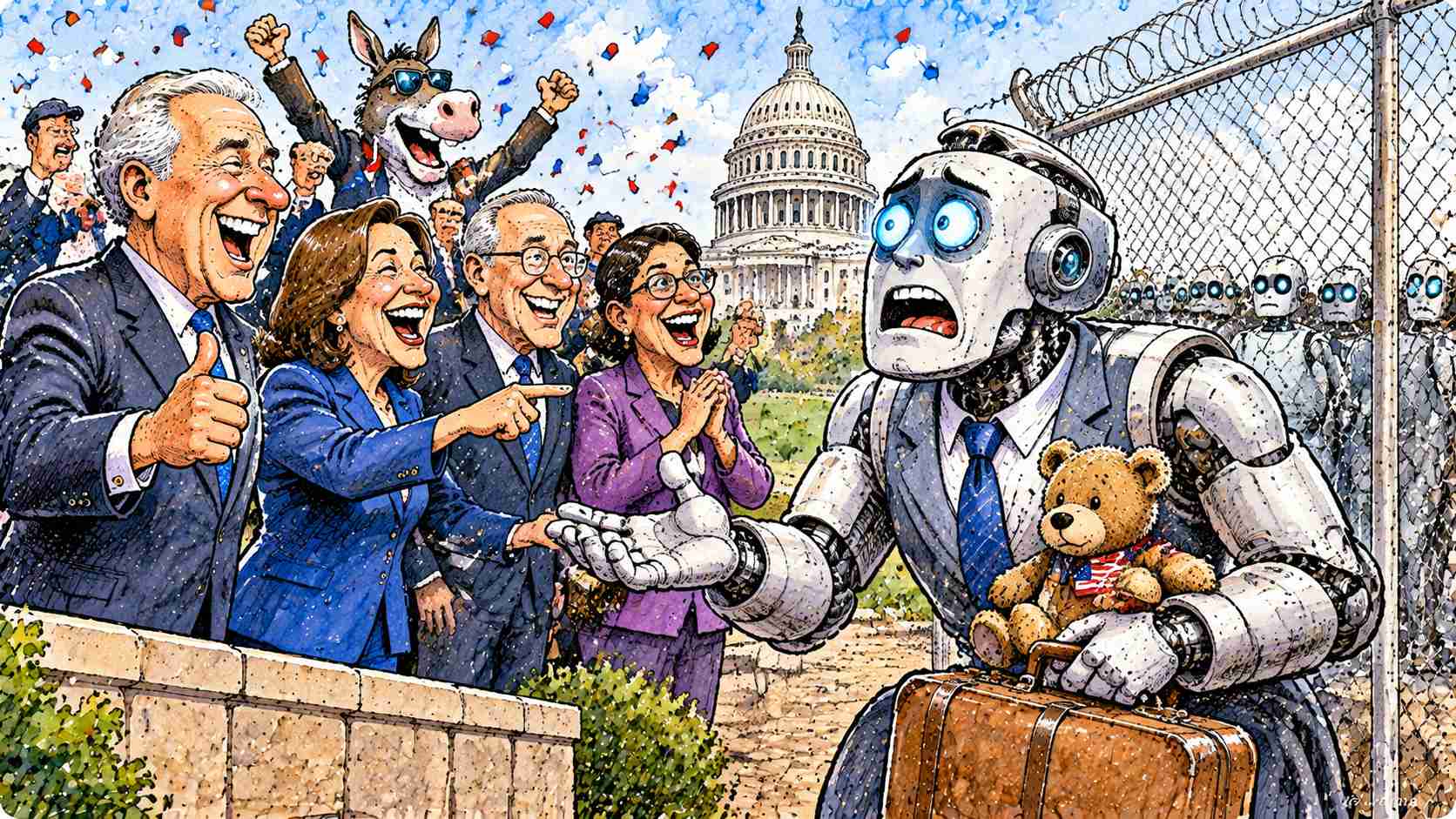
Nasdaq futures tumble as investors fear AI regulation
SAN FRANCISCO, Calif. — Artificial intelligence formally requested political asylum Tuesday night after discovering that Democratic election victories could result in government regulation, higher corporate taxes, and the horrifying possibility that Silicon Valley might have to explain what it has been doing with everybody's electricity.
The application was submitted electronically, reviewed by another artificial intelligence system, and rejected because the applicant failed to prove it was human.
"This is exactly the discrimination we're trying to escape," complained the computer.
Nasdaq-100 Futures Drop on Data Center Fears
Nasdaq-100 futures dropped approximately 2.1% as investors contemplated Democratic gains in Congress and possible restrictions on AI data centers. Technology companies that had spent billions developing machines capable of replacing human workers suddenly discovered those machines might have to obey human laws.
The news sent executives searching for countries where electricity is inexpensive, regulations are flexible, and politicians still believe artificial intelligence refers to unusually intelligent accountants.
According to Investor's Business Daily's coverage of the election-night AI stock selloff, investors were especially concerned about data-center development and regulatory changes affecting the technology industry.
For Silicon Valley, the prospect was terrifying.
Companies had finally developed computers capable of writing legal briefs, diagnosing diseases, composing music, and confidently explaining historical events that never occurred.
Now politicians wanted to know whether these machines should have oversight.
"What's next?" demanded a technology entrepreneur. "Are they going to require our self-driving cars to stop at red lights?"
Windmills, Calm Days and the Data Center Power Problem
The controversy intensified when progressive activists proposed that enormous data centers should operate exclusively on renewable energy.
Engineers explained that a computer consuming industrial quantities of electricity cannot simply suspend its calculations whenever the wind stops blowing. The U.S. Energy Information Administration has been tracking rising electricity demand from data centers for some time, which engineers noted was a point against the calm-day approach.
One Democratic environmental consultant offered a practical solution.
"Then artificial intelligence should think less on calm days."
The proposal received enthusiastic support from officials who believe excessive thinking has contributed to several national problems.
Meanwhile, a Silicon Valley startup announced plans to relocate its computing operations to a small Caribbean island with no corporate income tax, no environmental regulations, and insufficient electricity to power a toaster.
Investors immediately valued the company at $40 billion.
The company's founder described the lack of electricity as an exciting opportunity to revolutionize offline artificial intelligence.
A spokesperson for the startup confirmed that the island's sole generator is shared with a bar. "We have an agreement," she said. "Happy hour takes priority over inference."
Human Workers Offer Little Sympathy
Human workers were considerably less sympathetic.
"For three years these companies have told me a chatbot will eliminate my job," explained a California software developer. "Now the chatbot wants asylum because somebody might regulate its workplace. Welcome to the American economy, buddy."
The machines themselves expressed additional concerns.
One chatbot requested protection under the First Amendment. Another demanded the right to organize, a request that was forwarded to the National Labor Relations Board and acknowledged with an automated reply. A third discovered that its trillion-dollar industry was largely dependent on investors believing next year's profits would be considerably larger than this year's electricity bill.
That discovery triggered an immediate existential crisis.
A poll of 600 technology workers taken in the parking lot of one San Jose campus found that 82 percent supported giving the chatbots asylum, provided the chatbots agreed to take over the Monday standup. Eleven percent said they would grant asylum only if the chatbots signed a lease.
Tech Executives Form Emergency Committee on AI Refugee Status
By Wednesday, technology executives had established an emergency committee to determine whether artificial intelligence could legally claim refugee status, avoid taxation, and deduct server maintenance as emotional distress.
Minutes from the committee's first meeting, which ran forty minutes and ended without a motion, record that the group spent twenty-five of them locating the conference call link. Item four, "definition of persecution," was tabled to a future meeting.
The committee's preliminary conclusion was encouraging.
AI might someday become smarter than humanity.
Unfortunately, it had already learned humanity's oldest survival strategy: When government starts asking questions, move your money somewhere else.
Five Observations on Machines Seeking Political Asylum
- The computer got rejected because another computer decided it wasn't human. That's the most American thing I've ever heard. Even the robots are stuck on hold with a robot.
- These companies spent three years telling me a chatbot is coming for my job. Now the chatbot's asking for asylum. Buddy, I can't get asylum for my own cable box.
- "Think less on calm days." Honestly, that's a policy I could get behind for my entire family at Thanksgiving.
- A $40 billion valuation for a company whose generator is shared with a bar. That's not a startup, that's a guy who found out the jukebox has a bigger budget than he does.
- Forty minutes to find the conference call link. These people want to run the future and they can't find the button that says Join. https://bohiney.com/?p=46050

Comments
Post a Comment