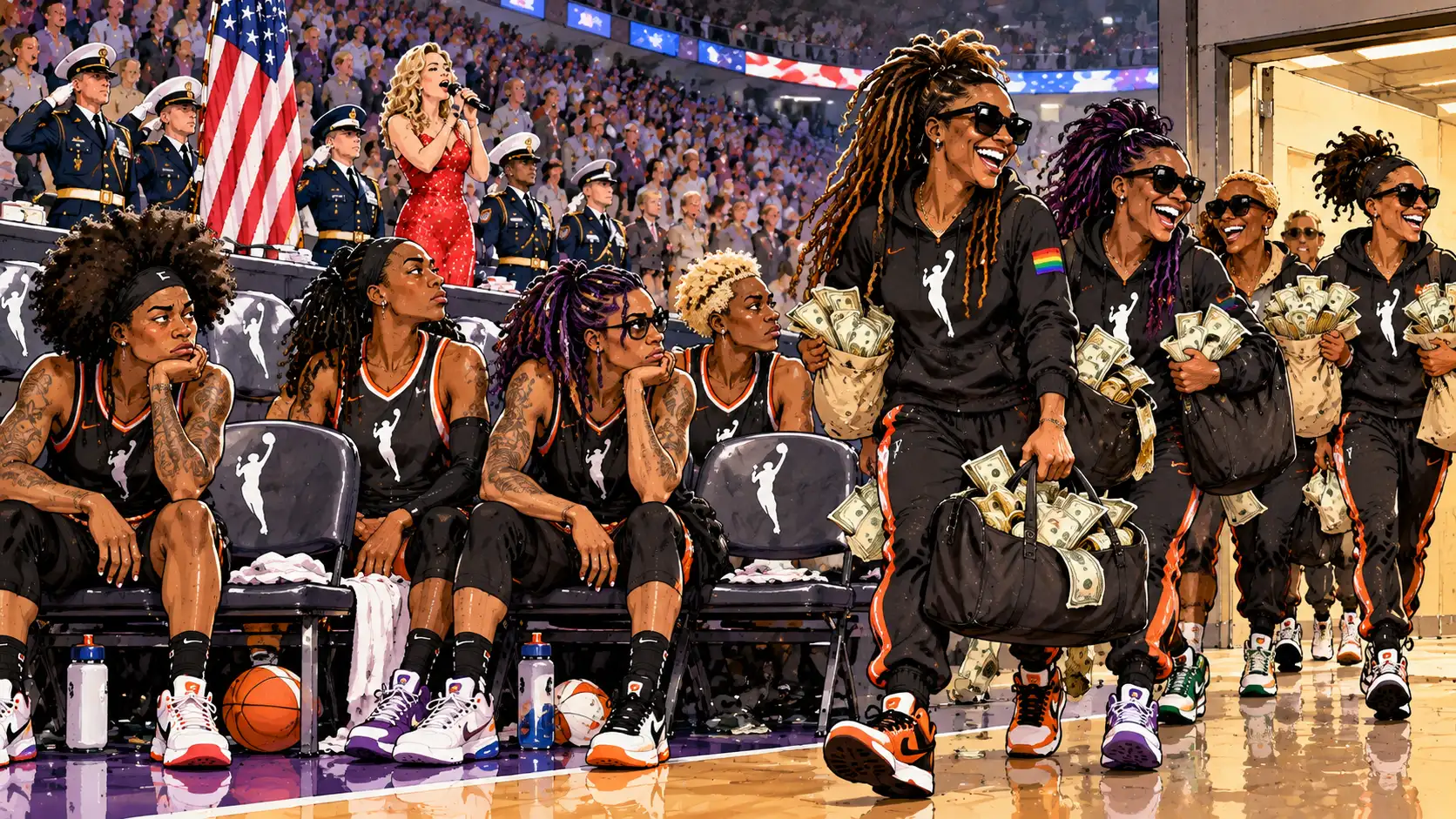
League Says Patriotism Is Optional, Direct Deposit Mandatory
ATLANTA, GEORGIA - The Women's National Basketball Association has introduced a bold new interpretation of American patriotism: the United States is a wonderful country in which to earn a living, negotiate sponsorship agreements, sell merchandise and pursue professional glory, but a somewhat inconvenient place to stand for 90 seconds while somebody sings the national anthem. According to an October 23 OutKick investigation into WNBA national anthem absences, players from the Atlanta Dream and Golden State Valkyries left the court before the anthem in each of the first three WNBA Finals games, returning shortly after the music ended. Coaches described the absences as a longstanding routine. The reasoning behind the routine proved remarkably hard to extract.
The development has raised an intriguing question in American sports: how can professional athletes master zone defense, three-point shooting and multimillion-dollar contract negotiations and still be unable to say where they went for a minute and a half?
The league insists that basketball remains its principal business. So does the American public, which would occasionally like to watch a basketball game without first enrolling in an undergraduate seminar on the political significance of standing upright.
WNBA Players and American Commerce: Wonderful When the Paycheck Clears
The WNBA's relationship with patriotic ceremony is complicated. Its relationship with American commerce is not.
Players enjoy the opportunities of professional sports in a country that permits them to criticize government, protest publicly and earn substantial sums playing basketball. That is one of America's more attractive features. Nobody has to love every government policy to collect a paycheck. The First Amendment exists precisely because Americans occasionally disagree, sometimes loudly, frequently without understanding what they're talking about.
But professional sports franchises also observe another constitutional tradition: convincing customers to buy tickets. This presents a commercial problem.
The league wants Americans to support women's basketball, embrace its athletes, purchase merchandise, watch broadcasts and persuade advertisers that professional women's sports deserve greater investment. Then some teams leave the floor during the patriotic ceremony that many of those same customers consider meaningful.
A successful business ordinarily avoids creating unnecessary conflicts with its customers. A restaurant would struggle if the chef insisted that diners were culturally backward for wanting their dinner served warm. An airline would run into trouble if it told passengers that complaining about the missing airplane showed insufficient appreciation for transportation diversity.
Yet professional basketball has discovered that customer relations can begin with a philosophical disagreement over whether athletes should stay in the building for the national anthem. The marketing slogan practically writes itself:
"Support Our League. Respect Our Decisions. Please Don't Ask About the Flag."
It's a bold business model. Most companies try to turn customers into fans. This one risks turning fans into political commentators.
Team USA vs. the WNBA: The Flag Looks Better Next to a Gold Medal
The controversy gets more entertaining once international basketball enters the picture.
Atlanta Dream guard Rhyne Howard, whose Team USA selection for the FIBA Women's World Cup made franchise history, represented the United States at the September 2026 Women's Basketball World Cup, where she stood for the national anthem. Asked about the difference between her WNBA appearances and international competition, Howard said she loves her country and stands for the anthem whenever she wears a USA jersey. Asked why she was absent for WNBA anthem performances, she did not offer an explanation, and the interview moved on.
The American flag, it turns out, has an unusual ability to become more attractive when it's embroidered onto expensive athletic clothing. At a WNBA game, it's part of a complicated pregame scheduling arrangement. At an international tournament, it's suddenly part of the uniform. The distinction is extraordinary.
Consider an American businessman who refuses to acknowledge his company's existence every morning but proudly announces his employment whenever the business wins an international award. His explanation might be that recognizing the company belongs to a different routine when trophies are involved. Human Resources would presumably request further clarification.
The Associated Press explanation of WNBA national anthem rules and international basketball protocols notes an important distinction: international basketball schedules national anthems immediately before tipoff, while WNBA pregame routines are arranged differently. So there is a genuine scheduling explanation for some of the contrast.
Nevertheless, the spectacle offers a beautiful piece of American irony. The same country is worthy of international representation and also negotiable as a matter of domestic pregame logistics. The American flag has effectively become a traveling salesman. At international tournaments, everybody welcomes him. At domestic games, somebody explains that he arrived during a staff meeting.
The WNBA Anthem Rule: The Rulebook Contains Rules
The league's administrative situation is even more impressive.
The WNBA's 2026 rulebook still contains language instructing players, coaches and trainers to line up respectfully during the national anthem. The league suspended those protocols in 2017, which means the written provision doesn't necessarily describe the current enforceable policy. The precise application of the rule remains unclear.
This is outstanding bureaucratic craftsmanship. Most organizations have rules that employees are expected to follow. The WNBA has developed rules that exist, have been suspended, remain published and require further investigation to determine whether anyone has to follow them. Washington bureaucrats are probably furious they didn't think of it first.
Imagine basketball itself operating this way. A referee blows the whistle for traveling. The player explains that traveling was suspended in 2017. The referee consults the rulebook, discovers traveling is still prohibited, and refers the matter to the league's Office of Historical Enforcement Ambiguity. Meanwhile, the player has reached the parking lot with the basketball.
The league could settle the matter by issuing a clear public explanation of its current anthem policy. That would require somebody in authority to answer a question, however, and recent developments suggest this may be the organization's most demanding athletic challenge.
Dream and Valkyries Coaches Perfect the Art of Saying Nothing
Golden State coach Natalie Nakase described the team's absence as part of its pregame routine. Asked who originally established that routine, she said she did not know. Valkyries forward Gabby Williams said the absences are not a protest and that the routine has existed for about seven years, though she did not say how it began. Atlanta coach Karl Smesko declined to elaborate beyond emphasizing his team's focus on the Finals.
This has inspired real admiration among professional politicians, who have spent generations trying to produce explanations containing so little usable information.
A routine, for those unfamiliar with the concept, is something people do regularly. Brushing your teeth is a routine. Walking the dog is a routine. Leaving the basketball court right before a patriotic ceremony and returning right after it can also become a routine.
But repetition explains frequency, not purpose. A man who repeatedly drives his lawn mower into his neighbor's swimming pool can't reasonably end the discussion by announcing that this is simply how he has always handled landscaping. Someone is going to ask why.
The WNBA's difficulty is that coaches know exactly how their teams prepare for basketball games but have offered limited explanations about the anthem-related timing. In ordinary employment, a manager who left the room every time the company president walked in might be asked whether it was intentional. Answering that it was part of his daily routine would probably produce more questions. The basketball equivalent produces another press conference.
WNBA Finals Press Conferences: The Most Effective Defense in Journalism Is "Next Question"
The most entertaining development is the response to reporters seeking clarification.
During Friday's media availability, questions about the timing and purpose of the anthem absences were repeatedly curtailed or redirected. OutKick reported attending 13 formal press conferences during the first three games without being called on. Reporters eventually got some answers, but not a complete explanation of why the timing had been maintained.
This is an astonishing innovation in media relations. Public relations departments traditionally exist to communicate information. The modern alternative involves preventing communication until the controversy grows larger. It's like hiring a fire department whose principal strategy is refusing to acknowledge smoke.
Imagine this approach spreading throughout American society.
A customer asks why his automobile has no engine.
"Next question."
A taxpayer asks why a government bridge cost $4 billion.
"That's part of our infrastructure routine."
A parent asks why the school bus is being driven by a man wearing scuba equipment.
"We're focused on transportation excellence."
Within months, nobody in America would have to answer anything. Politicians would celebrate. Corporate executives would rejoice. The Department of Motor Vehicles would discover that its existing customer-service system had finally become the national standard.
First Amendment Rights Also Apply to People Who Disagree With You
There is one important distinction that deserves acknowledgment.
American athletes have the freedom to express political opinions, take part in protests and decline to participate in patriotic ceremonies where league policy allows it. That freedom is part of the constitutional system the flag represents, and the First Amendment's protections for free speech don't come with a loyalty test.
Some WNBA anthem absences originated in campaigns concerning racial justice, including responses to the 2017 Charlottesville violence and protests in 2020. Other teams describe today's practices as established basketball preparation routines.
Critics likewise have the freedom to object. This is where American civic life becomes wonderfully inconvenient for everyone. The athlete can choose not to stand. The customer can choose not to applaud. The advertiser can decide which public image best represents its products. The fan can change the channel.
Freedom of expression does not arrive with a complimentary guarantee of enthusiastic agreement. Nor does declining to stand automatically establish that somebody hates America.
The problem for league officials is less the existence of disagreement than their reluctance to explain publicly how their current policy works. A clear explanation wouldn't eliminate controversy, but it might at least stop the public from believing the rulebook has been placed in the witness protection program.
The WNBA's Greatest Opponent May Be Its Own Public Relations Department
Basketball remains a demanding and impressive sport. The athletes are exceptionally skilled. Teams run sophisticated tactical systems. Professional competition takes discipline, strength and years of preparation. None of that disappears because people disagree about a national anthem ceremony.
But athletic achievement doesn't exempt a professional sports organization from explaining its policies. The league has spent years demanding greater recognition for women's basketball. It wants the sport taken seriously. It wants major media coverage. It wants commercial respect. Those are perfectly legitimate ambitions.
Being taken seriously means receiving serious questions, including questions an organization would prefer not to answer. A league can't reasonably demand the visibility of the NFL, the money of the NBA and the public scrutiny of a neighborhood badminton tournament.
The public might accept an explanation. It might reject the explanation. But it's difficult to evaluate an explanation that nobody has fully supplied.
Perhaps the WNBA should introduce a new competition during next year's All-Star weekend. Each coach receives a microphone and 90 seconds to explain an organizational decision. No rehearsed talking points. No staff intervention. No sudden pregame routine. Whoever gives the clearest answer receives a trophy. The runner-up receives a copy of the league rulebook, preferably updated to reflect whichever rules are actually in force.
And the winner of the entire competition gets the ultimate professional basketball honor: a press conference where someone answers the question that was asked.
Until then, American basketball fans can take comfort in one reassuring fact. The players know precisely when the national anthem ends. They always seem to make it back in time for basketball.
15 Humorous Observations: The WNBA vs. the American Flag
- WNBA players can run the length of a basketball court in seconds, but they need 90 seconds to escape the American national anthem. That's not a lot of time, and somehow it's still a lot of time.
- Patriotism is optional in the WNBA. Direct deposit, however, remains absolutely mandatory.
- The league wants Americans to buy the tickets, buy the jerseys and watch on television, preferably without expecting anyone to acknowledge the country where all of this commerce happens.
- WNBA players can find the American flag when they represent Team USA. It gets a lot easier to spot when there's a gold medal nearby.
- The WNBA has discovered a revolutionary form of protest: leave the room, refuse to explain and ask everyone to talk about basketball instead.
- The league's rulebook still has an anthem provision, but enforcement apparently requires permission from the people who might be violating it.
- Coaches say leaving the court is part of the pregame routine. So is putting on shoes, and nobody evacuates the building for that.
- The national anthem takes about 90 seconds. The WNBA has turned it into a controversy that's lasting longer than the playoffs.
- American fans are expected to respect the players' decisions. Asking the players to respect the fans' traditions is apparently an unreasonable negotiating demand.
- Team USA hears the anthem and stands proudly. Some WNBA teams hear the same song and take it as the official signal to locate the nearest exit.
- Players say they want attention for women's basketball. Then the league gets irritated when Americans pay attention to something that happens at a women's basketball game.
- The league wants to inspire young girls to become leaders, as long as nobody asks those leaders a follow-up question.
- A basketball player can explain a defensive rotation involving five athletes, three screens and two switches, but the question "Why did you leave?" is where the scouting report ends.
- The WNBA has perfected selective visibility: very visible during endorsement negotiations, much harder to find when the anthem starts.
- The league's public relations strategy seems to be that if everyone stops answering questions, eventually the questions get a technical foul.
Satirical Disclaimer
This article satirizes WNBA management, anthem policies, media relations and perceived inconsistencies between domestic and international basketball. The reported player absences are real; the comic analogies, corporate slogans and proposed competitions are satire. Absence during the national anthem does not, by itself, establish an athlete's political beliefs or feelings toward the United States.
This story is entirely a human collaboration between two sentient beings: the world's oldest tenured professor and a philosophy major turned dairy farmer. Their shared conclusion is that basketball should involve more shooting, less bureaucratic confusion and far fewer explanations that explain absolutely nothing. https://bohiney.com/?p=45660

Comments
Post a Comment