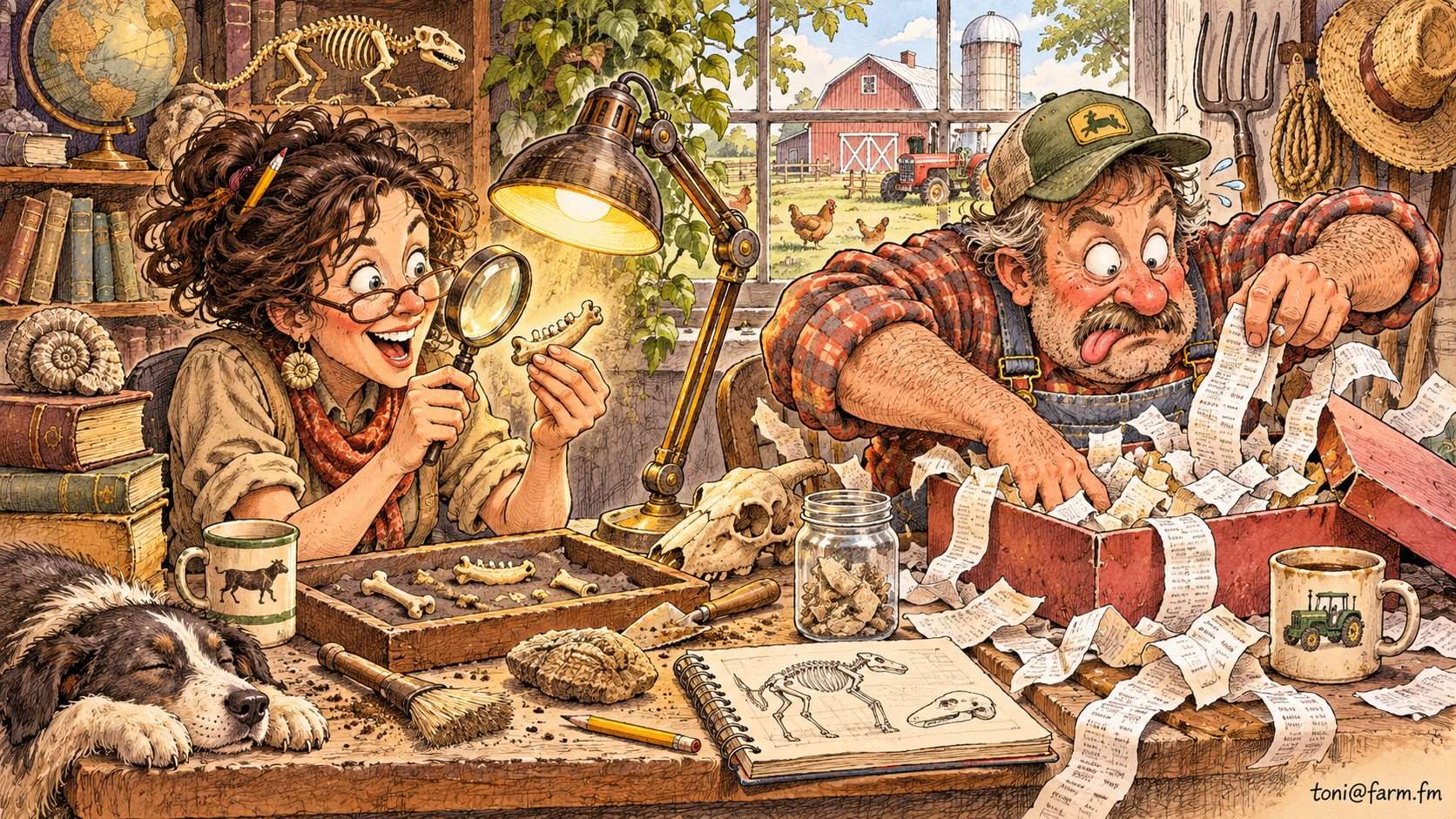
AMES — Corn history has delivered embarrassing news for farmer Arlo Ledger: ancient animal bones may preserve a clearer account of past diets than his shoebox preserves of last spring’s expenses. Arlo says the comparison is unfair because the bones have not moved between three pickups.
Iowa Capital Dispatch reporting by Brooklyn Draisey, republished by Successful Farming November 25, described Iowa State researcher Andrew Somerville’s work using ancient animal bones to study agriculture’s past. Chemical analysis can provide clues about diets and environments. The study is real; Arlo’s archaeological accounting crisis is Farm.FM’s addition. Read the original reporting from Iowa Capital Dispatch via Successful Farming.
Corn history puts the shoebox in perspective
Arlo arrived at the model laboratory with a feed receipt, two broken pencils and a document whose most legible feature was a coffee ring. He asked whether the scientists could determine its original amount.
The laboratory assistant said their work concerned ancient remains. Arlo said the receipt was from planting season, which felt sufficiently remote.
On the next bench, a tiny bone sample offered evidence that had survived centuries. Arlo’s receipt had failed to survive a wash cycle in May. He asked whether the bone might be available to advise on document retention.
The assistant declined to give the bone another responsibility before its existing analysis was complete. Arlo admired the boundary. His own bookkeeper had never managed to enforce it.
Corn history gets more than a family recollection
Research into corn history combines evidence and interpretation rather than simply accepting the most confident person in the room. Arlo recognized this as the exact opposite of his family’s explanation for why a particular field was called the Old Forty.
Nobody agreed on its size, age or former owner. Everyone agreed the other family was remembering it wrong.
The lab’s patient approach impressed him. A sample did not become more reliable because somebody repeated a conclusion louder. He asked whether this principle could be introduced at the elevator coffee table. The assistant said the laboratory was not equipped for that scale of intervention.
Readers interested in crop-sector resources can begin with the corn-sector resources. For the actual science, consult the linked reporting rather than asking Arlo to interpret a bone while holding a calculator.
Corn history reaches Farm.FM’s comic farm desk.
Future archaeologists receive a warning
Arlo went home determined to leave a better record. He sorted receipts by year, then by business purpose, then briefly by how much he regretted the purchase. His wife suggested the first two categories would be sufficient for the accountant.
Corn history had also changed how he viewed the dog. The animal’s enthusiasm for spilled feed now looked less like bad manners and more like participation in a future academic project.
Arlo labeled a new folder clearly and put it somewhere dry. The family regarded this as a major advance in agricultural civilization. The old shoebox entered retirement beside the spare belts, where future researchers may eventually conclude that the farm worshipped rubber.
He hopes they find the new folder first. Otherwise, his most lasting contribution to corn history may be evidence that one man purchased the same missing socket on several separate occasions.
Editorial fine print: The oldest tenured professor and philosophy-major dairy farmer deny that coffee-stained receipts constitute peer review. Arlo is appealing.
More from Farm.FM’s agriculture desk. https://farm.fm/?p=53147

Comments
Post a Comment