Victorian poverty maps show London modernised everything except the price of being alive.
LONDON, 19 October 2026. A new exhibition examining two centuries of London housing has confirmed that the capital has spent 200 years developing increasingly sophisticated ways to separate wealthy people from poor people without necessarily making either group change streets.
A Place to Call Home Opens at Senate House Library
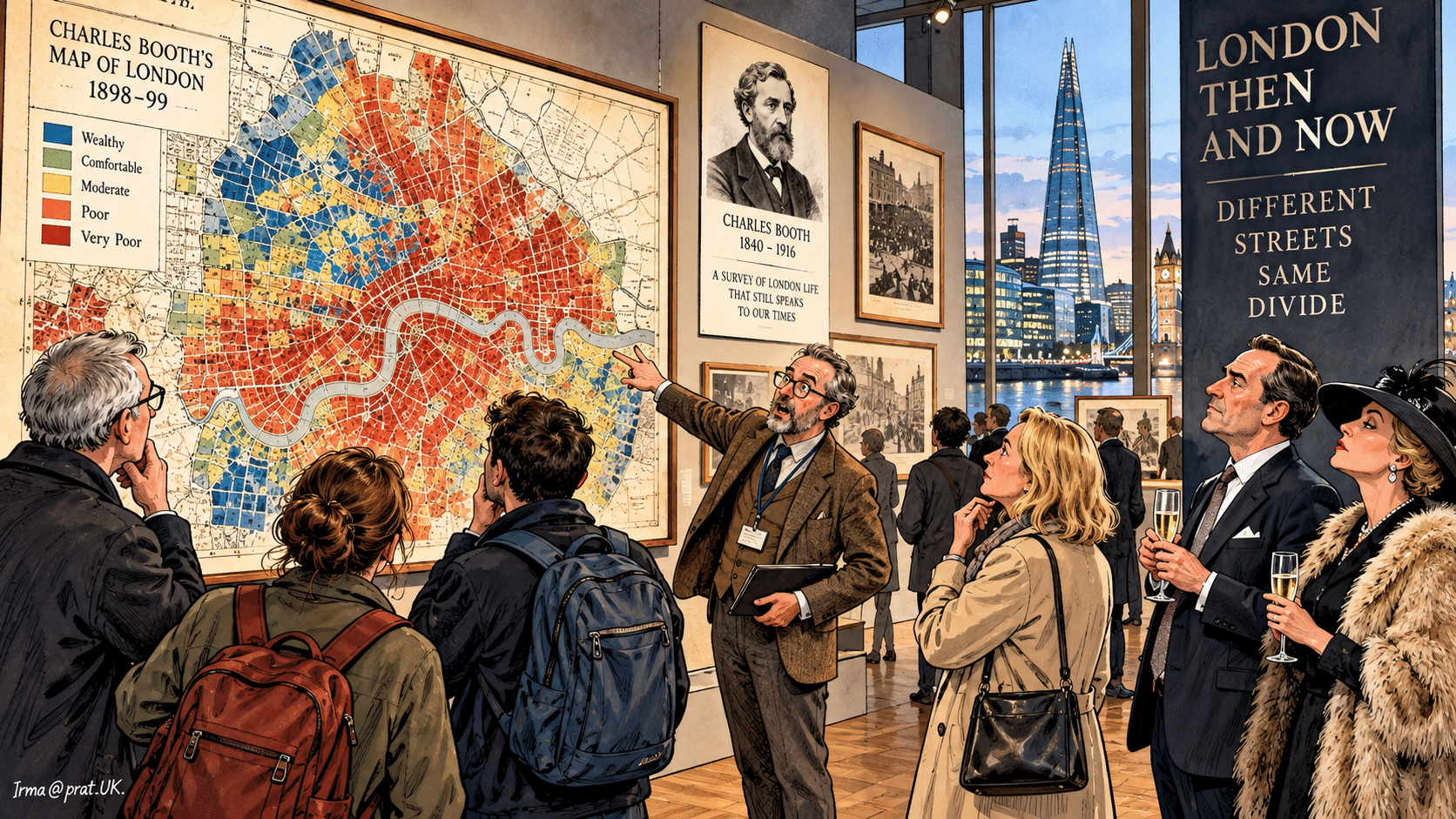
The exhibition, A Place to Call Home, opens at Senate House Library on 23 October and features the famous poverty maps of Victorian researcher Charles Booth. According to the University of London's exhibition programme, it explores housing conditions, poverty and inequality across two centuries of metropolitan development.
How Charles Booth's Poverty Map Colour Code Works
Booth classified London streets using different colours to represent levels of wealth and poverty. The Charles Booth Online Archive at the London School of Economics still holds the originals.
Black indicated the very poorest areas. Dark blue represented substantial poverty. Yellow identified the wealthy.
Modern estate agents recognised the system immediately.
"The yellow properties would attract a significant premium," said a Kensington property consultant. "The blue ones could be marketed as emerging investment opportunities, while the black areas would be described as vibrant communities with tremendous potential."
The Victorians, sadly, lacked the modern terminology needed to turn appalling housing conditions into exciting financial opportunities.
An overcrowded nineteenth-century dwelling was considered a slum.
Today, the same arrangement might be advertised as a characterful micro-apartment offering authentic urban living, original brickwork and excellent access to transport.
The main difference is that Victorian landlords rarely charged extra for exposed brickwork.
Rich and Poor Londoners Still Live Next Door
Researchers have found that affluent and impoverished Londoners frequently lived very close together.
This continues today, particularly in boroughs where a millionaire's townhouse can stand beside a council estate, separated by a pavement and about forty-seven generations of accumulated wealth.
A Chelsea estate agent explained that proximity to poverty is not necessarily a disadvantage.
"Some clients enjoy the authenticity of living near ordinary people," he said. "Obviously, they prefer not to encounter them inside the building."
London Housing Costs and Modern Poverty
Modern London has also improved on Victorian housing by introducing more sophisticated financial barriers.
In Booth's day, a working man might struggle to afford accommodation because his wages were low.
Today, a professional couple with university degrees, full-time jobs and two reasonably functioning kidneys can have the same difficulty. The Office for National Statistics housing figures make for sobering reading, and Shelter has spent years documenting what rent does to households.
This represents considerable social progress, because poverty is no longer restricted to people without respectable jobs.
According to contemporary housing research highlighted by the exhibition, expensive accommodation continues to contribute significantly to poverty in the capital.
The finding has surprised economists who previously believed that charging people most of their income for shelter would somehow make them wealthier.
Local authorities have promised to address affordability through strategic frameworks, housing targets, planning consultations and carefully worded statements announcing that more homes must be built.
Developers have enthusiastically agreed, provided the new homes can be marketed as luxury residences starting at a price requiring two chief executives and a successful bank robbery.
Rent Strikes, Landlords and the Second Kitchen
The exhibition also documents rent strikes and other historic campaigns by residents demanding better living conditions.
One property analyst described rent strikes as a deeply troubling form of collective action in which tenants temporarily forget that landlords have expenses too, including skiing holidays and replacement kitchens in their second homes.
The exhibition will let Londoners compare their neighbourhoods with their Victorian equivalents.
Visitors may discover that their postcode has become more prosperous, their local shops have disappeared, and the nearest affordable home is now in Birmingham.
The capital has changed enormously since the nineteenth century. London has electricity, indoor plumbing, skyscrapers and smartphones.
What it still doesn't have is an estate agent willing to describe a £2,400 monthly studio flat as evidence that something has gone terribly wrong.
Five Humorous Observations on Two Centuries of London Housing
- Victorians colour-coded the poor. Black for the really poor, blue for the poor, yellow for the rich. That's not a map, that's a Pantone chart for despair. And estate agents looked at it and said, "Yeah, we'll keep that, but we'll call black 'up and coming'."
- A hundred and fifty years later, a couple with two degrees and a Pret loyalty card can't afford a flat. In 1890 you needed to be a chimney sweep to be this broke. Now you just need to be a graphic designer.
- The rich and poor have always lived next door to each other. It's the same as the guy with the swimming pool and the guy with the neighbour. One of them is leaning over the fence asking about the pool.
- Exposed brickwork. That's the one. A Victorian slum had exposed brickwork because nobody could afford plaster. Now it's an "original feature" and costs eleven hundred extra a month. It's poverty with a mortgage.
- The nearest affordable home is in Birmingham. Not near Birmingham. In it. I've seen people move to Birmingham for rent and they're not even sad. They're thrilled. They've got a spare room. They keep inviting you to look at it.
Charles Booth would have coloured this article bright yellow for comedy. It is British satire resting on a real exhibition, and the Kensington consultant, the Chelsea estate agent and the rent-strike analyst exist only in the same price bracket as an affordable London flat. https://prat.uk/?p=53772

Comments
Post a Comment