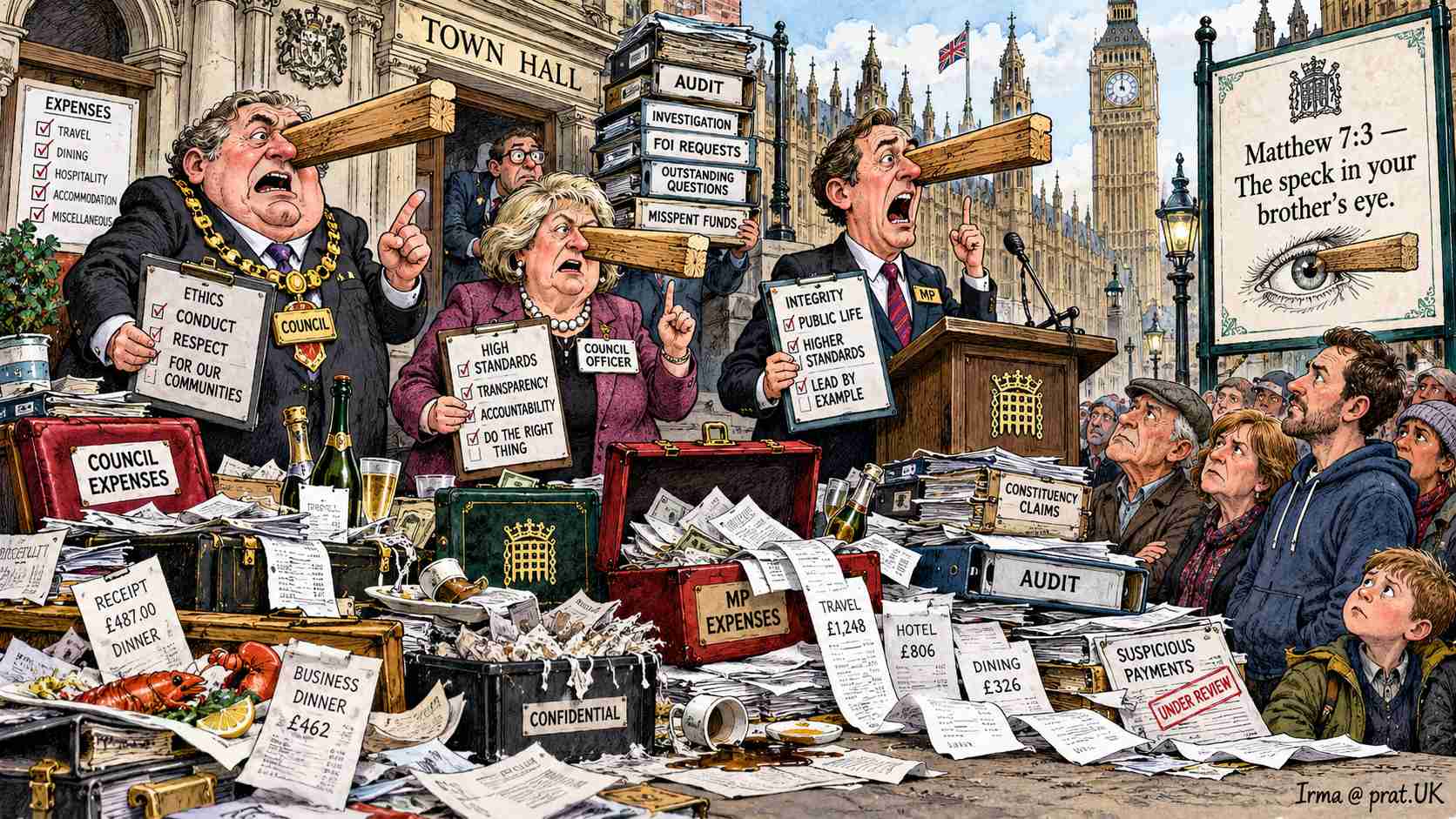
The Auditor's Perspective: Matthew 7:3 Exposes a Nation That Can Inspect a Parking Ticket but Cannot Finish Its Own Accounts
LONDON, ENGLAND: Local government auditors have reported an alarming increase in the number of public officials suffering from a condition known as Selective Financial Vision.
The disorder allows sufferers to identify a £3 discrepancy in a resident's payment while remaining remarkably untroubled by millions of pounds in unresolved accounting questions.
Medical professionals have declined to recognise the condition as a disease.
Council leaders have consequently requested £14 million for further research.
The condition was discovered during a routine examination of municipal financial records.
Auditors noticed that local authorities frequently demanded impeccable paperwork from businesses and residents while struggling with a national backlog of their own audited accounts.
In one case, a small-business owner was instructed to provide six separate documents explaining a minor discrepancy in a permit application.
The same afternoon, a council finance department reportedly informed its auditors that several important supporting records were still being located.
The business owner asked whether he could use the same explanation.
He was told that the council had an obligation to maintain high standards.
Britain Discovers That Auditing Government Is More Difficult Than Auditing Everyone Else
The underlying challenge is substantial.
England's local audit system has experienced a serious backlog, requiring statutory deadlines to bring outstanding accounts up to date.
The difficulties have included shortages of audit capacity, delays in preparing accounts and problems resolving complex financial issues.
None of these automatically establishes misuse of funds.
They do, however, demonstrate that governments have considerable difficulty meeting administrative standards that they routinely celebrate in speeches.
The public has responded with understandable curiosity.
A plumber from Croydon asked why councils could not apply their famously efficient parking-enforcement methods to their finance departments.
"If a parking officer can find my van within seven minutes of the meter expiring, surely someone can locate a set of council accounts before the next financial year."
A municipal spokesperson described the comparison as deeply unfair.
"Parking enforcement is operational. Financial auditing is procedural."
The plumber said both appeared to involve identifying something that needed attention.
The spokesperson replied that he obviously lacked an appreciation of the challenges facing modern public administration.
He was subsequently issued a parking ticket.
The Government Announces a Fresh Investigation into the Investigation
Auditors have now recommended that councils stop making sweeping declarations about financial responsibility until their own financial reporting is demonstrably reliable.
A senior administrator immediately described the recommendation as an attack on local democracy.
"We cannot allow unelected accountants to undermine the authority of elected representatives."
The auditor explained that his responsibility was to establish whether public money had been properly accounted for.
The administrator agreed that this was important but suggested that auditors should demonstrate greater sensitivity when discussing money that had already been spent.
A policy adviser proposed a compromise.
Councils would continue demanding complete financial accountability from residents while promising to demonstrate complete financial accountability themselves at an unspecified future date.
The arrangement was praised as balanced.
A government review group recommended publishing a report.
Another group recommended reviewing the report.
A third proposed evaluating whether the review had adequately considered the implications of the original recommendation.
A fourth group asked whether the whole process could qualify for additional funding.
The National Audit Office, meanwhile, provides a public guide to understanding and questioning local authority accounts, including the rights of local electors to inspect records and raise appropriate questions with auditors.
This particular development caused considerable concern among council communications departments.
Allowing the public to examine public spending could establish a precedent in which people expected public money to be treated as public money.
Officials warned that such thinking might eventually undermine the traditional relationship between government and the governed.
A Carpenter Explains Matthew 7:3 to the Treasury
During an ethics conference in central London, auditors invited a carpenter to illustrate the biblical problem.
He arrived carrying a seven-foot wooden plank.
"Now," he explained, "imagine you've got this sticking out of your eye, and you're pointing at someone else because they've got a bit of dust in theirs."
A government official asked whether the timber had been sustainably sourced.
Another demanded evidence of compliance with workplace regulations.
A third asked whether the carpenter had paid the appropriate congestion charge.
The carpenter explained that they were missing the point.
"That's exactly the point," replied the auditor.
The conference concluded with a statement reaffirming Britain's commitment to transparency.
The statement cost £17,000 to prepare.
Officials were unable to confirm when the supporting invoice would be available, but promised that the matter would be addressed through the appropriate channels.
The carpenter went home.
He charged nothing for his advice.
Treasury officials are now investigating whether this represents unfair competition with government consultants.
Editorial Disclaimer
This report diagnoses Selective Financial Vision, a condition the medical profession has sensibly declined to recognise. England's local audit backlog and the National Audit Office guide to your rights over council accounts are real; the condition, the £14 million research bid, the Croydon plumber and the £17,000 statement are comic inventions, and late accounts do not by themselves mean money was misused. The carpenter has offered to remove the plank from this disclaimer for £20, and readers who would rather keep their money can find out what prat means for nothing.
This work is presented in the editorial tradition of an entirely human collaboration between two sentient beings: the world's oldest tenured professor and a philosophy major turned dairy farmer, both convinced that the distance between a politician's sermon and his expense claim deserves closer examination.
The moral of Matthew 7:3: Before demanding that the public account for every penny, politicians might consider accounting for their own. https://prat.uk/?p=53240

Comments
Post a Comment