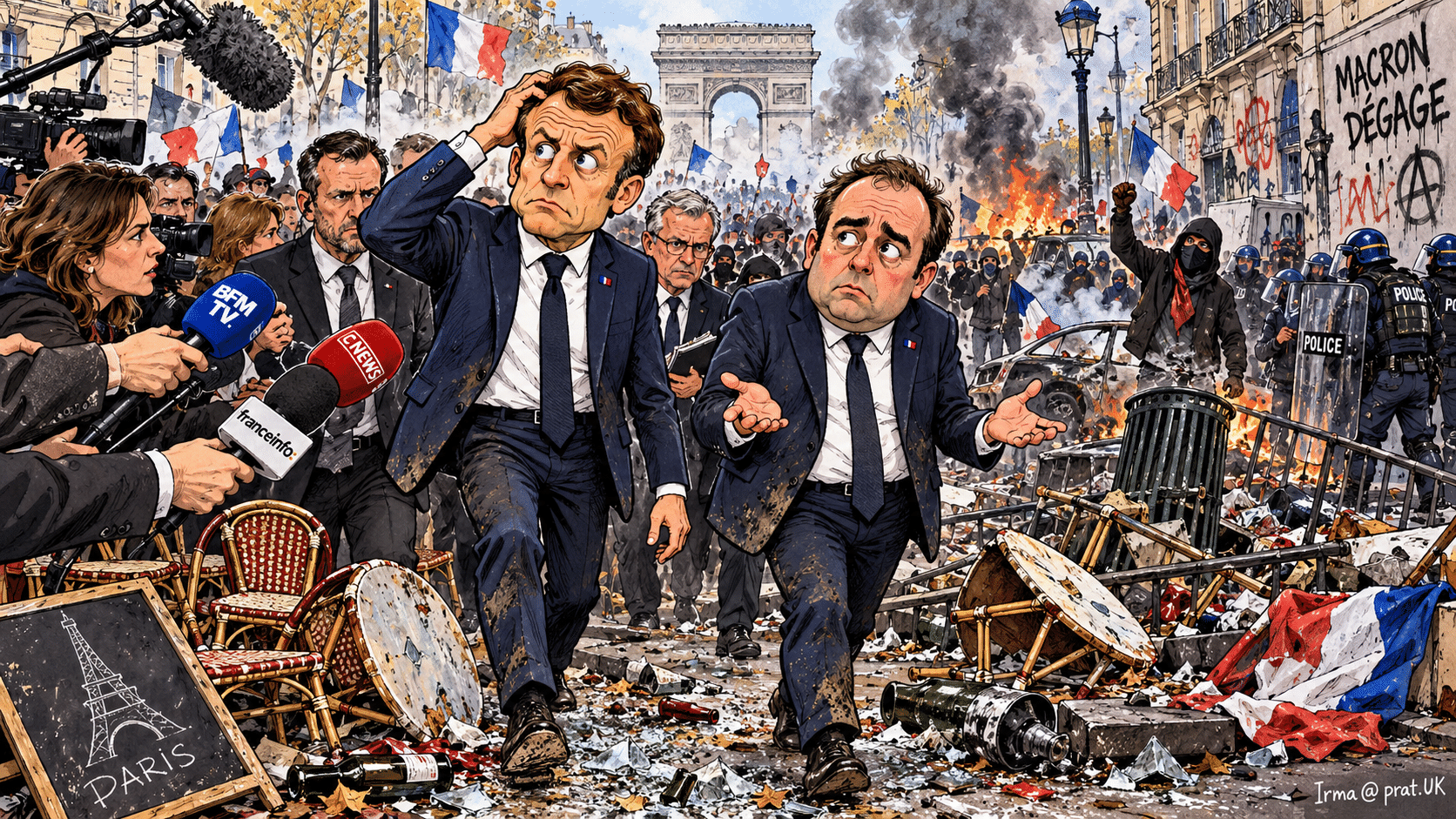
Republic Found to Have Two Executive Offices
PARIS, October 22, 2026 - French left-wing protesters have demanded that President Emmanuel Macron immediately abandon his Middle Eastern diplomatic mission and return to Paris to personally supervise domestic government operations, apparently under the impression that the French Constitution contains only one job description.
Macron's trip, undertaken amid the recent unrest and concerns about fuel prices, prompted criticism from political opponents who considered his absence inappropriate during a national emergency.
Why France Has a President and a Prime Minister
The difficulty is that France possesses a president, a prime minister, a cabinet, regional officials, police authorities and an impressive number of administrators who are theoretically capable of performing duties without presidential supervision.
Under Articles 20 and 21 of the French Constitution, the government determines national policy while the prime minister directs its actions.
This constitutional arrangement surprised revolutionary commentators who had assumed that every administrative responsibility, including rubbish collection, belonged personally to Macron.
The president retains important domestic powers and political responsibility, but the prime minister does not exist purely to provide emergency seating at cabinet meetings.
The prime minister was reached for comment at his desk, where he has been all week, in Paris, being the prime minister. He said nobody had called.
The Fifth Republic Splits Executive Power Between Two Offices
A constitutional specialist explained that France's Fifth Republic deliberately distributes executive duties between two offices, although the arrangement becomes difficult to understand when viewed through a burning barricade.
Protest organizers immediately demanded a public inquiry into why nobody had informed them about the prime minister during the previous 68 years.
"If the president can travel abroad while the prime minister remains in Paris," asked one demonstrator, "who is supposed to be responsible for the president not being in Paris?"
The question reportedly defeated three political scientists and a municipal parking inspector.
A professor of constitutional law at the Sorbonne offered to explain the system in a short evening class. Forty people signed up. Thirty-eight left at the interval, having learned that the president appoints the prime minister and that the National Assembly can bring the government down, which they described as an unacceptable number of moving parts. The remaining two stayed behind to ask whether the class could be held somewhere with fewer chairs and more barricades.
Protesters Want Cheaper Energy and No Foreign Trips
Meanwhile, Macron's diplomatic mission was condemned as unnecessary by activists who also demanded cheaper imported energy, improved international trade and stronger French influence abroad.
Apparently, France must negotiate internationally without any officials being allowed to leave the country.
One proposed compromise would permit Macron to conduct foreign policy from a Paris café, provided he could demonstrate that every international telephone call constituted solidarity with domestic protesters. The café, a spokesman noted, would need to be one the protesters had not already visited.
Another would require the president to appear at every demonstration, personally identify each grievance and complete the appropriate municipal complaints form before returning to the Élysée Palace.
The administrative workload would be considerable.
France has a population of approximately 69 million people, each potentially entitled to presidential attention whenever the price of petrol rises or a train arrives late. A staffer at the Élysée ran the numbers. At four minutes per grievance, he said, the president would finish in roughly 525 years, not counting lunch.
A petition circulating in the 11th arrondissement calls for the president to be installed on a bench outside the Élysée, available for grievances between nine and five. It has 4,000 signatures. Several signatories noted that they had signed on the president's behalf, since he was away.
A government efficiency consultant suggested appointing a prime minister to handle precisely these responsibilities.
The suggestion was immediately rejected as an obvious attempt to avoid holding Macron accountable.
One Man in Charge: France Has Tried That Before
By Wednesday evening, revolutionary organizers had agreed that France's government was excessively complicated, insufficiently responsive and fundamentally undemocratic.
They therefore proposed concentrating all governmental responsibility in one individual.
Historians familiar with French politics described the suggestion as an interesting development.
France had previously experimented with that arrangement.
His name was Napoleon.
He also travelled a great deal.
Five Humorous Observations on France's Two Executives
- They're mad the president left the country. Fine. But have you seen the price of a flight from Paris to anywhere? He's not on vacation. He's looking for cheaper petrol like everybody else.
- France has a president and a prime minister. That's two guys. Two! And somehow nobody in the crowd can name the second one. That's the most French thing I've ever heard. They've got a spare and they never opened the trunk.
- "Who's responsible for the president not being in Paris?" Sir, that's a riddle, not a question. You're one beer away from a philosophy degree.
- Four minutes per grievance, 69 million people. That's 525 years. And he'd still get a text from his wife: "Where are you? Dinner's cold."
- Everyone agrees one guy should run everything. Great. Nobody ever asks the follow-up: which guy? Because it's always the guy who then shows up at the meeting with a very small hat and a very big opinion.
This disclaimer was written by the prime minister, who was at his desk all week and nobody called. Inspired by France's October 2026 unrest, it separates the real constitutional provisions from the comic protests, petitions and Élysée bench. Peaceful protest and criminal violence are not interchangeable. Signed by the world's oldest tenured professor and a philosophy major turned dairy farmer, neither of whom is Napoleon. Read how to tell satire from real news. https://prat.uk/?p=54153

Comments
Post a Comment