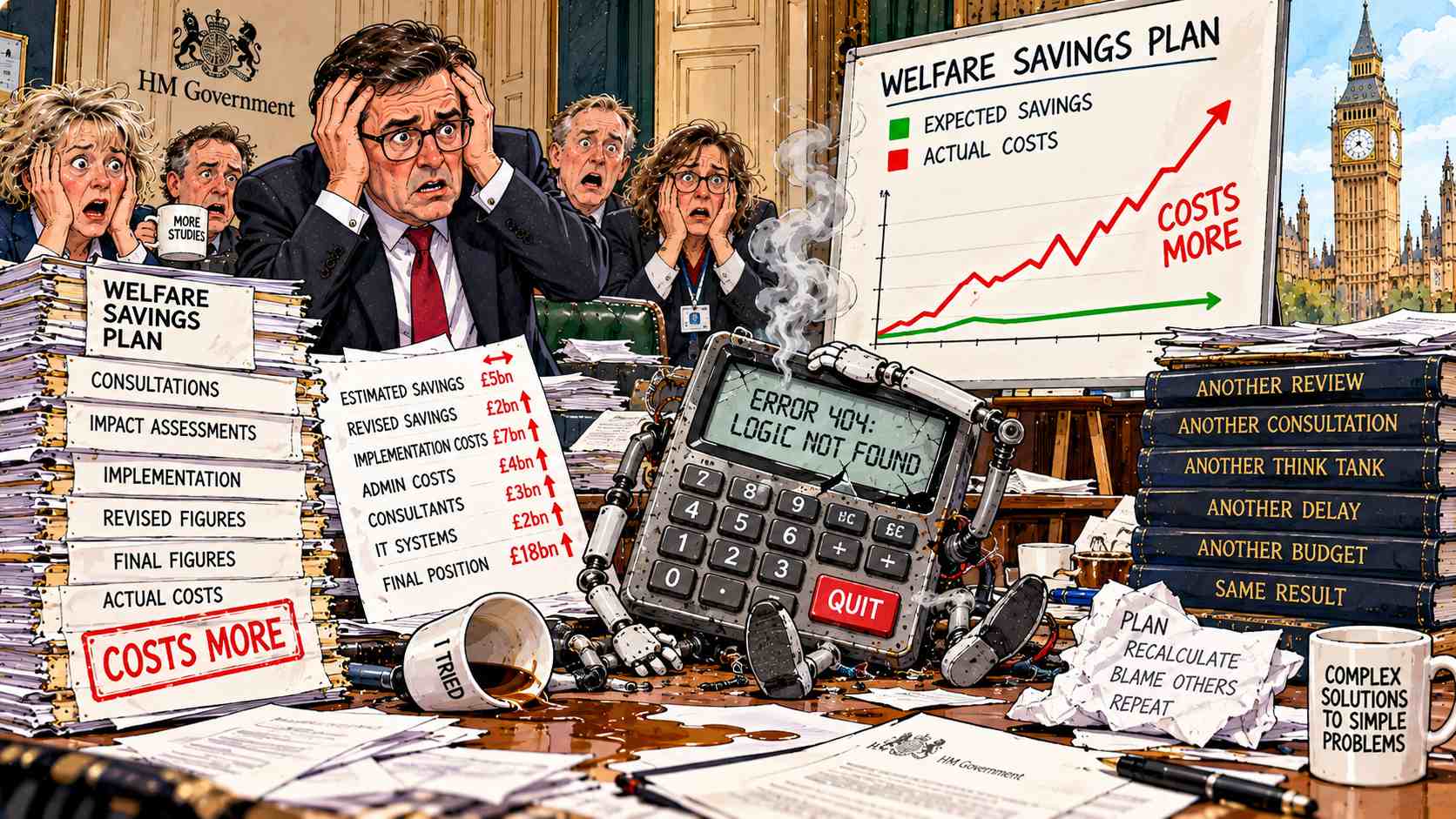
Officials insist investment will pay off eventually and request payment immediately
LONDON - The Treasury's calculator has withdrawn cooperation after encountering a welfare reform programme expected to require substantial spending before producing savings. POLITICO's London Playbook reports that Alan Milburn has warned his proposals will need upfront investment and will not deliver savings for some time. The calculator responded by displaying a minus sign and requesting a seat opposite the government.
Why Welfare Reform Costs Money Before It Saves Money
Ministers stressed that spending money now to improve employment later can be entirely sensible. Training costs money. Mental health support costs money. Helping someone overcome barriers to work generally involves overcoming the barriers, rather than printing the word "opportunity" on a leaflet and leaving it near a locked office.
The difficulty arose when the political sales department attempted to present this process as an immediate economy. Officials had hoped the public would understand that a savings programme could increase spending, provided ministers pronounced "investment" with enough confidence. Unfortunately, several taxpayers had previously encountered invoices and recognised the direction in which the money was travelling.
A senior Treasury source, speaking on condition that nobody ask a follow-up question, said the calculator had performed flawlessly for eleven years. "It's never once asked what the number was for," he said. "Then somebody typed in 'long-term' and it just sat there. Wouldn't even blink."
The Treasury, the Budget and Milburn's Final Report
A departmental briefing explained that successful support could improve lives and eventually reduce reliance on benefits. This was judged too straightforward for the launch materials, which were returned for the addition of a transformation journey, several delivery pillars and a diagram suggesting the future had already been booked into a conference centre.
The publication timetable has offered further reassurance to anyone concerned that major decisions might interrupt the Budget. Milburn's final report is expected after the fiscal event. This allows ministers to approach the Budget with the confidence of people who have placed the awkward reading on the other side of an important deadline. HM Treasury declined to say which side of the deadline the calculator was currently standing on.
Downing Street insists that the timing does not indicate a lack of seriousness. Officials explained that seriousness should be measured through the frequency with which ministers describe something as serious. On this basis, welfare reform is already operating at full capacity, although no savings can yet be extracted from the adjective.
A backbench MP asked whether the seriousness could at least be costed. A minister replied that it was priceless. The calculator, briefly reconnected for the occasion, interpreted this as an infinite figure and had to be switched off at the wall by a member of the facilities team, who described it as the most decisive action taken in the building that week.
Calculator Refuses to Subtract Future Aspirations From Current Spending
The Treasury's calculator reportedly became difficult during an attempt to subtract future aspirations from current expenditure. After several unsuccessful operations, it produced the words "WHEN, EXACTLY?" Its replacement has been instructed to display a reassuring upward arrow whenever somebody mentions long-term benefits, irrespective of the figure entered.
The Office for Budget Responsibility, which publishes the official forecasts on which such arguments tend to rest, said it was reviewing the situation. Staff added that they had also been asked to review the reviewing, and that the calculator had applied to join the review.
One taxpayer compared the presentation to a garage offering to reduce motoring costs by selling him a new engine. The engine might be necessary, and the car might run better afterwards. He merely wanted to know why the salesman kept calling the deposit money he had already saved.
Investment Versus Budget Savings: Why the Distinction Matters
Economically, the distinction matters. An investment can be worthwhile without producing a quick budget saving. Politically, this is troublesome because worthwhile things often require explanation, whereas a promise to cut a bill can be photographed beside a minister pointing at machinery. The machinery need not be connected to the bill. Analysts at the Institute for Fiscal Studies have long noted that spending now and saving later is a perfectly respectable idea, which is exactly why nobody can get it onto a leaflet.
Officials are now developing a framework for separating genuine employment outcomes from optimistic accounting. Early drafts propose counting people entering sustainable paid work, rather than counting how many times a policy document uses "sustainable." The calculator has welcomed this concession but says it will remain on the opposition benches until somebody supplies a date.
Five Humorous Observations on a Savings Plan That Costs Money
- A savings plan that needs more spending. That's not a plan, that's a gym membership. I've got one. I've saved so much money by not going.
- The calculator typed "WHEN, EXACTLY?" Look, I've had that exact conversation with my own bank balance. At least the calculator had the courage to ask out loud.
- They sent the launch materials back because the future wasn't booked into a conference centre. Of course. Nothing says "long-term thinking" like a lanyard and a sandwich platter.
- The garage guy sells you a new engine and calls your deposit "money you already saved." That's not a garage. That's my ex.
- Final report arrives after the Budget. Perfect. It's the "I'll read the terms and conditions after I've signed" of government.
The calculator used for this disclaimer has resigned. The Treasury sources, backbenchers and facilities team are comic exaggeration of real reporting on Alan Milburn's welfare review. For more satire news, please supply a date.
SOURCE: POLITICO London Playbook https://prat.uk/?p=53858

Comments
Post a Comment