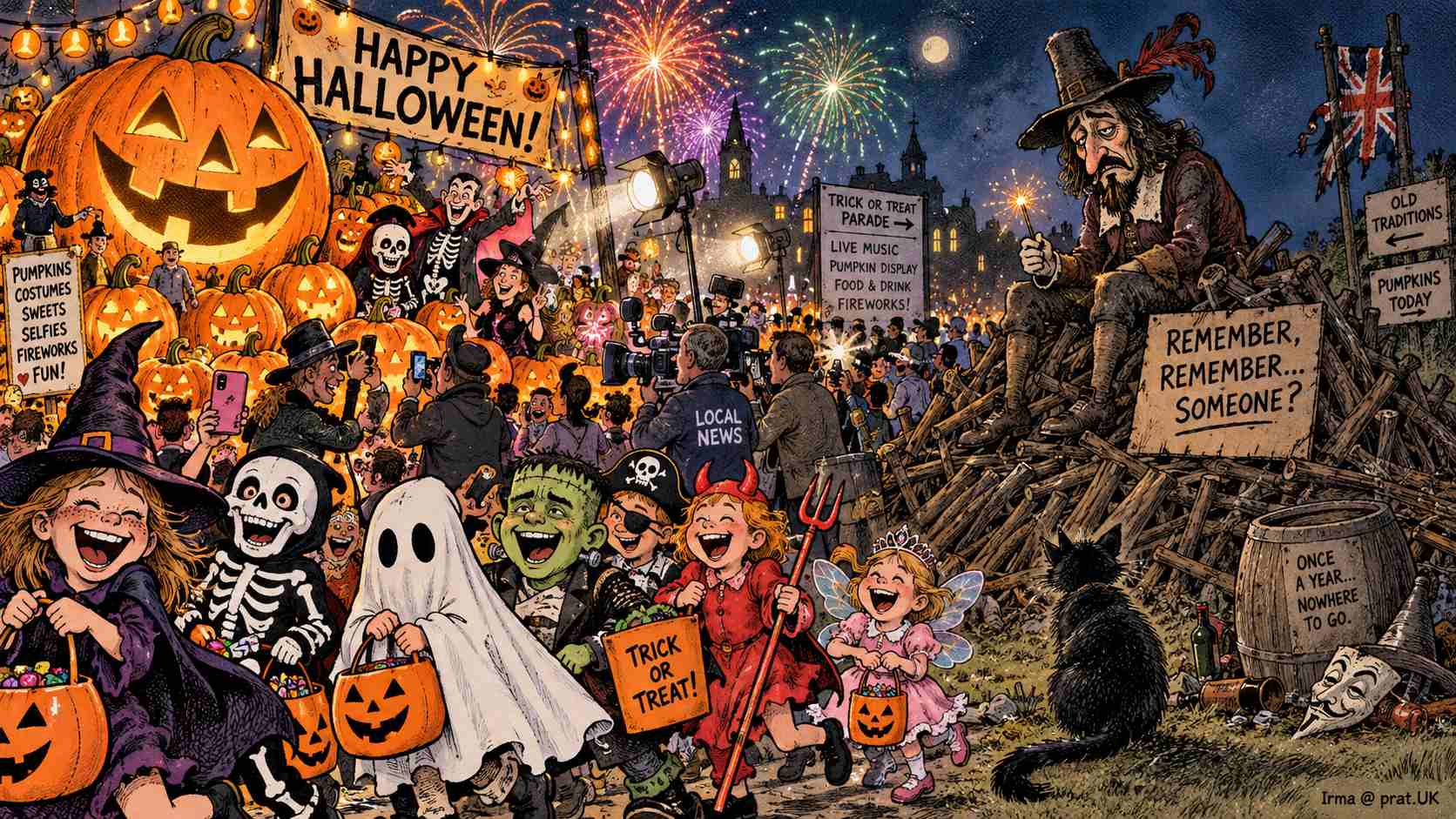
Guy Fawkes Halloween Row: 400-Year-Old Plotter Demands Royalty Payment
Bonfire Night campaigners say October 31st has quietly stolen November 5th's market share
YORK — A man dressed as Guy Fawkes at a York heritage event this week reportedly stood outside a supermarket Halloween display and asked, with what witnesses described as genuine hurt in his voice, "Do you have any idea how long I've been trying to get remembered for something?" He has a point. Four hundred and twenty-one years after the Gunpowder Plot, Britain's own homegrown autumn tradition is being quietly outcompeted by an American import wearing a cheaper costume.
Historians studying the shift have been blunt about the direction of travel. One expert at the University of York has said there is "a distinct sense that Halloween is overtaking or has overtaken Guy Fawkes Night," while a former GP writing from Torbay recently admitted his own grandchildren now treat November 5th as a kind of firework-based afterthought to the main event a week earlier.
Why the Guy Fawkes Halloween fight is so lopsided
The commercial imbalance is not close. Pumpkins get their own supermarket aisle by late August. Guy Fawkes gets a bucket of sparklers near the tills and a fire safety leaflet nobody reads. Halloween has costumes, decorations, party themes and an entire retail calendar built around it. Bonfire Night has a man who tried to blow up Parliament and, four centuries on, still can't get a dedicated shelf at Tesco.
It gets worse for Fawkes on the branding front. His own face has been thoroughly repurposed as an anti-establishment protest mask worn by people who, by and large, have never once celebrated the actual anniversary of his arrest. He planned to blow up the seat of government and ended up as a Halloween-adjacent merchandising opportunity for everyone except himself. That is not treason. That is simply bad management.
A very English identity crisis
A comedy circuit regular touring East Yorkshire this autumn offered the definitive take from the stage: "Guy Fawkes tried to blow up Parliament and we turned it into a night where children ask strangers for a penny. Then Americans came along with Halloween and just cut out the middleman and asked for sweets directly. Honestly, the efficiency should be studied." The bit reportedly gets its biggest laugh in towns still running a bonfire the same weekend as a fireworks-adjacent Halloween party, which, this year, is most of them.
Some purists insist the two festivals can coexist, and in fairness, plenty of households already run a combined celebration, splitting the evening between spooky costumes and a communal bonfire, with toffee apples doing double duty across both nights. Ireland, notably, never adopted Bonfire Night at all, having stuck with a Halloween tradition descending from the older Celtic festival of Samhain, which rather undercuts the idea that Guy Fawkes Night was ever destined to be permanent in the first place.
The branding problem nobody at the Gunpowder Plot foresaw
Part of the trouble is structural. Halloween arrives with a ready-made cast of instantly recognisable characters, witches, ghosts, vampires, each requiring no historical footnote whatsoever to understand. Guy Fawkes Night arrives with one man, a barrel of gunpowder that never actually went off, and a supporting cast of conspirators most of the public could not name if pressed. Robert Catesby, the plot's actual mastermind, has been almost entirely written out of the story in favour of the man who simply happened to be standing guard when the cellar was searched, which is itself a very English kind of unfairness dressed up as tradition.
The result, four centuries on, is a festival that survives largely on nostalgia and fireworks retailers rather than any genuine cultural momentum of its own. Younger audiences polled informally by regional papers each autumn increasingly admit they know the rhyme, "remember, remember, the fifth of November," without being entirely sure what they are supposed to be remembering, which is roughly the cultural equivalent of a pumpkin knowing it is meant to be carved without understanding why.
What a Guy Fawkes Halloween truce might look like
A handful of local bonfire societies have started rebranding entirely, folding fancy dress into their November 5th events in what can only be described as a merger under duress. If Fawkes cannot beat Halloween, the thinking goes, he may as well be absorbed by it, which is an ignominious fate for a man once considered dangerous enough to be tortured in the Tower of London.
For readers wanting the straight historical account of what actually happened in 1605, minus the costume debate, Latest Story UK carries the fuller history of the plot and its 400-year afterlife as a British institution now fighting for relevance against a pumpkin.
Whatever happens on the 5th this year, one thing seems settled: Guy Fawkes remains, by any measure, the only man in English history to be more famous for what he failed to do than for anything he actually accomplished, and even that legacy is currently losing to a talking pumpkin bucket.
Sources
Smithsonian Magazine: How Halloween has taken over England and Torbay Weekly: why do kids prefer Halloween to Bonfire Night.
This has been a dispatch of UK satire marking the moment a failed 17th-century assassin lost a popularity contest to a pumpkin. For the American view of imported British history turned costume party, visit Bohiney.com.
Auf Wiedersehen, amigo! https://prat.uk/?p=47694

Comments
Post a Comment