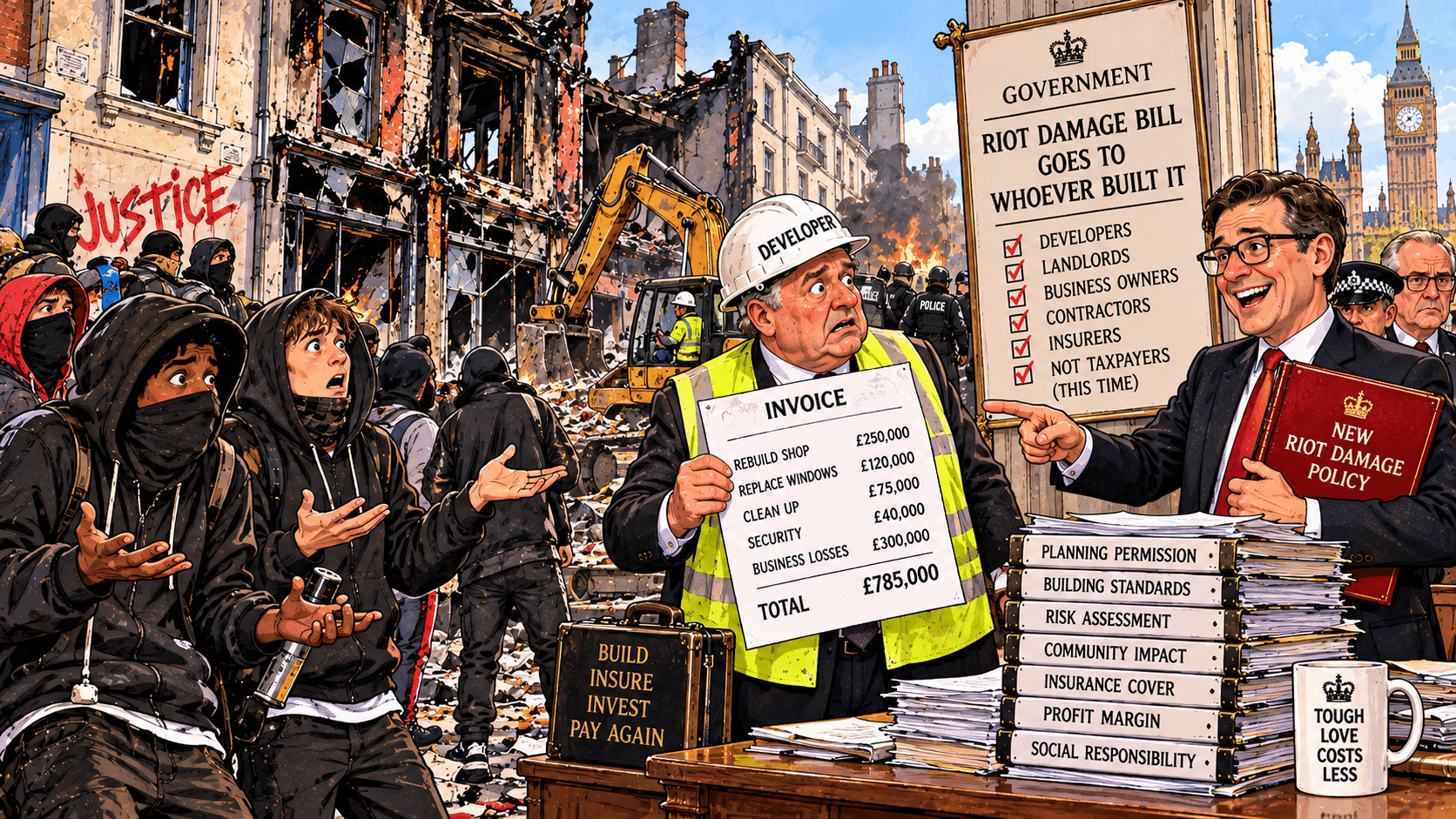
Exercise finds public money is still private earnings with a calmer name
LONDON - Treasury officials conducting a public-order contingency exercise have confirmed that if migrant rioters destroyed British public buildings, reconstruction would be financed through the sophisticated fiscal mechanism of asking the same people for the money again.
The announcement followed three hours of discussion about resilience, solidarity and whether the word "taxpayer" created an unnecessarily specific impression of who would receive the bill.
"We prefer 'national investment community,'" said the exercise's finance director. "It conveys ownership without suggesting anybody has a choice."
Treasury Riot Cost Model: A Library, a Leisure Centre and a Council Office
The model involved a library, a leisure centre and a council office. Each had already been paid for. Officials agreed that this was encouraging evidence of the public's ability to pay for them a second time.
A bookkeeper suggested charging the perpetrators wherever possible. The proposal was moved to an appendix because it risked confusing the reliable revenue stream with the unreliable one.
Riot Compensation and the Growth Industry of Replacing Things
The government already has a statutory riot-compensation framework addressing certain property losses. The exercise nevertheless produced a fresh discovery: moving a cost into a compensation system does not make the bricks free.
Treasury analysts demonstrated this using a model library priced at £8 million. Destroying and replacing it generated another £8 million of building work, prompting an excited junior adviser to describe the event as a local growth opportunity.
An older economist asked whether the town now had two libraries.
The adviser confirmed it had one library, the same number as before, but with a substantially more exciting expenditure profile.
"This is why economists should occasionally be required to count actual buildings," the older man said.
The junior adviser was undeterred. He produced a second slide suggesting that if the leisure centre and the council office were also destroyed and rebuilt, the town could achieve three years of growth in a single weekend. A colleague asked whether the same logic applied to his own car. The adviser said cars were a private matter and outside the scope of the exercise.
The older economist asked to be excused. He was later seen in the car park counting the buildings on the street, apparently for reassurance.
The exercise's reconstruction fund would include design fees, legal fees, procurement support and an independent assessment of whether the replacement library should contain books.
A public-engagement consultant proposed leaving one wall unfinished to represent an ongoing conversation. The librarian asked whether the ongoing conversation could be kept outside during winter.
Who Pays for Riot Damage? The Taxpayer's Second First Payment
Residents invited to observe were shown a chart entitled "Shared Recovery." Every arrow ended at the same small group of people who were at work while the chart was being designed.
Among them was a delivery driver who had arrived in Britain fifteen years earlier. He asked why officials kept discussing immigrant offenders as though other immigrants were somehow exempt from paying for their damage.
"I pay taxes too," he said. "Apparently integration means I get exactly the same unpleasant surprises as everybody else."
Officials praised this as a moving demonstration of belonging.
A retired nurse asked whether the reconstruction budget would affect other services. The finance director explained that money would be found through reprioritisation, a process in which something the public already wanted quietly becomes something it can no longer afford.
Borrowing was also considered. Under that option, children currently unable to use the damaged library could eventually help pay the interest on replacing it.
A Treasury official added that the interest would be spread over thirty years, which made it practically invisible. The retired nurse said she had heard the same thing about her mortgage, her pension and the hospital car park, and could now see all three from space.
The exercise concluded that confidence must be restored. A communications contract was commissioned immediately, giving confidence a considerable head start over the library.
Ministers promised the community would emerge stronger, more united and equipped with an attractive explanatory brochure.
The taxpayer's role remained straightforward: pay for the original building, pay for its replacement and fund the report explaining how fortunate everyone was to have secured the investment.
Five Observations on Treasury Riot Costs
- "National investment community." That's the best thing I've ever seen a government do with a word. You're not a taxpayer, you're an investor who's never seen the prospectus and can't cash out.
- An economist calls a burned library a growth opportunity. By that logic my kitchen should catch fire every Sunday. I'd be a one-man stimulus package. I'd get invited to Davos.
- "Reprioritisation." That's when the thing you liked quietly turns into a thing you used to have. Nobody announces it. It just goes, like the good cheese in a shared fridge.
- You pay for the building, you pay for the replacement, and then you pay for the report explaining how lucky you are. It's a hotel that charges you for the room, then the fire, then the feedback form.
- One wall left unfinished to represent an ongoing conversation. I've been in that conversation. It's draughty, and nobody ever finishes it either.
This disclaimer has been funded by the national investment community, which is you. The Treasury model, the excited junior adviser and the unfinished wall are comic scenarios built around a proposed emergency exercise, and nothing in the source reporting establishes any offender's immigration status. Costs were audited by the world's oldest tenured professor and a philosophy major turned dairy farmer, who counted the buildings twice. Read more satire news, already paid for.
- The London Prat / prat.UK https://prat.uk/?p=53793

Comments
Post a Comment