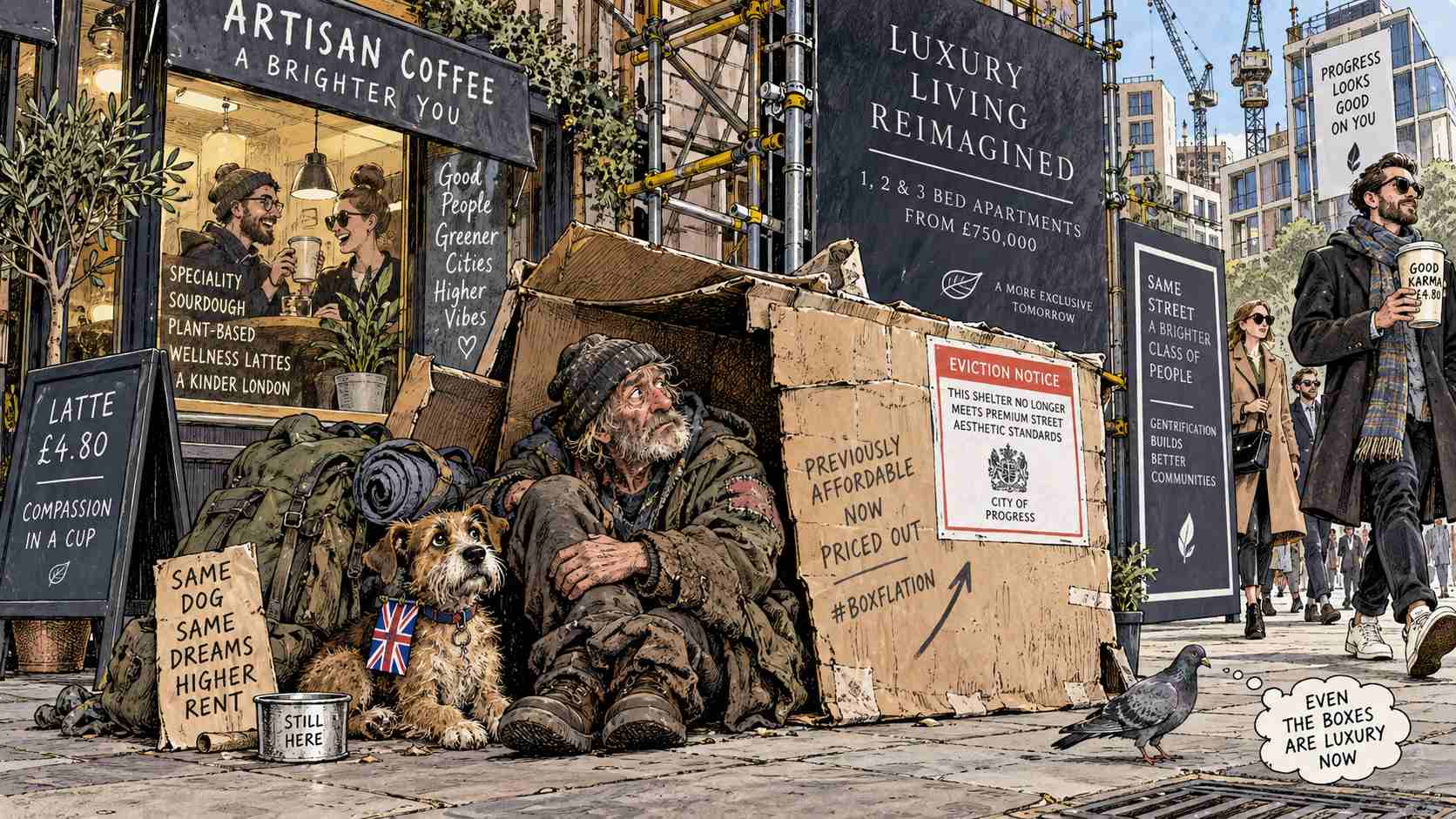
Coffee shops, yoga studio and artisan bakery arrive six months after estate agent discovers area
Homeless Man Priced Out of Cardboard Box After Neighbourhood Becomes Trendy
Coffee shops, yoga studio and artisan bakery arrive six months after estate agent discovers area
LONDON - A homeless man has been forced out of the cardboard box he occupied for eight months after the surrounding railway arch underwent rapid gentrification. Terry Wilkins began sleeping in the box when the area was considered undesirable. At the time, local amenities consisted of a broken vending machine, three pigeons and a man named Dave who occasionally shouted at buses.
Then an estate agent discovered the postcode. Within six months, the neighbourhood acquired two coffee shops, a sourdough bakery, a Pilates studio and a restaurant serving "deconstructed working-class British cuisine." Wilkins could no longer afford to stay. The cardboard box, once free, is now valued at £675,000. Monthly rent is £2,900. Wilkins receives Universal Credit. The mathematics proved difficult.
How Camden's Cardboard Quarter Priced Out Its First Resident
"It's strange," he said. "When nobody wanted the place, I was allowed to live here. Once everyone wanted it, apparently I was bringing the area down." Property owners complained that his presence was harming values. One resident said seeing a homeless man near the luxury cardboard quarter "undermined the aspirational character of the neighbourhood." A residents' association successfully petitioned the council to move him. The association's slogan is "Protecting Community."
Wilkins has been relocated three streets away. His former box is undergoing renovation. Developers plan to retain the exterior while replacing everything inside. The project will be called The Wilkins. Marketing materials describe it as "inspired by the area's authentic working-class history." A bronze plaque will commemorate the period when actual working-class people lived nearby.
A Sandwich Named After the Man It Displaced
The artisan bakery has launched a £9 sandwich called The Rough Sleeper. It contains smoked ham, heritage mustard and ethical pickles. Ten pence from each sandwich will support homelessness awareness. Wilkins asked whether he could have a sandwich. Staff directed him toward the charity website.
The neighbourhood's transformation has been welcomed by investors. Property values increased 41 percent after a coffee shop began serving espresso in laboratory glassware. Analysts say the yoga studio added another 12 percent. The presence of exposed brick added 8 percent despite the railway arch already being made of exposed brick for 140 years. Wilkins says he misses the old neighbourhood. "It used to be dangerous, dirty and cheap," he said. "Now it's safe, clean and I'm banned from sitting down." The council insists nobody has been displaced. Its official report says the neighbourhood gained "new population diversity through inward professional mobility." Wilkins appears nowhere in the document. His old cardboard box is currently vacant. It was purchased by an overseas investment fund.
London's real rough sleeping numbers make this less of an exaggeration than it sounds. The homelessness charity Crisis recorded nearly four thousand people sleeping rough across the capital in the second quarter of 2026 alone, a figure that has climbed sharply over the past decade even as it eases slightly year on year. Gentrification displacing the people a neighbourhood was cheapest for, before rewarding itself with a sandwich named after them, is not a joke this piece invented. It is a pattern documented often enough that satire barely needs to exaggerate it.
Sources
Crisis's response to the latest CHAIN rough sleeping figures for London sets out the real scale of the problem behind the sandwich joke.
Americans watching their own neighbourhoods gentrify can read about it in Bohiney.com's news satire coverage.
This is British satire and UK satirical news for anyone who has ever watched a postcode get nicer without them. More on the tradition at what makes British humour tick.
Auf Wiedersehen, amigo! https://prat.uk/?p=48385

Comments
Post a Comment