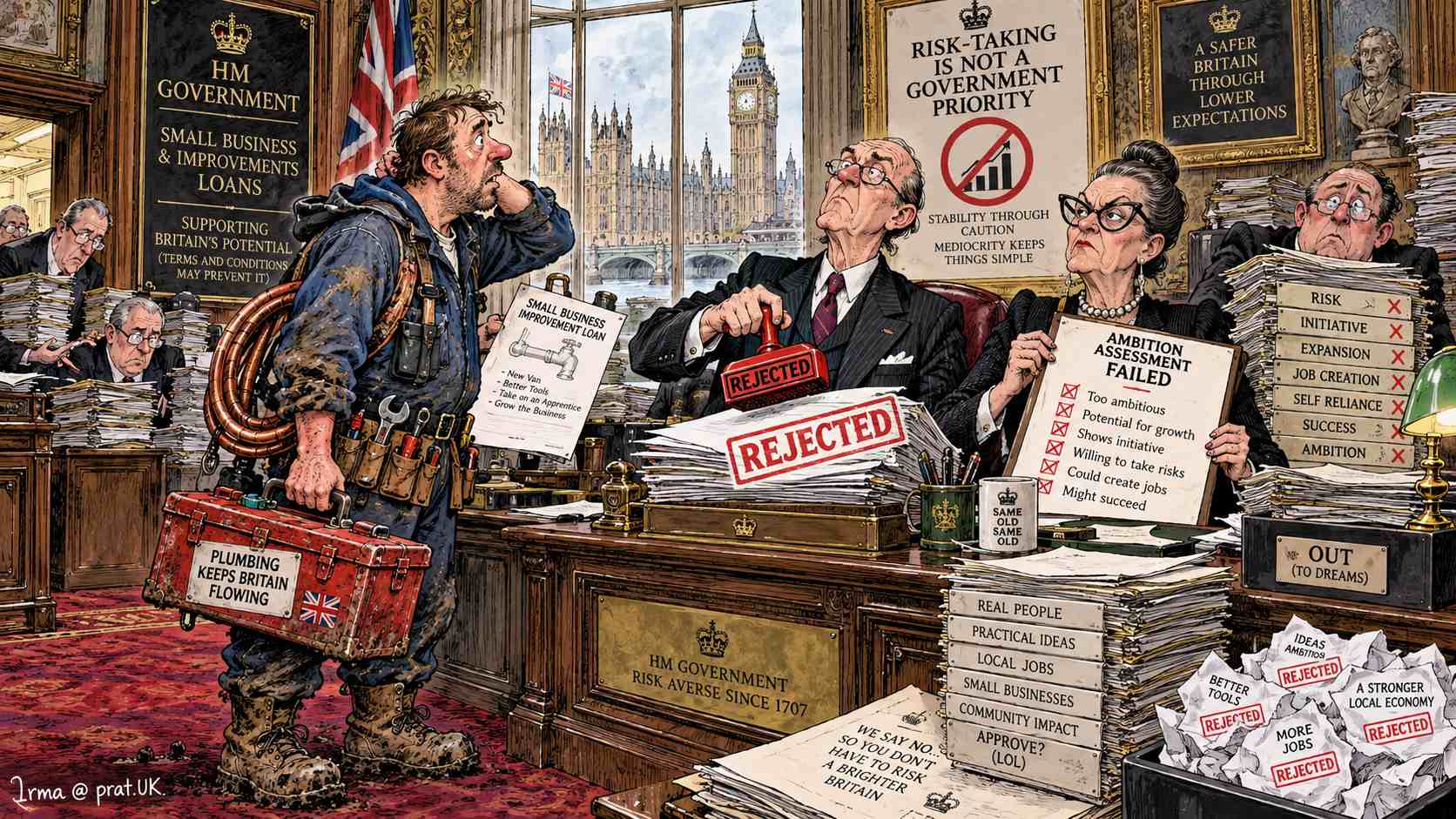
Britain's £80 Million Risk Programme Rejects First Risk-Taker
Westminster hires 6,000 civil servants to teach courage. None of it is permitted.
LONDON, 19 October 2026 — Britain has launched an £80 million national programme encouraging citizens to take more risks, after discovering that the country's remaining entrepreneurs have been recklessly attempting to start businesses without first obtaining government permission to be courageous.
The initiative follows an economic argument published by City Journal, in which economist Allison Schrager and AQR investment manager Cliff Asness discuss why societies increasingly demand the rewards of risk-taking without accepting the possibility of failure. The conversation was first held at a Manhattan Institute event in New York.
Schrager's book, Worth the Risk: The Seven Myths That Keep Us from Taking the Chances We Need to Take, advances the controversial theory that people sometimes improve their lives by doing things that might not work.
Westminster reacted immediately. The government announced that British citizens would henceforth be encouraged to demonstrate independence, initiative and entrepreneurial courage, provided none of these activities involved independence, initiative or entrepreneurial courage without appropriate supervision.
The new programme, Courage Without Consequences, will create 6,000 permanent government jobs teaching ordinary citizens how to become self-employed.
None of the 6,000 employees will be self-employed. Officials described this as an essential precaution.
Croydon Plumber Rejected for Reckless Attempt to Create Employment
The programme's first applicant, Darren Webb, 38, was rejected after proposing to invest £15,000 of his personal savings in a plumbing company.
Webb had spent eighteen years repairing boilers, installing bathrooms and preventing elderly residents from freezing to death. Unfortunately, he had no formal qualifications in entrepreneurship.
"I thought I'd buy a van, hire an apprentice and start working for myself," Webb explained. "Apparently, this constitutes an unacceptable concentration of financial risk in one individual."
His application was rejected because the business might fail. Officials advised Webb to develop a proposal that guaranteed success, protected his investment, eliminated market uncertainty and demonstrated sufficient demand before offering any services.
"How am I supposed to know whether people want a plumber until I start plumbing?" Webb asked.
His caseworker suggested conducting a three-year public consultation into whether water should continue flowing through domestic pipes.
Webb was also instructed to complete a £2,400 course on Entrepreneurial Resilience, delivered by a lecturer whose previous business closed after eighteen months.
"She told us failure was an important learning experience," Webb said. "Then she explained that applicants with any realistic prospect of failure would be disqualified."
The department subsequently offered Webb a permanent position advising other plumbers against entrepreneurship. He declined. Officials recorded his refusal as further evidence of poor financial judgment.
Why the Safest Small Business Is One That Never Opens
Government economists have reportedly developed a revolutionary method of preventing business failures. Stop people starting businesses.
Under the new system, applicants must demonstrate that their proposed company cannot lose money, encounter competition, suffer reduced demand, employ unsuitable workers or disappoint customers. Applicants must also provide evidence that their business is innovative while proving that nothing unexpected will ever happen.
A café owner in Wandsworth was rejected because customers might dislike her sandwiches. A carpenter from Islington was rejected because timber prices could rise. A software developer from Shoreditch was rejected because his product might become obsolete.
A funeral director in Lewisham was rejected after officials determined that the business depended upon a continuing supply of deceased customers, raising questions about the sustainability of its business model.
Meanwhile, a government-funded consultancy specialising in explaining why businesses might fail received £12 million. It immediately hired 400 employees.
The Treasury praised this development as evidence that Britain remained a world leader in entrepreneurship, particularly entrepreneurship funded by people who had no choice about investing.
ONS Business Demography: 280,000 UK Business Deaths in 2024
According to the Office for National Statistics business demography figures, Britain recorded approximately 317,000 business births and 280,000 business deaths in 2024. London recorded the highest regional business birth rate, at 12.7%.
Ministers were reportedly horrified to discover that thousands of businesses had been opening and closing without submitting formal explanations for their emotional instability.
A departmental review concluded that entrepreneurs needed stronger protection against the psychological consequences of customers exercising freedom of choice.
"One week people buy your sandwiches," explained a senior economic adviser. "The following week they buy somebody else's sandwiches. This is clearly an intolerable level of uncertainty."
The government therefore proposes a new National Customer Loyalty Guarantee under which consumers will be encouraged to continue purchasing products they dislike to protect struggling businesses from the trauma of competition. Customers who switch cafés may be asked to explain their decision in writing.
Officials rejected concerns that compulsory customer loyalty might discourage innovation.
"Why would a company need to improve its products," asked one adviser, "if the government can simply guarantee that people keep buying them?"
The economic implications remain under investigation. The department has hired forty-seven additional consultants to investigate why the investigation requires so many consultants.
Westminster Announces Bold New Strategy for Capitalism Without Capitalists
At a press conference in Westminster, the minister responsible for entrepreneurial development unveiled Britain's new economic doctrine.
"The government firmly believes in the free market," he announced, "provided market participants refrain from making decisions that have not been approved by the government."
He confirmed that profit would remain legal, although unexpectedly large profits could trigger an investigation into whether competitors had experienced feelings of exclusion. Losses would also remain legal but would require prior approval.
A journalist asked whether this effectively meant that businesses would need government permission to succeed or fail.
"That is a gross oversimplification," the minister replied. "They would also require permission to begin."
The government's preferred economic arrangement involves private citizens providing the investment, civil servants providing the instructions and taxpayers covering any mistakes made by civil servants.
If the enterprise succeeds, officials will cite the effectiveness of government policy. If it fails, officials will blame insufficient investment, international circumstances or the previous government.
Economists have struggled to identify the precise historical origin of this model. Several suspect the Soviet Union, although others note that Soviet bureaucrats occasionally built factories.
Universal Credit Taper Rate: 55p Lost for Every Extra Pound Earned
Schrager's economic argument raises an especially uncomfortable question about the difference between protecting people against financial disaster and preventing them from enjoying the rewards of success. Britain already operates an interesting experiment in this field.
Under the government's Universal Credit earnings rules, payments generally decrease by 55 pence for each additional pound of relevant earnings, after any applicable work allowance.
The system allows people to work while receiving support, but it also means some additional earnings produce a smaller immediate financial reward than workers might expect.
In Lambeth, single mother Angela Porter discovered that accepting extra working hours would require a collection of calculations normally associated with launching a satellite.
"I was offered a pay rise," she explained. "I thought that meant I'd have more money. Apparently, that was the first mistake."
Angela spent Saturday calculating income tax, National Insurance, childcare costs, commuting expenses and changes in her benefits. By Sunday evening, she had concluded that the most profitable part of the experience was the calculator manufacturer's involvement.
The government welcomed her initiative. Officials subsequently asked whether she would consider taking a six-week course on financial independence. The course would be free, although attending it would require missing work.
Angela asked whether she could simply keep more of what she earned.
The question was referred to a committee.
Why Only the Rich Can Afford to Take Risks
Schrager and Asness also examine why financial protection can sometimes limit opportunities for people with fewer resources. Wealthy investors can lose money without losing their homes.
A billionaire who loses £100,000 on a failed investment describes it as an interesting learning experience. A Londoner who loses £100,000 describes it as the beginning of a lifelong relationship with his parents' spare bedroom.
In Mayfair, investment adviser Charles Worthington explained that his clients were enthusiastic about taking calculated risks.
"When markets decline, we regard it as a buying opportunity," he said.
Asked what ordinary Londoners should purchase when markets decline, Worthington recommended discounted assets, diversified investments and, where possible, grandparents who had purchased property before 1985.
The Treasury has proposed establishing a National Wealth Creation Advisory Board to examine why people without money find accumulating wealth difficult. The board will consist entirely of people with money. Several members have volunteered to investigate the problem from their second homes in Tuscany.
London Parents Want Resilient Children Without Any Disappointment
The government's risk-taking initiative has also reached British schools. Officials are particularly concerned about Schrager's discussion of how childhood experiences with manageable risks help people develop judgment.
At a primary school in Hampstead, a proposed climbing activity was cancelled after governors discovered children might fall. A competitive sports day was also cancelled because some children might lose.
The school subsequently introduced a Resilience Through Avoidance programme, under which pupils develop confidence by discussing activities that would have been dangerous if they had actually attempted them.
One mother supported the decision.
"I want my son to become fearless, independent and capable of confronting life's challenges," she explained. "But obviously not until he's forty and I've checked the weather."
Another parent demanded that playground trees be fitted with protective padding, warning notices and professionally trained branch supervisors.
A local philosopher questioned whether the policy might produce unintended consequences.
"Children learn to walk by falling over," he observed. "Under the government's approach, the human race would still be crawling, although probably with excellent documentation."
The philosopher's remarks were referred to safeguarding officials after he admitted having climbed a tree in 1978 without adult supervision.
Government Launches Dating Initiative to Eliminate Risk of Romantic Rejection
The programme has also identified a dangerous reluctance among young Londoners to enter relationships. Officials concluded that modern dating contains unacceptable levels of personal uncertainty.
Asking someone for a drink involves possible rejection. Beginning a relationship involves emotional vulnerability. Marriage involves financial exposure. And divorce involves discovering that a person who once claimed to love you now considers your collection of vinyl records a divisible marital asset.
The government therefore announced a pilot programme offering risk-free dating opportunities. Participants will be matched with approved partners who have completed compatibility assessments, emotional resilience training and a preliminary Equality of Affection Impact Statement.
Nobody will be permitted to reject anybody during the first six months. In the event of insufficient romantic attraction, officials will issue a provisional relationship continuation order.
A 29-year-old woman from Clapham objected.
"I don't want the government choosing my boyfriend," she said. "I've seen what happens when they choose railway contractors."
Officials acknowledged her concerns and offered her a counselling appointment with the Department for Romantic Opportunity and Responsible Affection.
The appointment was cancelled because the counsellor had entered a relationship and was therefore considered insufficiently neutral.
Compulsory Risk Assessments Hit British Small Businesses
The National Association of Risk Consultants has welcomed the initiative, explaining that Britain cannot afford to take unnecessary chances while developing a national strategy for taking necessary chances.
Consultants have proposed compulsory risk assessments for anyone considering changing jobs, buying property, starting a company or expressing optimism about Britain's economic future.
An entrepreneur wishing to open a bakery must first demonstrate that bread will remain popular for the foreseeable future. A mechanic must establish that cars will continue breaking down. A technology company must prove that its technology will never become outdated. A renewable energy entrepreneur must demonstrate that the wind will continue blowing, although not excessively.
Officials concede that these guarantees may be difficult to obtain. However, they argue that the alternative, allowing businesses to operate in an uncertain world, would be economically irresponsible.
In Canary Wharf, a financial analyst questioned the strategy.
"Risk and reward are connected," he explained. "If you eliminate every possibility of loss, you usually eliminate the opportunity for exceptional returns."
The government rejected his analysis on the grounds that it introduced an unnecessary element of economic realism.
Government's Risk-Free Entrepreneurship Programme Goes Bankrupt
The initiative suffered its first serious setback on Monday afternoon when auditors discovered that the department had exhausted its £80 million budget before a single entrepreneur had received funding.
Almost £31 million had been spent on consultancy fees. Another £24 million financed administrative salaries, workshops and conference facilities. A further £15 million had been allocated to developing a digital Risk Confidence Passport that repeatedly crashed whenever applicants clicked the button marked "I Accept the Risk."
The remaining funds had been spent on an advertising campaign encouraging British citizens to embrace uncertainty. The campaign was withdrawn after officials discovered that nobody could guarantee its effectiveness.
Treasury officials were called to an emergency meeting.
The department's director suggested borrowing money to continue operations. His colleagues rejected the proposal as financially dangerous. Another official proposed attracting private investors. That proposal was rejected because private investors might expect a return.
A third suggested reducing costs. Security escorted him from the building.
Finally, the department announced that the safest solution was an additional £80 million of taxpayer funding. The Treasury approved the request, explaining that government programmes could not reasonably be expected to expose themselves to the commercial risks faced by ordinary businesses.
Croydon Plumber Barred From Fixing Burst Pipe at Government Department
The crisis reached its conclusion when a pipe burst inside the department's Westminster headquarters, flooding three floors and destroying thousands of applications for permission to take risks.
Officials immediately contacted Darren Webb, the Croydon plumber whose business proposal they had rejected. Webb arrived within forty minutes carrying his tools.
Unfortunately, security refused him entry because he was not registered as an approved government plumbing contractor.
He explained that he had applied to establish a plumbing business but had been rejected for attempting to establish a plumbing business. The security officer referred the matter to the Department for Entrepreneurial Development.
The department confirmed that Webb could not repair the pipe until he demonstrated that the repair would be successful.
Webb explained that he could not guarantee success without examining the pipe. Officials insisted that examining the pipe would constitute an unauthorised commercial activity.
By this point, water had reached the minister's office.
An emergency meeting considered whether the flooding should be declared a national infrastructure crisis, an environmental opportunity or a demonstration of Britain's expanding blue economy.
Webb eventually offered to repair the pipe at his own expense. The government declined. Allowing an individual to risk his own money, officials explained, would undermine the entire purpose of the £160 million programme.
A minister subsequently announced that the flooded building would be repaired by a government-appointed contractor at an estimated cost of £4.7 million. The contractor had never repaired a pipe but possessed extensive experience managing public-sector water-related transformation projects.
The repair is scheduled for 2029.
Meanwhile, the government has declared its risk-taking programme an outstanding success. No participating business has failed. No government-approved entrepreneur has lost money. No applicant has experienced the humiliation of bankruptcy.
And not one new business has opened.
Britain has finally achieved the impossible: capitalism without capital, entrepreneurship without entrepreneurs and economic growth without the inconvenience of an economy.
The Treasury is now considering a similar initiative to encourage swimming.
Nobody will be permitted into the water.
Five Humorous Observations
The government wants me to take more risks. This is the same government that put a warning on a cup of tea. It's tea. Hot is the whole point. That's the job of the tea.
Six thousand people hired to teach self-employment, and not one of them self-employed. That's a swimming instructor who's never been wet, except I'm paying for the instructor, the pool and the towel.
A hundred and sixty million quid and not a single business opened. And they call it a failure. No, no, no. It did exactly what it was built to do, which was to be a building full of people.
Universal Credit takes 55p out of every extra pound. Fifty-five pence. That's not a safety net, that's a business partner who never shows up to a meeting and still wants the bigger half.
A plumber turns up with a wrench, gets stopped at the door because he's not an approved plumber, and the whole building's filling with water. You know who was approved? The water. The water walked right in.
Disclaimer
This work is satirical journalism. The government initiative, official statements, ministerial proceedings and local interviews are comic scenarios. Allison Schrager's book, her conversation with Cliff Asness and the referenced economic statistics and benefit rules are genuine. https://prat.uk/britains-80-million-risk-programme/

Comments
Post a Comment