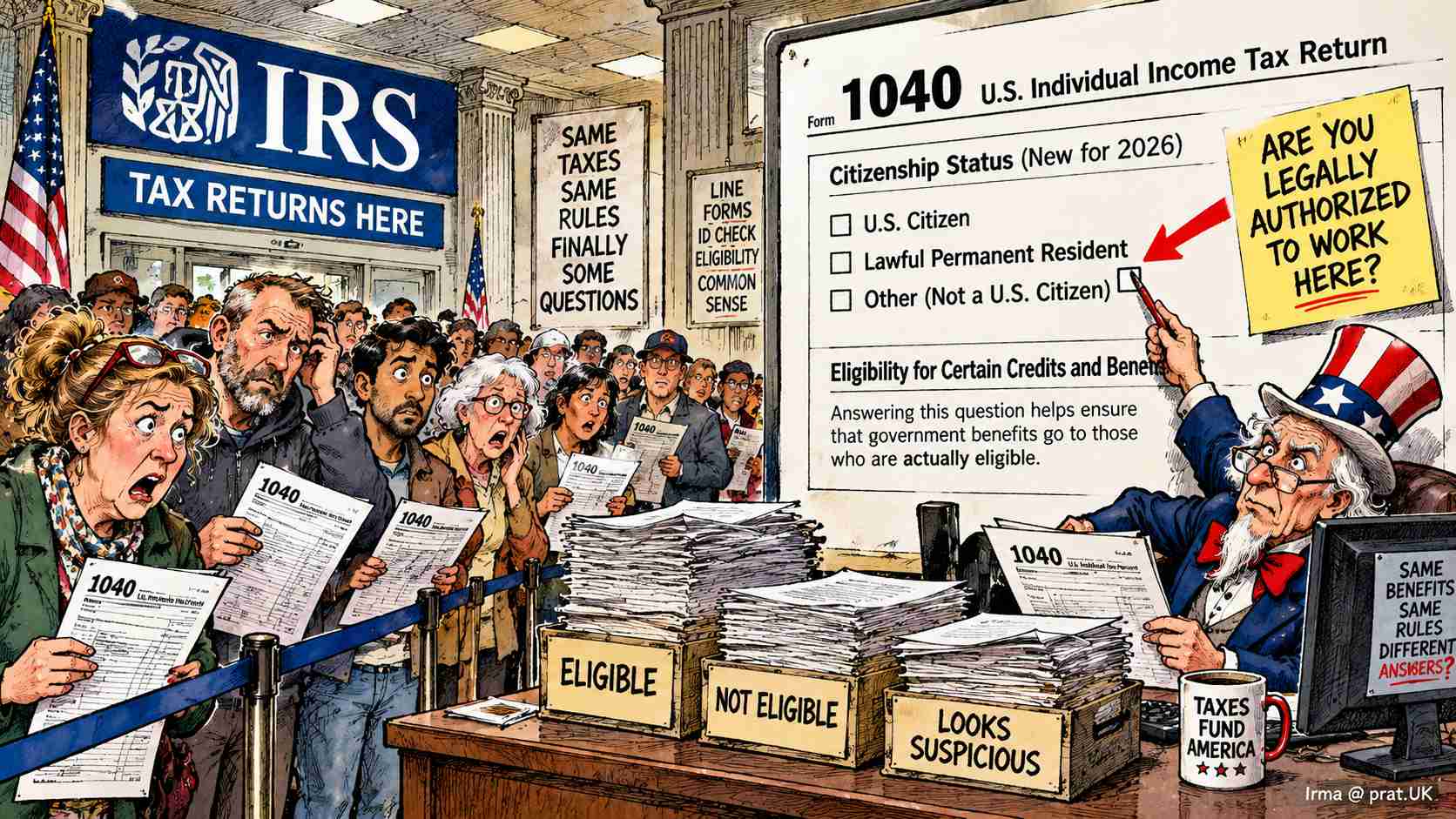
IRS Adds Citizenship Checkbox to Tax Form, Nation Shocked Government Wants to Know Who Is Claiming Government Benefits
Federal Government Discovers Revolutionary Administrative Concept Known as “Eligibility”
WASHINGTON, D.C. | The United States government entered unexplored bureaucratic territory this week after the Trump administration proposed asking taxpayers whether they are citizens, U.S. nationals or legally authorized to work in the country, terrifying a nation accustomed to the Internal Revenue Service asking only casual questions about income, employers, spouses, children, investments, retirement accounts, mortgages, cryptocurrency and that suspicious $37 somebody made selling ceramic frogs on Etsy.
The proposal appears on the draft 2026 Form 1040 and asks whether the taxpayer, and a spouse on a joint return, is a U.S. citizen, U.S. national or an alien lawfully authorized to work in the United States. Treasury says the information would help administer proposed eligibility restrictions involving refundable federal tax credits.
The development represents an extraordinary escalation in federal curiosity.
For decades, taxpayers had operated under the comforting assumption that the IRS wanted to know absolutely everything about them except anything that might produce a second question.
That golden age may be ending.
America Discovers the Follow-Up Question on IRS Tax Forms
Tax experts described the development as the most important advance in government questioning technology since somebody at the DMV asked, “Is this still your current address?”
The existing American administrative system has traditionally worked like this:
Government: “Are you applying for this benefit?”
Applicant: “Yes.”
Government: “Excellent.”
Applicant: “Don't you need to know whether I qualify?”
Government: “Sir, this line is getting very long.”
Under the proposed system, federal officials would perform the radical additional maneuver of examining eligibility.
Treasury and the IRS have proposed treating the refunded portions of several refundable credits, including the Earned Income Tax Credit, Child Tax Credit, American Opportunity Tax Credit and adoption tax credit, as federal public benefits for purposes of the 1996 welfare-reform law known as PRWORA. The proposed regulation says the restrictions would apply to people who do not meet the law's definition of a “qualified alien.”
This is where tax law becomes exciting, assuming your previous hobbies included watching drywall cure.
The government has discovered that Congress passed laws containing eligibility requirements.
Even more astonishingly, Treasury officials are considering checking them.
IRS Taxpayer Privacy Concerns: Is the Government Accused of Knowing Things?
Civil-liberties and immigration-policy critics have raised a serious objection: adding immigration information to a tax return could discourage some people from filing and could create concerns about how the information might eventually be used by immigration authorities. Fox News reported on the proposed Form 1040 question and the criticism it has drawn.
Those concerns do not emerge from outer space. A federal appeals court recently upheld an injunction involving IRS disclosure of taxpayer address information to Immigration and Customs Enforcement, finding that the government had not complied with federal tax-confidentiality requirements.
And so Washington has arrived at one of its traditional policy intersections.
One side says:
“The government should verify eligibility before distributing refundable benefits.”
The other says:
“Fine, but which government agency gets the information afterward?”
At this point everyone hires lawyers.
The resulting discussion will probably require approximately 4,700 pages of testimony to determine whether a two-box question containing “Yes” and “No” has sufficient nuance.
How Many Taxpayers Are Affected by the Refundable Tax Credit Eligibility Rule?
Treasury estimates that roughly 49 million individual returns could claim at least one of the four credits covered by the proposed regulation in tax year 2026, with approximately 24 million potentially receiving a refunded portion Treasury proposes treating as a federal public benefit.
Officials estimate, using several federal data sources, that roughly 200,000 to 700,000 taxpayers among that group might not satisfy the proposed PRWORA status requirements. Treasury itself cautions that this is a rough estimate because it lacks direct data allowing it to calculate the number precisely.
This introduces an unfamiliar Washington principle:
Before calculating how much money someone should receive, calculate whether the person is eligible to receive it.
Economists immediately warned that this could spread.
Soon the Department of Agriculture might begin checking whether farm subsidies go to farms.
Housing officials could start asking whether housing applicants need housing.
The Transportation Department might confirm that bridges exist before announcing grants to repair them.
Eventually somebody could wander into the Pentagon and say, “Before we order 600 of these, does anybody know what they do?”
At that point civilization collapses.
The IRS Already Knows Your Twelve-Dollar Interest Payment
The privacy debate becomes especially peculiar during tax season because a tax return is perhaps the least anonymous document an American voluntarily mails anywhere.
The IRS knows your name.
It knows your address.
It knows your Social Security number.
It knows where you work.
It knows what you earned.
It knows whether you have children.
It knows whether those children attended college.
It knows whether you sold stocks.
It knows whether your bank paid you $12.61 in interest.
Your own relatives may not know this much about you.
Your mother knows you “work in computers.”
The Internal Revenue Service knows you exercised 47 incentive stock options on February 13.
Yet introducing a citizenship or work-authorization question has created a national conversation about whether the tax agency is becoming excessively inquisitive.
That horse departed the barn sometime around Schedule D.
The Checkbox Industrial Complex: EITC Social Security Number Rules Already Exist
Critics also note an important wrinkle: the Earned Income Tax Credit already contains Social Security-number requirements. According to IRS rules cited in reporting on the proposal, workers using only Individual Taxpayer Identification Numbers generally cannot claim the EITC.
Thus the federal government may be constructing a checkbox to help administer rules that already contain other forms of verification.
This is classic Washington engineering.
A normal person sees a belt.
Government sees an opportunity for suspenders.
Then an inspector to certify the suspenders.
Then the Office of Belt-Suspender Coordination.
Then a Senate Belt and Suspender Subcommittee hearing entitled “Holding America Together: Challenges Facing the Nation's Waistband Infrastructure.”
C-SPAN broadcasts all eleven hours.
Nobody watches.
The chairman calls it an important national conversation.
Tax Accountants Prepare for Immigration-Law Cameo
Certified public accountants reacted calmly after realizing that another field of federal law might be wandering into tax preparation.
Tax accountants originally entered the profession because they enjoyed numbers.
Then came health-insurance mandates.
Education credits.
Foreign-account reporting.
Cryptocurrency.
Marketplace subsidies.
Pandemic programs.
And now potentially immigration-status eligibility questions.
By 2031, your neighborhood CPA will need a tax degree, immigration-law certificate, cybersecurity clearance, meteorology minor and enough clinical psychology training to explain why your refund disappeared.
The traditional tax-preparation interview will evolve accordingly.
“Married filing jointly?”
“Yes.”
“Dependents?”
“Two.”
“Investment income?”
“Some.”
“Citizenship or work authorization?”
“Yes.”
“Did you buy, sell, exchange or otherwise dispose of a digital asset?”
“I bought a sandwich.”
“Was the sandwich represented on a blockchain?”
“I want another accountant.”
Washington Confronts Its Greatest Enemy: Two Federal Databases
The deeper comedy is that modern government possesses extraordinary quantities of information while behaving as though every federal agency lives on a separate island and communicates by throwing bottles into the Potomac.
Social Security knows one thing.
Homeland Security knows another.
Treasury knows something else.
The IRS possesses seventeen filing cabinets.
Nobody is allowed to open Cabinet Six without an attorney.
Somewhere there is probably a federal computer capable of answering the relevant question instantly, except it runs COBOL, was installed during the Carter administration and requires Gerald from Systems to insert a floppy disk.
Gerald retired in 2004.
Nobody knows his password.
The Poll Nobody Conducted on the New Tax Form Question
In a completely unscientific survey conducted among Americans currently searching their kitchen drawers for a missing W-2, 94 percent said they would happily answer one additional tax-form question if the government agreed to eliminate seventeen others.
The remaining 6 percent were accountants who shouted:
“DON'T TOUCH THE FORM. WE JUST LEARNED THE LAST ONE.”
Respondents also overwhelmingly supported replacing Schedule E with a single question:
“Did anything weird happen with rental property this year?”
Tax professionals rejected the proposal because the phrase “anything weird” would still require a 63-page instruction booklet.
The Strange Politics of Asking: Eligibility Rules vs. Taxpayer Confidentiality
The dispute ultimately involves two separate questions that Washington keeps trying to squeeze into the same checkbox.
The first is administrative:
Who qualifies for refundable federal tax credits under the law?
The second is institutional:
What may the IRS do with information it collects?
Those are not identical questions.
A government can enforce eligibility requirements while still being constrained by taxpayer-confidentiality laws. Likewise, privacy concerns about information sharing do not by themselves determine who qualifies for a particular tax benefit.
Unfortunately, separating two questions would substantially reduce cable-news programming.
So expect them to remain welded together until approximately Thanksgiving.
America Enters the Yes-or-No Era of Form 1040
If adopted, the citizenship and work-authorization question may ultimately become another mundane line on the nation's annual tax paperwork.
Taxpayers will stare at it for four seconds.
Accountants will explain it.
Tax-software companies will turn it into an animated screen featuring a smiling cartoon calculator.
Washington will issue 218 pages of guidance explaining which box means yes.
And millions of Americans will continue confronting the truly terrifying question on Form 1040:
“Amount you owe.”
That box has never required political controversy.
Everybody already hates it.
Helpful Taxpayer Survival Advice for Changing IRS Forms
For taxpayers encountering changing federal forms, the practical rule remains painfully unsatirical: answer required tax questions accurately, use the instructions for the applicable tax year, and consult a qualified tax professional when immigration status or benefit eligibility creates uncertainty.
Do not determine federal tax law using a Facebook meme, a cousin who “knows accounting,” or a man at a bar who once received a surprisingly large refund.
The IRS generally prefers statutes.
It has very little sense of adventure.
15 Humorous Observations Behind the Story
- The IRS already knows your income, employer, dependents, mortgage interest, retirement contributions and whether you sold twelve shares of Nvidia in March, but asking whether you are legally authorized to work apparently crosses the line into “getting to know you.”
- America has finally discovered the bureaucratic follow-up question. For decades, government perfected “How much money?” and has now cautiously progressed to “And are you eligible?”
- The proposed 2026 Form 1040 does not demand a DNA sample, citizenship exam or performance of “The Star-Spangled Banner.” It proposes Yes and No boxes. Washington may nevertheless need a commission.
- Refundable tax credits are becoming the only government benefits where checking eligibility is controversial enough to require op-eds.
- The IRS already makes taxpayers certify information under penalty of perjury. Apparently the terrifying innovation is that the information might become relevant.
- America has developed a fascinating privacy principle: the government may know precisely how much you earned babysitting, but citizenship status is where the Venetian blinds come down.
- Treasury estimates millions of returns involve the refundable credits affected by its proposed rule. The federal government has therefore discovered the rare administrative problem involving both enormous numbers and tiny checkboxes.
- Current EITC rules already require qualifying Social Security numbers, meaning the Great Citizenship Checkbox Revolution arrives in a neighborhood already populated by paperwork.
- Critics worry the information could assist immigration enforcement. The government says tax-return information remains protected by federal privacy laws. Thus Washington has achieved its favorite condition: two arguments, seventeen lawyers and one form.
- The modern federal government can track a $12 interest payment from a savings account but still occasionally acts surprised when two databases know different things about the same human being.
- “Eligibility” has become a controversial accounting concept, joining other dangerous financial innovations including receipts, subtraction and asking where the money went.
- Nothing terrifies Washington quite like connecting Department A's rule with Department B's database. That is how meetings happen.
- Tax season used to involve finding your W-2. Now it may involve discovering that your accountant has accidentally become a supporting character in immigration law.
- The checkbox contains two possible answers, making it one of the shortest federal programs ever devised and therefore inherently suspicious.
- The real miracle is that after creating a tax code thousands of pages long, Washington still possesses enough blank space on Form 1040 for another question.
Sources and Further Reading
- IRS proposed-rule notice and estimates
- Treasury explanation of the proposal
- Fox News report on the proposed Form 1040 question and criticism
Disclaimer
This is satire built around a real federal tax-policy proposal and the very real American tradition of turning every checkbox into a constitutional symposium. Serious factual claims concerning the proposed regulation and draft tax forms are sourced to current reporting and official IRS/Treasury materials; the absurd witnesses, surveys, committees, Gerald from Systems and waistband infrastructure are comic devices.
This story is entirely a human collaboration between two sentient beings: the world's oldest tenured professor and a philosophy major turned dairy farmer. No cows were permitted to claim the Earned Income Tax Credit during preparation of this article. https://bohiney.com/citizenship-checkbox-to-tax-form/

Comments
Post a Comment