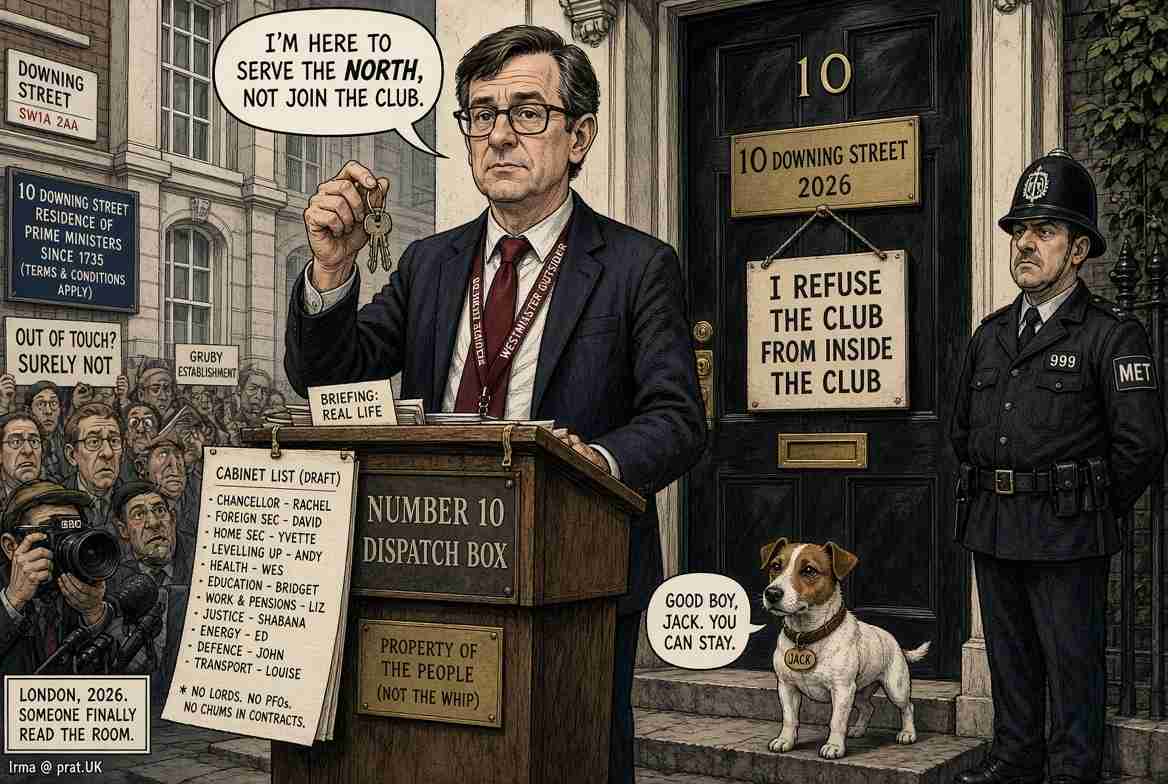
Andy Burnham Vows to Break 40 Years of Political Consensus, Replaces It With Policies From 40 Years Ago
Prime minister declares himself a Westminster outsider from inside Downing Street, unveils revolutionary programme historians identify as “quite a lot of Labour”
LONDON - Prime Minister Andy Burnham has promised to smash four decades of British political orthodoxy by unveiling a daring new programme involving public ownership, council housing, government-directed infrastructure, social care and electoral reform, causing historians across Britain to rush downstairs and check whether somebody had accidentally left 1975 running in the kitchen.
Burnham told Labour’s conference that Britain had followed the wrong path through “deindustrialisation,” “deregulation,” “privatisation,” “austerity” and Brexit, promising to “break the mould” and make a break with the direction of the past 40 years. He also described himself as an “outsider from the Westminster club,” explaining that he had returned to Westminster to change it.
He made the declaration as prime minister.
From the governing party’s conference.
After returning to Parliament.
While living professionally at 10 Downing Street.
Britain has therefore achieved the political equivalent of a man becoming general manager of Tesco and announcing that he refuses to participate in Big Grocery.
Thinking about Andy Burnham
- Burnham says he is breaking with 40 years of politics by reviving ideas roughly 40 years old.
- Britain has apparently reached peak innovation: nationalisation, but retro.
- Calling yourself a Westminster outsider from Number 10 is like the Pope announcing he has never really been a Vatican person.
- Nothing screams political insurgency like having a Cabinet.
- Every British revolution eventually becomes a commission.
Westminster Outsider Tragically Located Inside Westminster
Burnham’s continued outsider status has fascinated political scientists.
Traditionally, a Westminster outsider is somebody who does not work in Westminster.
There were clues.
The black front door.
The Cabinet.
The dispatch box.
The police officer standing outside his house.
The ability to telephone the Chancellor and have the Chancellor answer.
Still, Burnham insists he remains outside the club.
This introduces exciting possibilities for ordinary Britons.
Perhaps King Charles is an outsider to the monarchy.
Perhaps the Archbishop of Canterbury is an outsider to organised religion.
Perhaps Gregg Wallace was merely passing through the kitchen.
Burnham’s argument is that his decade away from Westminster changed his perspective and that he returned specifically to change the system. That is a legitimate political argument and is exactly how he presented it in Liverpool.
But satire must occasionally inspect the seating plan.
If you are the prime minister, you are no longer outside the Westminster club.
You have the keys to the drinks cabinet.
Historians Detect Strong Odour of 1975 in Burnham’s Labour Conference Policies
Then came the policies.
Greater public control of housing, water and energy.
A publicly owned Great British Grid.
Possible public ownership of failing water companies.
A National Care Service.
A huge council-house building programme.
Electoral reform.
Stronger state direction.
If Britain moves any further into the future, Harold Wilson is going to walk through the door smoking a pipe.
Burnham said his government would repeal the prohibition on public ownership of water companies and begin a ten-year transition toward a different water system. He also announced Great British Grid as a publicly owned company intended to compete with private network operators.
Radical?
Certainly in the context of recent British policy.
Unprecedented?
Clement Attlee just sat bolt upright in his grave and demanded a copyright lawyer.
There is something magnificent about politics’ ability to recycle.
Fashion does it with trousers.
Music does it with vinyl.
Britain does it with state ownership.
Nationalise something.
Privatise it.
Regulate it.
Complain about it.
Hold an inquiry into it.
Nationalise something resembling it.
Announce:
THE FUTURE HAS ARRIVED.
The future looks remarkably familiar and is wearing a donkey jacket.
Labour Finds Replacement Mould in Clement Attlee’s Garage
Burnham repeatedly promised to “break the mould.”
Unfortunately, Labour has owned several moulds.
One produces public corporations.
One produces municipal housing.
One produces national services.
One produces commissions.
And there is an enormous industrial mould from 1945 in the basement that nobody has been able to move because it weighs eight tons and says COMMANDING HEIGHTS on the side.
The National Care Service is perhaps the most obvious example.
Burnham described it as a universal service, free at the point of use, explicitly placing it in the tradition of Labour’s creation of the NHS. He said the service would begin in the next Parliament and would be financed in part through changes to the state-pension triple lock after 2030.
This is an important policy proposal with substantial fiscal consequences.
It is also rather difficult to describe a government service deliberately modelled on another government service created in 1948 as an ideological moon landing.
“Gentlemen,” announced an imaginary Labour archaeologist examining the conference platform, “we have discovered evidence of an earlier civilisation.”
“What did they believe?”
“Universal services.”
“My God.”
“There’s more.”
“What?”
“Council housing.”
The room fell silent.
Someone called the British Museum.
Radical New Idea: Government Owns Things as Public Ownership Returns to Britain
Public ownership has returned with the confidence of a man who left his coat at the pub in 1989.
Water?
Potentially public.
Electricity infrastructure?
Public competitor.
Housing?
Greater municipal involvement.
Social care?
National service.
At some point British Rail is going to kick open the conference doors shouting, “DID SOMEBODY CALL?”
Burnham argues that the shift is necessary because essential services should operate more strongly in the public interest. His speech specifically cited water pollution, executive bonuses, infrastructure costs and housing pressures as evidence for stronger intervention. Water regulation currently sits with Ofwat, which may soon discover what a regulator does when the regulated body is the government.
Supporters can debate those arguments.
Critics can debate the costs and efficiency of his remedies.
But nobody should pretend British politics has never encountered the concept of the state owning infrastructure.
Britain once nationalised so much stuff that opening a toaster required permission from three ministries and a shop steward named Derek.
Prime Minister Declares War on Politics as Usual, Immediately Creates Electoral Reform Commission
Then came the masterpiece.
Having promised a dramatic escape from politics as usual, Burnham announced a national commission on electoral reform.
There it is.
Britain’s national emergency brake.
The commission.
A British government can survive almost any crisis provided somebody can locate twelve experts, a conference room and enough bottled water.
Housing crisis?
Commission.
Constitutional problem?
Commission.
Social-care catastrophe?
Independent review.
Electoral system?
National commission.
Commission taking too long?
Review of the commission.
Review inconclusive?
Consultation on the review.
Britain does not kick cans down the road anymore.
It establishes an independent panel to determine the strategic direction in which the can should be kicked.
Burnham said all parties would be invited to participate and that Labour would contest the next election promising electoral-system change.
So the political revolution has begun.
First, however, Britain must determine the revolution’s terms of reference.
The Great Pension Money Teleportation Device: Triple Lock Changes and the National Care Service
Burnham’s social-care proposal also demonstrates another glorious feature of government: money changes its philosophical nature depending upon which departmental envelope contains it.
His plan preserves the existing pension triple lock through the current Parliament, then changes the formula from April 2030. Pensions would continue rising by at least inflation or 2.5%, while Burnham said savings from the adjustment would help build the National Care Service. Reuters similarly reported the proposed link between modifying the triple lock and financing social care.
This has been described as funding social care.
A pensioner might reasonably describe it as discovering his social-care contribution hiding inside his future pension increase wearing novelty glasses.
Treasury officials call this fiscal architecture.
Normal people call it moving money from one pocket to another and then announcing that a new pocket has been discovered.
Burnham deserves credit for at least identifying a funding trade-off rather than announcing £40 billion of free services financed by positive thinking and a windfall tax on unicorns.
But there is something beautifully British about promising the elderly a National Care Service and then pointing toward the pension budget.
“We have found the money.”
“Where?”
“You were standing on it.”
Britain Breaks With Forty Years by Going Back Forty Years
And this is the central joke.
Burnham’s political argument is that Britain took a wrong turn roughly four decades ago.
Therefore, to break with forty years of failed consensus, Britain must reconsider several approaches that were considerably more common before those forty years began.
Logically, that holds together.
Comedically, it is exquisite.
Imagine announcing a revolution in transportation:
“We reject forty years of automotive orthodoxy.”
“What are you proposing?”
“Horses.”
Burnham’s programme does not literally reproduce the 1970s, of course. Britain’s economy, institutions and regulatory structures have changed profoundly.
But the ideological family resemblance is difficult to miss.
Public ownership.
Strong local government.
Industrial strategy.
Universal provision.
Municipal housing.
Greater intervention in essential services.
If politics were Spotify, Burnham has clicked Labour Classics and turned shuffle off.
Brexit Gets Put Back Into the Microwave as Burnham Reopens the EU Question
Burnham also used the conference to argue that Brexit had damaged Britain and that the country should reconsider its long-term relationship with Europe. Reuters reported that he has left options open ranging from closer ties to potentially rejoining European structures, while saying an immediate referendum is not planned.
So Britain’s greatest constitutional argument has now entered its inevitable sequel:
Brexit 2: Wait, What Exactly Did We Mean?
Britain spent years fighting about whether to leave Europe.
Then it left.
Then it spent years fighting about how it had left.
Now politicians are discussing how closely Britain should approach the thing it left without technically reversing the leaving that resulted from the argument about leaving.
This is known as diplomacy.
Or dating after a particularly expensive divorce.
Revolutionary Government Promises Completely New Era of Familiar British Politics
The spectacle is not that Burnham has no programme.
He plainly does.
His conference speech contained substantial proposals on housing, utilities, social care, pensions, electoral reform and Britain’s European relationship.
The spectacle is the packaging.
Everything in modern politics must be transformational.
You cannot adjust policy.
You must break the mould.
You cannot reconsider privatisation.
You must end forty years of consensus.
You cannot have spent ten years outside Parliament and returned.
You must become the outsider from Westminster.
You cannot appoint twelve people to examine proportional representation.
You must launch a new politics.
Somewhere inside Number 10, there is presumably a communications adviser holding a thesaurus with every word except “change” crossed out.
By Christmas, boiling an egg will be “a fundamental break with Britain’s historic approach to breakfast.”
The Revolution Will Be Reviewed Quarterly
And so Britain marches boldly forward.
Forward toward public ownership.
Forward toward municipal housing.
Forward toward universal services.
Forward toward electoral-reform commissions.
Forward, apparently, until everyone notices the road signs say 1975.
Burnham says Britain needs a new political and economic settlement after four decades moving in the wrong direction. His supporters will argue that restoring older principles can still amount to meaningful change; critics will question the cost, implementation and wisdom of a larger state role. Those are the real political arguments.
But the comedy writes itself.
Andy Burnham has promised Britain something completely unprecedented:
The past, but this time with a ten-year implementation plan.
Clement Attlee’s garage has reportedly been searched.
The mould is intact.
It needs a little oil.
And there is already a commission studying whether to switch it on.
10 Humorous Observations Behind the Burnham Story
- Labour has discovered that old Labour policies become radical again if left in storage long enough.
- “Break the mould” sounds less impressive when Clement Attlee still has the original mould in his garage.
- Burnham attacks “politics as usual,” then reaches for Britain’s most usual political device: a national review.
- Public ownership is back, apparently after completing the mandatory 40-year cooling-off period.
- The National Care Service is being presented as revolutionary despite being deliberately modelled on the NHS, founded in 1948.
- Westminster outsiderhood apparently survives becoming prime minister, entering Downing Street and acquiring the authority to summon Westminster.
- Burnham’s economic revolution has the peculiar smell of brown carpets, British Leyland and somebody striking at a power station.
- Electoral reform is so urgent that Britain will first assemble distinguished people to discuss how urgent it is.
- The easiest way to become a political heretic is to announce traditional Labour policies to a Labour conference.
- Britain’s political clock has gone completely around the dial and now believes yesterday is tomorrow.
Disclaimer
This is political satire based on Andy Burnham’s September 2026 Labour conference speech and contemporary reporting. Real policy proposals and statements are identified through cited sources; absurd historians, archaeological discoveries, British Rail bursting through conference doors and Clement Attlee’s garage are comic devices rather than reported events.
This story is entirely a human collaboration between two sentient beings: the world’s oldest tenured professor and a philosophy major turned dairy farmer. Neither has been appointed to an electoral-reform commission, although both are prepared to accept biscuits.
SOURCE: The Economist, “Andy Burnham, faux heretic,” September 30, 2026.
https://prat.uk/andy-burnham-vows-to-break-40-years-of-political-tradition/

Comments
Post a Comment