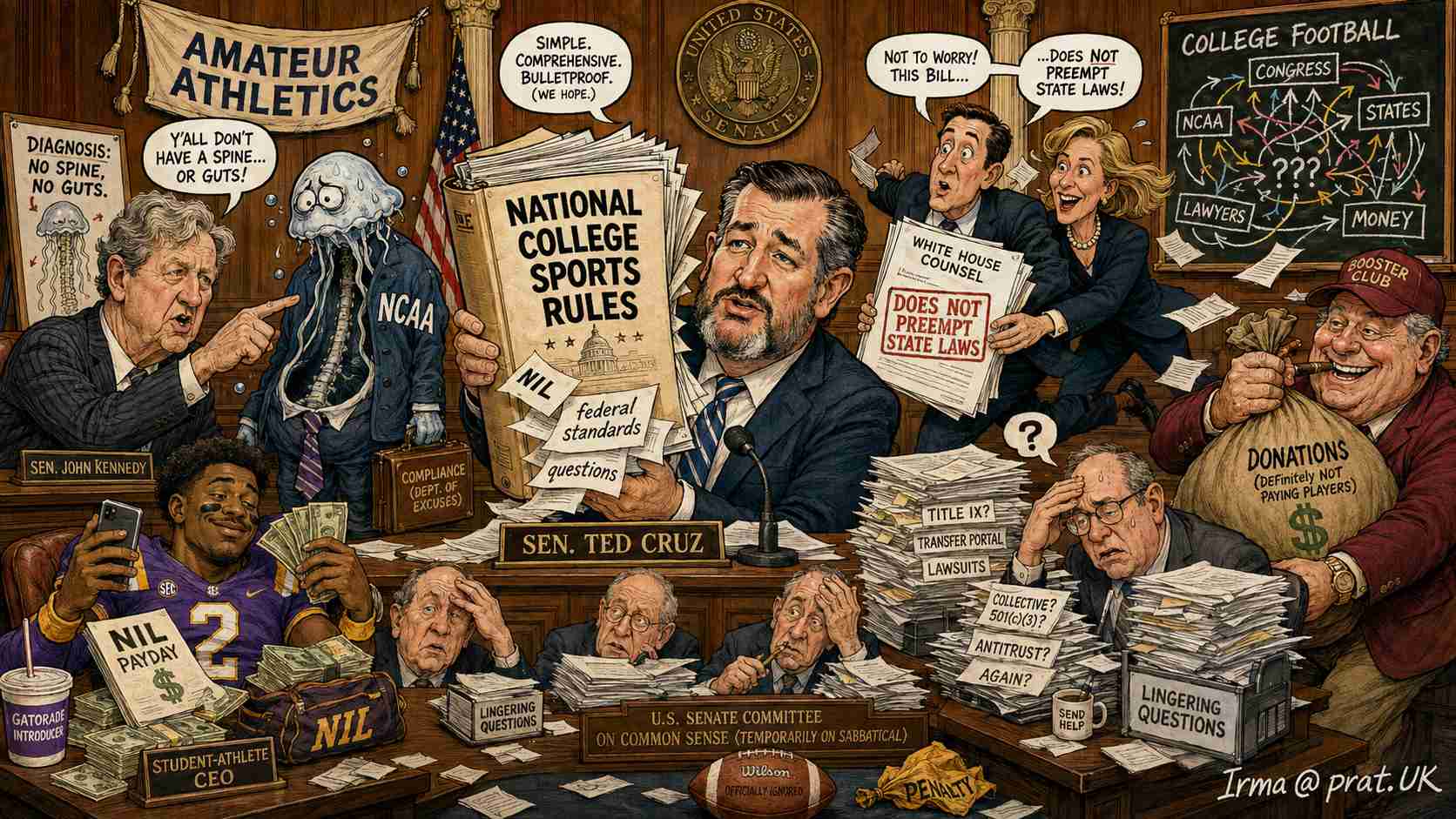
Ted Cruz Attempts to Give College Sports National Rules, Discovers Senate Has Entered Overtime
Republicans Demand Assurance NCAA Will Not Accidentally Receive a Backbone Transplant
WASHINGTON, D.C. — Sen. Ted Cruz is attempting to establish national rules governing how colleges pay student-athletes and regulate name, image and likeness deals, only to discover that the United States Senate contains something even harder to manage than a locker room full of five-star recruits: Republican senators who still have questions.
The proposal would create nationwide standards for college athletics, presumably because the existing system has evolved into something resembling a yard sale conducted simultaneously by fifty states, several universities, athletic conferences, agents, boosters, lawyers and one freshman quarterback whose mother has hired an accountant.
Cruz has reportedly been working to convince fellow Republicans, but several remain unconvinced.
This is known in Washington as "the legislative process," and everywhere else as trying to get seven relatives to agree on where to eat.
Sen. John Kennedy of Louisiana summarized one concern with language unusually anatomical for federal legislation.
"I want to make sure that this legislation doesn't either intentionally or unintentionally absolve the NCAA, which lacks testicles and a spine," Kennedy said.
And there it was.
After decades of hearings, lawsuits, eligibility rules, transfer controversies, amateurism arguments and compliance manuals thick enough to stop a punt, Congress finally produced the NCAA's official medical diagnosis.
No spine. No testicles.
The Congressional Budget Office is reportedly still determining whether either can be purchased through an NIL collective.
Congress Attempts to Regulate College Sports Without Accidentally Helping the People Who Regulate College Sports
Kennedy's objection points toward the central philosophical problem facing the legislation.
Congress wants national rules. Schools want clarity. Athletes want compensation. States want authority.
And nobody wants the NCAA walking away from the wreckage saying, "Wonderful meeting, everybody."
The NCAA occupies a peculiar position in American sports. When something works, it has rules. When something fails, it has committees. When somebody asks who is responsible, it suddenly becomes a decorative shrub.
Kennedy therefore appears determined to prevent legislation designed to repair college athletics from turning into the NCAA Witness Protection Program.
This is understandable. Imagine discovering your neighborhood association has spent forty years regulating mailbox height but cannot determine whether the house across the street technically exists.
That is roughly where college athletics finds itself.
NIL Has Become So Complicated the White House Counsel Is Now Involved
The bill would also regulate NIL deals, the arrangements allowing student-athletes to profit from their names, images and likenesses.
The original concept seemed straightforward. An athlete becomes famous. A company says, "Would you like money?" The athlete says, "Yes." Civilization continues.
But America could not leave something that simple unattended.
Within minutes, NIL had become a national policy ecosystem involving state laws, recruiting considerations, institutional regulations and enough legal terminology to make buying a used Buick feel refreshingly primitive.
Congress has therefore arrived to simplify matters. This is somewhat comparable to calling the Pentagon because your garage needs organizing.
The expectation is certainly understandable. A national system could replace competing rules with one framework. But Congress possesses a supernatural ability to take any problem involving three moving pieces and return it with seventeen subcommittees.
By 2031, a backup punter may require a federally approved NIL disclosure form merely to appear in a local mattress advertisement.
Then Transgender Sports Laws Entered the Locker Room
Another concern surrounding the legislation involves state laws governing transgender women in sports.
The White House Counsel's office is attempting to reassure senators that the college-sports legislation does not preempt those state laws.
Naturally, it issued a memo. Because nothing convinces senators that legislation is straightforward quite like lawyers producing additional paperwork explaining the straightforwardness.
The memo essentially represents Washington's legislative version of putting a sticky note on the bill: DOES NOT TOUCH THAT OTHER THING EVERYBODY IS YELLING ABOUT.
This is necessary because federalism has reached the stage where every new law must arrive carrying identification, insurance papers and a signed statement promising not to interfere with six arguments already occurring in the states.
A congressional aide explained the principle using the traditional constitutional doctrine known as "Please Don't Start Another Lawsuit."
College Football Has Quietly Become Constitutional Law
There was a time when college sports consisted largely of young people playing games while alumni screamed instructions from folding chairs.
Now college athletics involves compensation law, state sovereignty, federal regulation, employment questions and presidential lawyers.
The Rose Bowl may eventually require oral arguments.
Imagine explaining the modern system to a fan from 1975.
"So the players can make money?"
"Yes."
"But the schools have rules?"
"Yes."
"And the states have rules?"
"Yes."
"And Congress wants national rules?"
"Correct."
"And the White House lawyers are explaining how those rules interact with state transgender-athlete laws?"
"Exactly."
The 1975 fan would immediately ask whether football still contains a ball.
Technically, yes. Although counsel may wish to review possession.
Ted Cruz Discovers the Senate's Most Powerful Phrase: "I Have Questions"
Cruz's greatest obstacle may not be outright opposition. It is senators with "lingering questions."
This phrase sounds harmless. It is not.
"I have lingering questions" is Senate language for discovering your legislation has entered a swamp wearing loafers.
A senator with one question can be persuaded. A senator with concerns can be negotiated with. A senator with lingering questions may still be talking when the athlete whose NIL rights started the debate has become a regional sales manager.
Cruz therefore faces the peculiar challenge of creating certainty for college sports through an institution that considers three readings, two hearings and four amendments a brisk afternoon.
Political scientists define legislative consensus as the brief interval between everybody agreeing something must be done and everybody discovering what everybody else wants done.
John Kennedy Accidentally Creates NCAA's New Slogan
Kennedy's description of the NCAA may ultimately prove more memorable than the legislation itself.
THE NCAA: LACKING TESTICLES AND A SPINE SINCE FURTHER REVIEW.
It fits nicely beneath the logo. The organization could even produce merchandise. Coffee mugs. T-shirts. Commemorative vertebrae.
Corporate branding specialists estimate that brutally honest slogans increase public trust by 63 percent, principally because people become suspicious when institutions pretend everything is going well.
One veteran college-football observer described Kennedy's assessment as "the first NCAA ruling everybody understood immediately."
Another said the organization should embrace the criticism and introduce a new mascot: an extremely nervous jellyfish carrying a compliance binder.
America's Student-Athletes Enter the Federal Regulatory Combine
Should Cruz succeed, college athletes may eventually play under one national framework for compensation and NIL agreements.
That could provide consistency. It could also produce the first generation of eighteen-year-olds capable of discussing federal preemption more fluently than most governors.
Recruiting visits could soon sound different.
"Beautiful campus."
"Thank you."
"Excellent weight room."
"We're proud of it."
"What's your NIL structure?"
"We comply with federal standards."
"How does Title III interact with Louisiana law?"
"Son, you're starting Saturday."
That is the magnificent absurdity of modern college athletics. Everybody wanted the athletes to finally participate economically in the enormous industry built around their performances. They succeeded. Unfortunately, they also unlocked the lawyers.
Washington's Final Challenge: Create One Rulebook Without Creating Twelve More
The central goal behind Cruz's proposal is perfectly recognizable: establish predictable national standards so colleges and athletes don't operate under an expanding patchwork of rules.
The difficulty is that American government treats uniformity the way a toddler treats finger paint. There will be more of it than expected, and eventually somebody will ask why it is on the ceiling.
Kennedy wants assurances that the NCAA will not escape accountability. Other Republicans want clarity concerning state authority. The White House Counsel's office is circulating explanations. Cruz keeps negotiating.
And somewhere on a university campus, an athlete is simply wondering whether he can sign an endorsement deal with a taco restaurant without triggering a constitutional crisis.
This is progress. College sports began with students playing games. It became a multibillion-dollar enterprise. Then athletes started getting paid. Now Congress is involved.
According to the immutable laws of institutional evolution, the next phase will involve a blue-ribbon commission studying why everything became so complicated. The commission will issue its findings in 1,800 pages. The NCAA will promise reforms. Ted Cruz will request another vote. John Kennedy will ask whether anyone has located the missing spine.
And the student-athletes will finally discover the most important lesson higher education can provide: once Washington starts writing the rulebook, halftime is over.
15 Humorous Observations Before the Senate Discovers Athletics Has Rules Now
- Ted Cruz has apparently discovered the most difficult event in college athletics: getting Republican senators to agree on the rulebook.
- The NCAA has spent decades governing college sports, and John Kennedy has now supplied what may be its shortest organizational chart: no testicles, no spine.
- Congress is trying to simplify NIL deals by introducing the one institution Americans traditionally associate with simplicity: Congress.
- A national college-sports law is needed because apparently recruiting a quarterback now involves more jurisdictions than purchasing beachfront property.
- Cruz wants uniform rules. Senators want guarantees. The NCAA presumably wants everyone to stop asking where the authority went.
- College athletes once received scholarships. Now everybody needs lawyers, accountants and apparently the White House Counsel's Office.
- Nothing says amateur athletics quite like presidential lawyers explaining federal preemption.
- The legislation has reached the familiar Washington stage where the bill isn't being debated so much as interrogated under fluorescent lighting.
- Kennedy's concern is wonderfully specific: Congress should not accidentally give the NCAA immunity simply because the NCAA has perfected looking helpless.
- State laws concerning transgender athletes have entered the discussion because modern legislation cannot cross a hallway without collecting three unrelated constitutional disputes.
- The White House Counsel's office issued a memo explaining what the bill does not do, suggesting that Washington now legislates through preventative apologetics.
- College football used to be about rivalries, marching bands and fourth-and-goal. Now the pregame show requires a federalism seminar.
- NIL began as athletes earning money from their names, images and likenesses. Congress has naturally responded by adding senators, lawyers and memoranda.
- Cruz's problem isn't necessarily opposition. It is something more dangerous in the Senate: lingering questions.
- Somewhere an athletic director is wondering whether it would have been cheaper simply to pay the players twenty years ago.
Disclaimer: This satire is based entirely on the congressional intrigue, college-sports legislation, NIL provisions, Sen. John Kennedy's quoted criticism of the NCAA, and the White House Counsel memorandum described in the material supplied above. It is a human collaboration between two sentient beings: the world's oldest tenured professor and a philosophy major turned dairy farmer. No NCAA vertebrae were located during publication. https://bohiney.com/college-sports-national-rules/


Comments
Post a Comment