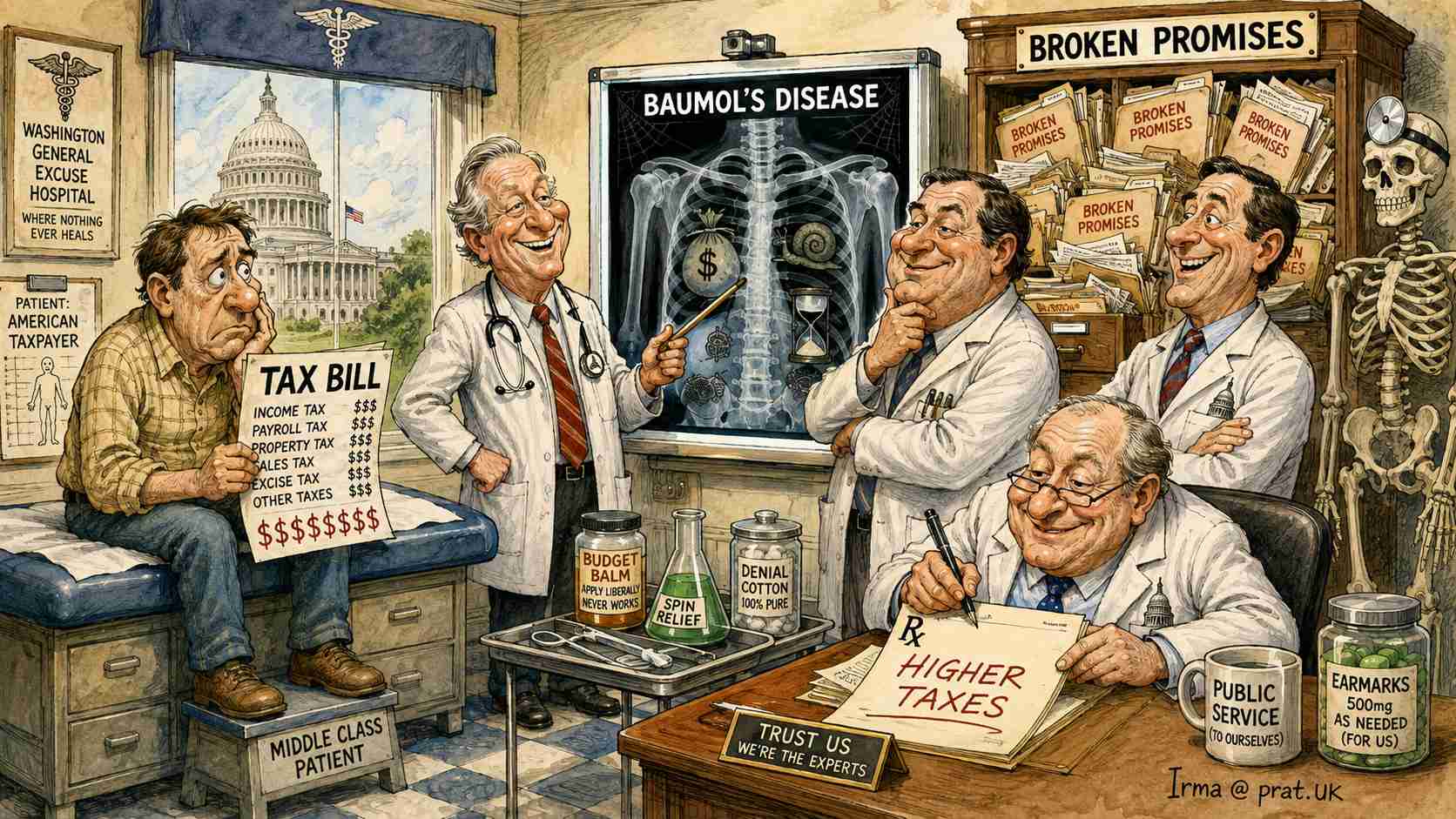
Politicians Welcome Baumol’s Disease, First Medical Condition Capable of Explaining Every Broken Campaign Promise
Washington diagnoses angry taxpayers with an economic disorder, prescribes higher taxes and schedules another consultation after the midterms
WASHINGTON, D.C.— Financial Times — American voters wondering why they pay more taxes for schools that cannot teach, roads that cannot remain paved and government offices that cannot answer a telephone have officially been diagnosed with Baumol’s cost disease.
Baumol’s cost disease explains why labor-intensive services become relatively more expensive as productivity improves elsewhere. A factory can manufacture twice as many televisions with fewer workers, but a nurse cannot compassionately comfort 70 patients simultaneously without becoming a flight attendant.
Washington immediately embraced the theory as the first medical condition capable of explaining every broken campaign promise without implicating anyone who made it.
Fifteen American Symptoms
Voters Paying More for Worse Government Diagnosed With Rare Economic Condition Known as “Not Being Idiots”
Government services now cost like bespoke human care but operate like a vending machine that kept the money.
Politicians promise Scandinavian services, collect American taxes and deliver the customer experience of a bus station bathroom.
Nurses cannot work like robots, so the government orders robots and assigns nurses to train them.
Public schools need more teachers but somehow receive another deputy superintendent.
Government cannot automate compassion but has perfected the automated rejection letter.
The Department of Motor Vehicles preserves the human touch by making citizens wait near actual humans who cannot help them.
AI will eliminate public-sector paperwork after a committee finishes printing its 600-page AI strategy.
Every federal efficiency initiative requires a new office, a new logo and 400 additional employees.
Taxpayers are told deteriorating services prove that private industry has become wonderfully productive.
Economists explain that “value” is an outdated manufacturing concept unsuited to government.
Public agencies operate like orchestras: expensive, heavily managed and still tuning up when everyone wants to leave.
Every failed government website is declared a valuable lesson, making Washington the most educated city on Earth.
Voters are diagnosed with anger, misinformation or insufficient appreciation whenever they notice the bill.
The government treats accountability as a labor-intensive luxury vulnerable to cost disease.
Liberal democracies have united around one economic model: charge more, deliver less and name the outcome after a professor.
Washington Finds the Perfect Alibi
Until now, elected officials had few medically respectable ways to explain why government spending increases while government performance declines.
They blamed the previous administration, the next administration, congressional gridlock, corporate greed, foreign interference, domestic extremists, unusual weather and Americans who refused to understand how complicated everything is.
Baumol’s disease offers something better: an economist who died before the latest budget was written.
“This changes everything,” said Senator Buckley Spendlove, chairman of the Senate Committee on Explaining Expenditures. “We no longer have failed programs. We have labor-intensive public investments experiencing structural cost pressure.”
Asked whether that meant the programs were still failing, Spendlove said the question reflected “outdated outcome-based thinking.”
The senator then announced hearings to determine why voters insist upon receiving something after paying for it.
Angry Voters Diagnosed, Tax Increase Recommended
The first outbreak was detected in Ohio, where accountant Denise Walker noticed that her property taxes had risen while her children’s school eliminated two teachers and hired an Assistant Director of Transformational Belonging.
“I assumed the school needed money for classrooms,” Walker said. “Apparently classrooms are where education happened before it became an administrative framework.”
Doctors initially suspected taxpayer selfishness. Tests found Walker supported teachers, firefighters, parks and libraries. The diagnosis became more serious when she asked how much of every additional dollar reached those services.
“That’s when we knew she was suffering from Not Being an Idiot,” said a county economist. “The condition causes people to compare costs with results. Left untreated, it can lead to voting.”
The government prescribed higher taxes and another community consultation.
Walker was invited to a listening session where six officials explained why nobody could answer her questions until the listening session had concluded.
Public Services Become Luxury Experiences Without the Experience
Under Baumol’s theory, services requiring personal attention naturally become more expensive relative to mass-produced goods. Teaching, nursing, policing and caregiving cannot achieve factory-style productivity without sacrificing their essential human character.
American government has responded by sacrificing the human character while preserving the expense.
Calling a government office now begins with a recorded voice saying, “Your call is important to us,” the traditional American warning that nobody plans to answer.
Citizens then navigate a telephone menu offering nine options, none related to why they called. Pressing zero returns them to the beginning, where the machine congratulates them for participating in democracy.
“It’s like a vending machine that keeps your money and then asks you to complete a customer-satisfaction survey,” said Marcus Green, a contractor from Atlanta. “The only difference is the vending machine occasionally contains food.”
Green spent three months correcting a licensing error created by a computer. Each employee blamed the system. The system blamed insufficient information. Green provided the information four times.
On the fifth attempt, an automated message congratulated him on withdrawing his application.
Nurses Cannot Become Robots, Robots Ordered Immediately
Healthcare provides one of the clearest examples of Baumol’s disease. A nurse requires time to examine a patient, administer treatment and offer reassurance. Productivity cannot simply be doubled without turning bedside care into an Indianapolis 500 pit stop.
The Department of Health and Human Services therefore commissioned several thousand robots.
The machines will not treat patients at first. They will patrol corridors, deliver motivational statements and remind nurses that their overtime forms are incomplete.
A prototype named C.A.R.E.—Compassionate Automated Reimbursement Evaluator—was demonstrated at a Washington hospital.
“My chest hurts,” said the test patient.
“Your concern has been successfully recorded,” C.A.R.E. replied.
“When will I see a doctor?”
“Your expected wait time is between four minutes and the collapse of the insurance market.”
Federal officials praised the robot for reproducing the modern healthcare experience at one-third the emotional cost.
Nurse Carla Mendoza watched the demonstration and asked whether the money could instead hire more nurses.
Officials recorded her question as a software malfunction.
Public Schools Receive Everything Except Teachers
Education is also vulnerable to cost disease because good teaching depends on attention, judgment and time. A teacher responsible for 30 students cannot educate 60 students equally well merely by speaking twice as fast.
This presented policymakers with two options: employ more teachers or redefine education until fewer teachers appear necessary.
They selected the second.
At Jefferson Future-Ready Learning Campus in suburban Maryland, social studies teacher Daniel Brooks spends five hours each week entering student data into four platforms designed to improve classroom efficiency.
“One records grades, one measures engagement, one measures equity and one confirms I used the other three,” Brooks said. “I used to spend that time planning lessons, but lesson plans don’t produce dashboards.”
When the district lost three mathematics teachers, administrators formed a Recruitment Innovation Council.
The council hired a consultant, adopted a slogan and produced a color-coded teacher-retention map. By the time it finished, two more teachers had resigned.
The district called this “valuable baseline data.”
AI Will Eliminate Paperwork Following Extensive Paperwork
Artificial intelligence has been identified as a possible cure for administrative overload. Federal agencies believe AI could summarize documents, process routine applications and free employees to handle complex human needs.
Before that can happen, the government must determine whether AI is innovative, dangerous, equitable, sustainable, secure, inclusive and capable of attending mandatory ethics training.
A new Interagency Commission for Responsible Algorithmic Paperwork Reduction has produced a 600-page preliminary strategy.
The report was printed in triplicate because the electronic records system rejected its file format.
“We expect AI to eliminate unnecessary paperwork by 2034,” said commission director Cynthia Formwell. “Our immediate priority is hiring 800 specialists to define unnecessary.”
The commission’s first experiment asked AI to simplify a federal grant application.
The system reviewed the 94-page form, requested asylum and disconnected itself from the electrical grid.
Taxpayers Told Their Declining Services Prove Prosperity
Economists attempted to reassure voters that rising service costs can accompany growing prosperity. As manufacturing becomes more productive, goods become cheaper relative to human-intensive services.
Americans can now buy a television larger than a Buick for less than the cost of visiting an emergency room waiting area.
“This means society is wealthier,” explained Professor Milton Ledgerbook of the Institute for Contextual Affordability. “Your television is dramatically cheaper.”
“My property tax increased $2,400,” replied homeowner Gerald Price of Phoenix.
“Yes, but consider the television.”
“The fire department took 28 minutes to arrive.”
“Have you seen the resolution on the television?”
Price admitted the picture was excellent, particularly during local news coverage of his garage burning down.
The Government Orchestra Continues Tuning
Experts frequently use an orchestra to illustrate Baumol’s insight. A Beethoven symphony still requires approximately the same musicians and playing time as it did generations ago.
Government works similarly, except the orchestra employs 12 conductors, three communications directors and a Deputy Secretary for Woodwind Accessibility.
The musicians are ready. The audience has paid. The concert is scheduled for 7 p.m. But the performance cannot begin until an environmental review determines whether the triangle has an acceptable carbon footprint.
At 11:45 p.m., the orchestra announces that public engagement has been encouraging and reschedules Beethoven for the next fiscal year.
“The great difference between government and an orchestra,” observed Alan Nafzger, a Texas philosopher and dairy farmer, “is that the orchestra eventually plays something recognizable.”
Compassion Removed, Rejection Successfully Automated
Government leaders insist certain services must remain human because citizens require dignity, understanding and personal judgment.
Those principles disappear remarkably quickly when an application is denied.
Veteran Robert Ellis of San Antonio received an automated letter informing him that his benefits claim lacked documentation. The missing document was one the agency had mailed to itself.
Ellis called for assistance and heard 47 minutes of patriotic hold music.
“The recording thanked me for my service every three minutes,” he said. “By the end, I had been thanked more than I had been helped in 20 years.”
His call was disconnected when the office closed.
The next morning, the system emailed him a survey asking whether the representative had shown empathy.
Ellis selected “not applicable,” which caused the survey to crash.
Value Declared an Obsolete Concept
Voters continue to demand better value for their taxes, a request economists have described as emotionally understandable but technically unsophisticated.
“Value implies a measurable relationship between cost and outcome,” said federal consultant Avery Spendwell. “Government programs produce broader stakeholder narratives that cannot be reduced to simplistic concepts such as working.”
A highway that opens on time may be valuable, but a highway delayed eight years creates jobs, hearings, revised plans, community meetings, litigation, consulting contracts and several opportunities for governors to wear hard hats.
By that broader measure, failure generates far more economic activity than success.
Deductive reasoning therefore establishes that the least functional project may be the greatest contributor to national prosperity.
Washington has suspected this for decades.
Liberal Democracies Agree on a Treatment
Officials from several wealthy democracies met to discuss their common crisis: citizens paying more while receiving less.
After three days, delegates reached a historic consensus. Governments should raise additional revenue, establish advisory panels and improve public communication so voters understand why their experience is incorrect.
The summit’s final declaration promised “human-centered, productivity-aware, fiscally inclusive service transformation.”
No services were transformed.
Delegates celebrated the agreement at a catered dinner prepared by actual human beings, proving that labor-intensive services remain affordable when taxpayers are not permitted to see the invoice.
How Americans Can Manage the Condition
Citizens suffering from Not Being an Idiot should document symptoms carefully. Save tax bills, agency letters and screenshots of government websites displaying “temporarily unavailable” for the sixth consecutive month.
When officials blame Baumol’s disease, ask three questions: How much money reaches frontline workers? How many layers of management stand between the taxpayer and the service? What measurable outcome improved?
Support the nurses, teachers, police officers, firefighters and caregivers whose work genuinely requires time. Then ask why every person delivering a service appears to be surrounded by committees explaining why delivery is impossible.
Finally, retain your sense of humor. It remains one of America’s few unsubsidized public goods.
Congress is expected to regulate it shortly.
Disclaimer
Baumol’s cost disease is a genuine economic theory. The symptoms, committees and administrative job titles described here have been treated with medically necessary exaggeration. Readers experiencing prolonged taxpayer awareness should consult an accountant, a voter-registration office or one government employee who still answers the telephone. This story is entirely a human collaboration between two sentient beings—the world’s oldest tenured professor and a philosophy major turned dairy farmer.
SOURCE: https://www.ft.com/content/da83fd36-a963-4092-8aa3-d4f349b399ae?shareType=nongift https://bohiney.com/politicians-welcome-baumols-disease/


Comments
Post a Comment