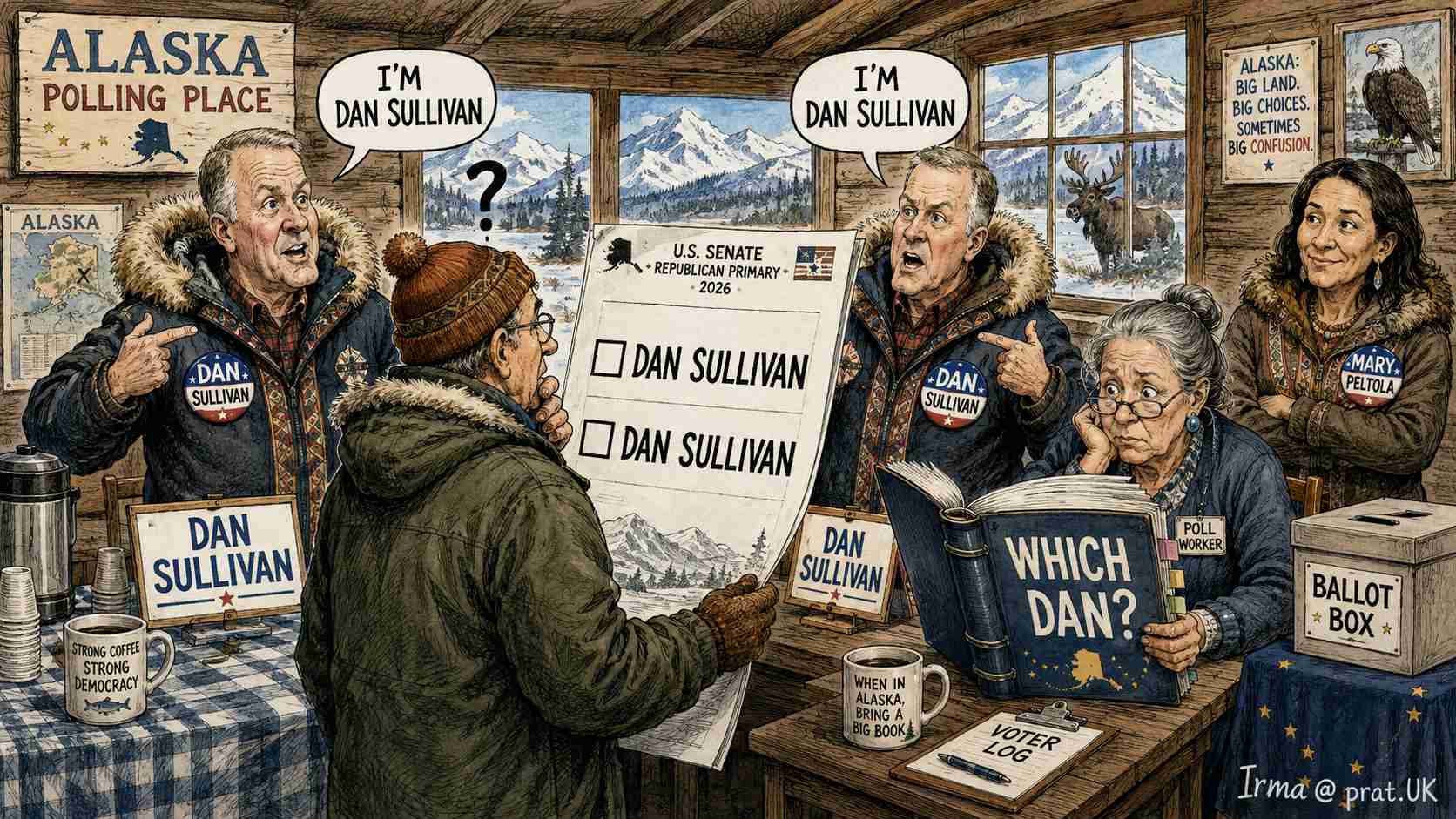
Alaska Senate Primary Forces Dan Sullivan to Defeat Dan Sullivan Before Dan Sullivan Can Win
Incumbent senator discovers that name recognition becomes less useful when somebody else recognises the same name
ANCHORAGE, ALASKA — Alaska’s Senate primary has produced a constitutional question overlooked by the Founders: what happens when Republican Senator Dan Sullivan runs against another Republican named Dan Sullivan, and both men respond when a poll worker shouts, “Will the real Dan Sullivan please step forward?”
Fifteen Humorous Observations
- Dan Sullivan spent twelve years building name recognition. Another man achieved roughly the same result by visiting the Department of Motor Vehicles.
- The senator’s campaign slogan is now “The Dan Sullivan You Were Previously Thinking About.”
- Alaska election officials distinguished the candidates by adding occupations and hometowns, effectively turning the ballot into a dating app with fewer photographs and more federal spending.
- The incumbent says the second Sullivan may confuse voters. This is unfair to Alaska voters, who routinely distinguish among seventeen identical snowdrifts while fleeing a moose.
- Donald Trump endorsed the senator, although the endorsement required a middle initial, an employment history and two forms of identification.
- The challenger is a retired teacher, making him the first person to enter the Senate race because taking attendance was no longer sufficiently confusing.
- Mary Peltola is campaigning against Dan Sullivan while Dan Sullivan does most of her opposition research on Dan Sullivan.
- The senator has spent millions becoming famous. His opponent has demonstrated that American politics can be disrupted for the price of a filing fee and a personalised fleece.
- Ranked-choice voting now allows Alaskans to rank Dan Sullivan above Dan Sullivan without ever deciding whether they like Dan Sullivan.
- The Republican Party insists only one Sullivan is legitimate, reviving its traditional belief in limited government and unlimited trademark enforcement.
- Campaign volunteers knocking on doors must ask voters whether they support Dan Sullivan, then remain on the porch for a twenty-minute clarification.
- The Senate race contains sixteen candidates, but political consultants have determined that America can emotionally process only two men with the same name.
- The second Sullivan denies being a political plant. This is persuasive because most plants have clearer biographies and better fundraising operations.
- Alaska’s ballot is becoming so descriptive that voters may soon need to select candidates by height, favourite salmon and childhood dental records.
- Whichever Dan Sullivan loses can still issue a statement announcing that Alaska rejected Dan Sullivan—and remain technically accurate.
Senator Dan Sullivan Demands Exclusive Rights to Being Dan Sullivan
The incumbent, formally identified as Dan S. Sullivan, entered election day with the traditional advantages of office: money, endorsements, organisation and the ability to appear on television without the presenter first asking which Dan Sullivan had arrived.
Then came Daniel J. Sullivan Jr., a retired teacher and fellow Republican whose principal qualification was possessing a perfectly legal name at a politically inconvenient moment.
The senator’s campaign accused Democratic interests of encouraging the challenger’s candidacy to confuse Republican voters. The challenger denied being anybody’s tool, explaining that he had wanted to run for office and had been called Dan Sullivan for considerably longer than the campaign found suspicious.
This is the trouble with democracy. It permits citizens to run for office even when an established politician has already invested heavily in the same collection of vowels.
A judge ruled that the second Sullivan could remain on the ballot. Courts traditionally require evidence of illegality rather than evidence that a campaign manager has developed a nervous twitch.
Election officials subsequently included distinguishing information beside the candidates’ names. The official candidate list identifies the incumbent as “Sullivan, Dan S.” and marks him as the incumbent, which is government language for “the one who already has the office furniture.” Alaska’s Division of Elections certified the primary field ahead of the August 18 vote.
Alaska has therefore achieved what philosophers call individuating identity and campaign consultants call an emergency.
Trump Endorses the Correct Dan After Extensive Sullivan Verification
President Trump intervened by endorsing the incumbent Sullivan, a task reportedly completed only after aides placed both candidates’ photographs on the Resolute Desk and asked, “Sir, which one has already been agreeing with us?”
The endorsement helped clarify matters, although several voters reportedly wondered whether Trump had endorsed the senator, the teacher or the abstract concept of Sullivanhood.
At a fictional Anchorage focus group conducted for The London Prat, 38 percent of participants supported Dan Sullivan, 34 percent preferred Dan Sullivan, 19 percent wanted more information about Dan Sullivan and nine percent asked whether Sarah Palin was still available.
The survey had a margin of error of plus or minus one Sullivan.
“Name recognition normally helps an incumbent,” explained Dr. Ernest Pollworthy, a local philosopher specialising in ballot metaphysics. “But when recognition reaches 200 percent, democracy begins behaving like a hotel lobby where two guests grab the same suitcase.”
This is deductive reasoning. If voters like Dan Sullivan, and both candidates are Dan Sullivan, then voters like both candidates. If voters dislike Dan Sullivan, both candidates should immediately suspend their campaigns. Political science has never been more efficient.
Mary Peltola Discovers the Republican Party Is Running Against Itself
Former Democratic Representative Mary Peltola, the most prominent challenger in the race, raised $18.5 million compared with the incumbent’s $11.7 million, according to primary reporting summarised by the Associated Press. Alaska’s nonpartisan primary advances four candidates to November, where ranked-choice voting determines the winner.
Peltola’s strategy is now refreshingly straightforward: remain Mary Peltola.
While Republicans distribute laminated cards explaining the difference between Dan S., Daniel J. Jr. and whichever Sullivan is currently speaking, Peltola can introduce herself in fewer than three syllables and immediately discuss fish.
Her fictional campaign slogan, “Only One Mary,” tested extremely well among voters exhausted by genealogy.
“I came here expecting to compare policies,” said imaginary Anchorage voter Doris Halibut. “Instead, I’m comparing middle initials like I’m sorting mail for a divorced family.”
A second fictional voter, Earl McFreezer, said he intended to vote for “the experienced Dan Sullivan.”
Asked which one that was, Earl stared towards the mountains and whispered, “That was the only part of my plan.”
A third witness, Bush pilot Hank Tundra, said the confusion was exaggerated. “Alaskans can identify twelve species of salmon,” he said. “We can distinguish two politicians. One asks for your vote. The other asks why you gave it to the wrong Dan.”
Ranked-Choice Voting Becomes Ranked-Sullivan Voting
Alaska’s system sends the top four primary finishers to the general election, followed by ranked-choice tabulation. The arrangement was designed to broaden voter choice. It has succeeded beyond the emotional carrying capacity of the electorate.
Under the new practical system, voters may rank:
Dan Sullivan, but the senator.
Dan Sullivan, but the teacher.
Mary Peltola, unmistakably.
Someone selected accidentally while attempting to escape the booth.
Reuters described the Alaska contest as an important test in the national battle for Senate control. Democrats need four seats to capture the chamber, which explains why national strategists are studying Alaska with the concentration of bomb technicians examining two identical red wires.
The senator’s predicament proves that every political advantage contains its own weakness. Fame creates name recognition. Name recognition creates brand value. Brand value attracts imitation. Imitation produces another Dan Sullivan wearing a campaign button. Therefore, incumbency inevitably causes retired teachers.
This is a false cause, but it has already been booked on three cable-news programmes.
Congress Proposes the Political Name Protection Act
Washington officials are reportedly considering emergency legislation granting incumbent politicians exclusive use of their names within 500 miles of a polling station.
The proposed Dan Sullivan Identity Security and Electoral Clarification Act would require challengers sharing an incumbent’s name to campaign under an approved substitute such as “Not That Fellow,” “Different Dan” or “The Sullivan Your Consultant Warned You About.”
Civil-liberties groups objected, noting that Congress cannot privatise ordinary names. Congress responded that it has already privatised several ordinary ideas, most of the tax code and Tuesday afternoon.
The act would also establish a National Candidate Registry. Before seeking office, Americans named John Smith, Mike Johnson or Bob Casey would undergo fingerprinting, retinal scanning and a brief oral examination about which senator they claim not to be.
Alaska officials oppose federal intervention because the state already has a practical solution: print enough biographical information on the ballot that every vote becomes an open-book exam.
Helpful Advice for Confused Alaska Voters
Citizens should remain calm. Read the entire ballot. Check the middle initial. Confirm the occupation. Bring reading glasses, provisions for two nights and a trusted genealogist.
Do not select a candidate merely because the name looks familiar. Both names look familiar. That is the problem.
If approached by a campaign volunteer, ask the candidate’s full name, employment history, favourite species of salmon and whether he has recently taught seventh-grade geography. If the volunteer answers, “Which Dan?” the democratic process is functioning normally.
Most importantly, voters should not feel embarrassed. America regularly elects people without knowing who they are. Alaska has merely made the tradition visible.
Alaska Guarantees That Dan Sullivan Will Make the Headlines
When the votes are counted, one truth is certain: Dan Sullivan will receive votes intended for Dan Sullivan, Dan Sullivan will accuse political operatives of helping Dan Sullivan, and headline writers will declare either that Dan Sullivan defeated Dan Sullivan or that Dan Sullivan lost despite Dan Sullivan’s endorsement.
The incumbent may advance comfortably. The retired teacher may collect only a small share. Peltola may emerge with the clearest path to November. But the second Sullivan has already accomplished something rare in American politics: he made a sitting senator campaign on the daring proposition that he is himself.
For years, voters complained that politicians were interchangeable.
Alaska finally listened.
Disclaimer
This report is satire based on an actual Alaska primary containing two Republican candidates named Dan Sullivan. Imaginary witnesses, surveys, legislation and quotations are comic constructions; linked election details and reported campaign facts are real. This story is entirely a human collaboration between two sentient beings—the world’s oldest tenured professor and a philosophy major turned dairy farmer.
SOURCE: https://www.nytimes.com/2026/08/18/us/politics/dan-sullivan-alaska-senate-primary.html https://bohiney.com/dan-sullivan-to-defeat-dan-sullivan/


Comments
Post a Comment