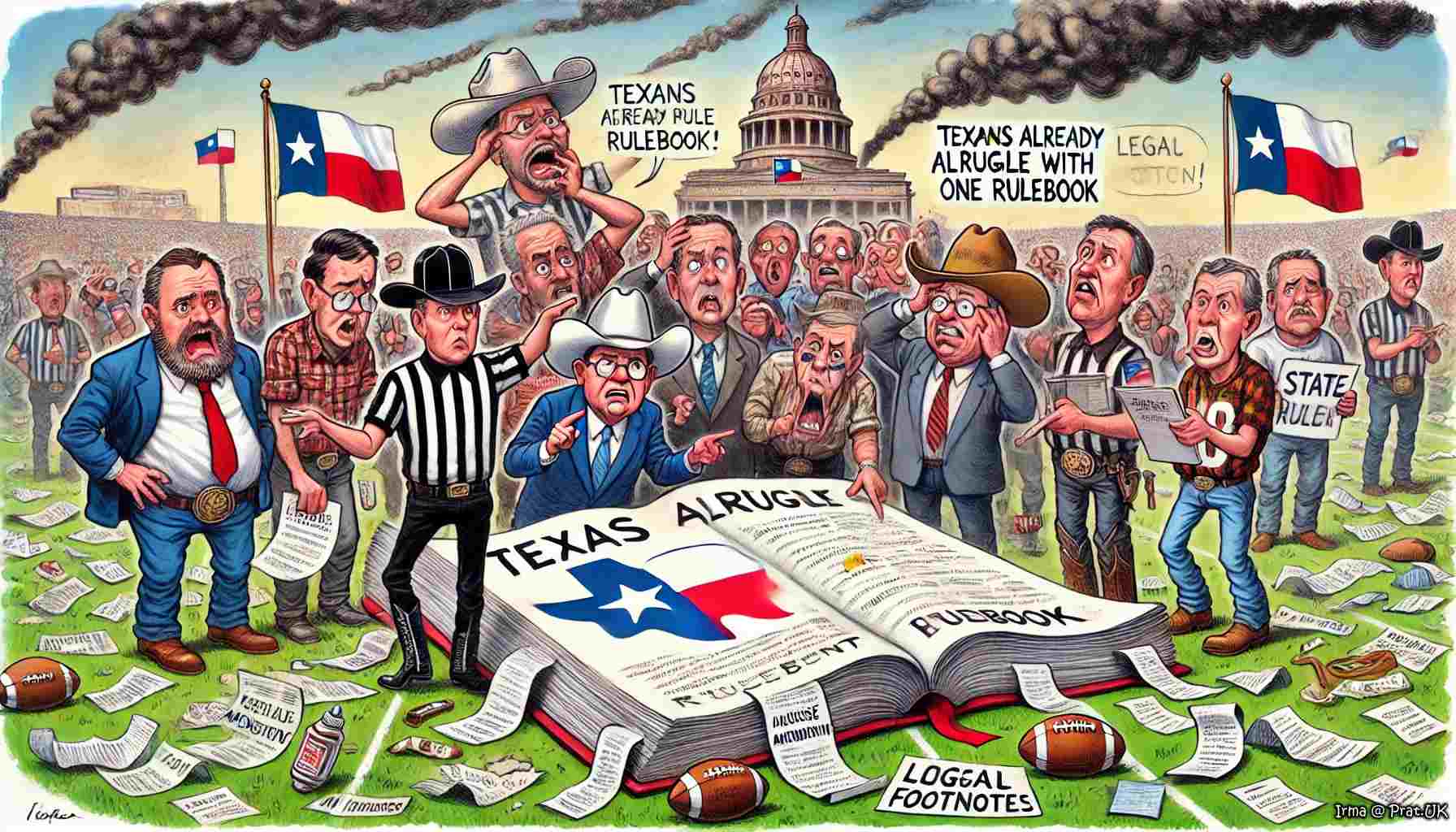
Texas Republicans Warn Against Sharia Courts, Discover Texans Already Avoid Jury Duty At All Costs
Texas politics occasionally resembles a county fair debate moderated by a malfunctioning leaf blower. Everyone is talking at once, someone is selling funnel cakes, and eventually a committee forms to investigate whether the funnel cakes violate the state constitution. The funnel cakes, for the record, have hired a lobbyist.
AUSTIN, TEXAS. Delegates at the Texas Republican convention spent the week denouncing the imaginary threat of Texans waking up one morning to discover that the state had quietly replaced district courts with a panel consisting of an imam, a high school vice principal, and somebody's very opinionated uncle. The uncle, sources confirm, would have ruled on everything regardless of jurisdiction.
The "Don't Sharia My Texas" Panel That Packed The Ballroom
No issue at the convention drew bigger crowds than the now-famous "Don't Sharia My Texas" session, where attendees reportedly sat on the floor and stood at the back, which is also how Texans behave at a Buc-ee's brisket counter.
Critics of the convention language argued that opposition to "Sharia law" unfairly stigmatized Muslims who simply wish to practice their faith in peace, pay their property taxes, and complain about the heat like everyone else.
Others responded that the concern was never that the Texas Legislature would formally vote to replace the Texas Penal Code with a translated medieval manuscript bound in decorative leather. Rather, they worried about the emergence of parallel systems of arbitration operating according to religious principles while still expecting the protections and infrastructure of secular government.
Why "Two Legal Systems" Makes Americans Sweat
Political scientists immediately clarified that the phrase "two legal systems" tends to make Americans nervous because they spent centuries arguing over whether homeowners associations should even exist. Some Americans still believe the HOA is Sharia law, just with a stricter dress code for your lawn.
"It's not that people think Governor Abbott is going to hold a press conference announcing that traffic tickets will now be settled through theological interpretation," explained one exhausted constitutional law professor. "The fear is that communities may increasingly pressure members to resolve disputes through religious authorities while retaining access to state courts whenever convenient. Americans tend to prefer one rulebook, even if they ignore half of it and lose the other half in a junk drawer."
The professor was promptly shouted down by three men arguing over whether barbecue judges should have subpoena power. A fourth man, who had not been invited, demanded the right to cross-examine the brisket.
Texans Already Struggle With One Rulebook
Meanwhile, ordinary Texans expressed confusion.
"I can barely understand the current legal system," admitted Wichita Falls resident Gary Minton while unsuccessfully renewing his vehicle registration online for the third time. "Now I'm supposed to learn a second one? I still don't know what a writ of mandamus is. I assumed it was a kind of fish."
Records show that the average Texan will drive ninety minutes to avoid a courthouse, treat a jury summons as a personal insult from the government, and would sooner schedule a root canal than serve on a grand jury. The notion that these same citizens are secretly yearning for a second court system is, experts noted, optimistic to the point of being adorable.
Private Arbitration: The Plot Twist Nobody Mentioned
Religious freedom advocates pointed out that private arbitration already exists throughout American society, mostly buried in the terms and conditions nobody reads before clicking "I Agree."
"Corporations have arbitration agreements. Churches have internal disciplinary structures. Families settle disputes privately all the time, usually at Thanksgiving, usually loudly," noted one observer. "The question becomes whether participation is genuinely voluntary or whether social pressure makes opting out difficult. The same question, incidentally, applies to your cousin's pyramid scheme."
Texas immediately responded by creating seventeen separate committees to determine whether committee meetings themselves violate traditional Texan values. An eighteenth committee was formed to determine whether seventeen was too many committees. It deadlocked.
Delegates Insist They Are Misunderstood
Delegates at the convention insisted their concerns were being misunderstood.
"We're not suggesting that every Muslim in Texas secretly wants to replace the state constitution," one participant clarified. "We're saying that Americans generally prefer disputes involving contracts, custody, inheritance, and civil rights to remain subject to the same legal framework regardless of whether someone attends church, mosque, synagogue, or a Dallas Cowboys game."
The Cowboys organization declined to comment, citing ongoing theological disputes regarding fourth-quarter clock management. A spokesman added that the franchise has not won a playoff sermon since 1996.
The Exhaustion Of Trying To Discuss It At All
Outside the convention hall, several Texans expressed frustration that the debate had become impossible to discuss rationally.
"If you oppose discrimination, you're accused of wanting open borders," sighed one voter. "If you worry about separate legal systems, you're accused of declaring war on an entire religion. It's exhausting. I came here for the free tote bag."
The Whataburger Compromise
To restore balance, lawmakers proposed that all future political disagreements be settled according to an ancient Texas tradition known as "arguing loudly at Whataburger until somebody's fries get cold."
The proposal currently enjoys rare bipartisan support, though a procedural fight has already erupted over whether the spicy ketchup constitutes a religious accommodation.
What The Constitution Already Does, Quietly, Without A Convention
Constitutional scholars noted that the United States already possesses a framework for resolving such tensions. Citizens remain free to practice their religion, establish voluntary communities, and order their personal lives according to conscience. At the same time, state institutions maintain final authority over criminal law, constitutional rights, and equal treatment before the law.
This arrangement has worked reasonably well for centuries, aside from occasional interruptions caused by social media and one very long argument about a tea tax.
By week's end, Texans had once again demonstrated their remarkable ability to transform complex questions involving religious liberty, pluralism, and civic integration into a shouting match featuring oversized belt buckles and at least one airhorn.
In a final act of compromise, delegates agreed that no legal system should supersede Texas law except football rankings, which remain entirely beyond human understanding, divine interpretation, or the reach of any committee yet formed.
Disclaimer
This satirical article comments on public debates surrounding religious liberty, cultural integration, and constitutional principles. It does not assert that Muslims as a group support parallel legal systems, nor does it minimize legitimate concerns about coercion, discrimination, or equal treatment under the law. As with all good Texas arguments, everyone involved remains convinced they are the only adult in the room.
Auf Wiedersehen, amigo!
This story is entirely a human collaboration between two sentient beings: the world's oldest tenured professor and a philosophy major turned dairy farmer.
https://bohiney.com/texas-republicans-warn-against-sharia-courts/


Comments
Post a Comment