Taylor Swift's Sin: Getting Rich Without a Government Grant
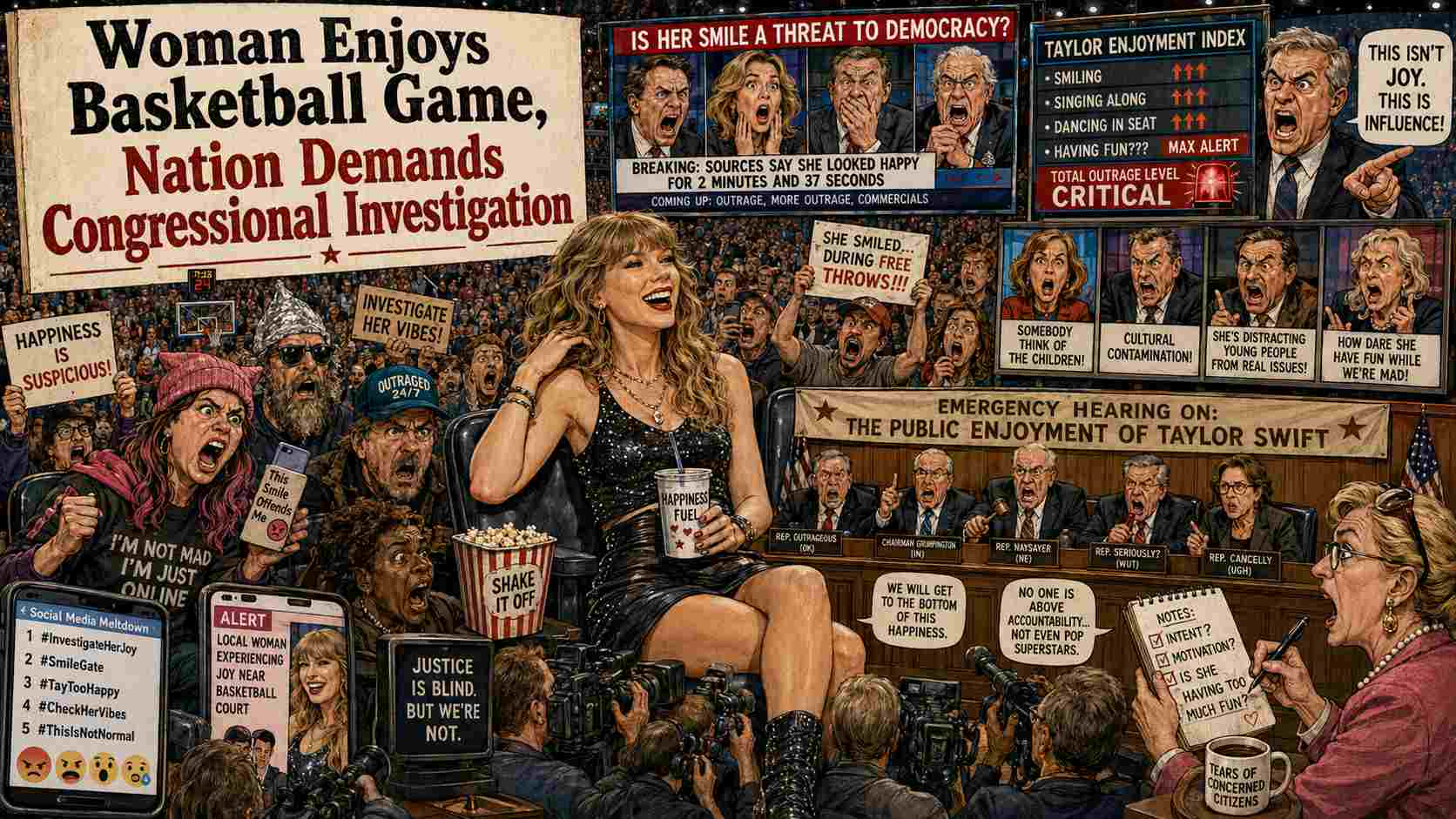
Woman Enjoys Basketball Game, Nation Demands Congressional Investigation
NEW YORK — America is once again confronting one of its most pressing social crises: a successful woman appeared in public, smiled, wore a themed T-shirt, and seemed to be having a genuinely good time.
The controversy erupted after Taylor Swift attended a New York Knicks playoff game, where critics reacted as though she had personally substituted herself into the starting lineup and demanded the ball on every possession. Actor Hank Azaria complained about Swift's courtside presence, joining a growing list of people distressed by the sight of a woman enjoying a sporting event.
Observers noted that Swift's offense appeared to consist primarily of sitting in a chair and cheering for a basketball team.
"I can tolerate billionaires, influencers, hedge-fund managers, ticket scalpers, and celebrities receiving preferential treatment," said one outraged commentator. "But a woman smiling during a game? There has to be a line."
The Fun Tax: Why Successful Women Owe America an Apology
Sociologists describe the phenomenon as "The Fun Tax," a cultural condition in which successful women are required to apologize for every visible sign of happiness.
"If Taylor Swift attended the game and looked miserable, critics would say she seemed cold and detached," explained one researcher. "If she stays home, she's out of touch. If she attends and enjoys herself, she's attention-seeking. The only acceptable behavior is apparently existing in a soundproof bunker where nobody can see her."
The backlash has become so predictable that analysts can now chart it like weather patterns. A woman succeeds. The woman becomes famous. The public insists it's exhausted by her while consuming every article about her. The woman then commits the cardinal error of appearing somewhere. And within minutes a national emergency forms, complete with panelists, hot takes, and at least one man who didn't get the courtside seat he wanted.
The Real Charge: Wealth Built Without a Single Bailout
But the smiling was never the actual crime. Scratch the outrage and you find something older and stranger underneath. The unforgivable thing about Taylor Swift isn't that she went to a game. It's that she got there on her own dime, and so did everybody mad about it.
Here's the part that drives a certain kind of critic up the wall. Swift built a fortune by selling music, concerts, merchandise, and tickets to people who actually wanted them. No appropriations committee signed off. No grant-funded task force studied her viability. No subsidy propped up the second album. Millions of ordinary Americans voluntarily handed her their own money, in exchange for something they enjoyed, and walked away feeling they'd gotten a deal. She is, in effect, a one-woman stimulus package that nobody had to vote for.
And that is what stings. A hedge fund manager can accidentally vaporize a pension fund and still get introduced as a visionary. A bank can torch itself, pass the hat to the Treasury, and be back to record bonuses by Christmas. But a woman who got rich one cardigan and one concert ticket at a time? That somehow becomes a moral matter requiring a panel discussion.
The numbers don't help her case with the resentful. Her last tour made her a billionaire and grossed roughly $2.2 billion, the highest-grossing concert tour ever staged. One analysis pegged the broader economic ripple at a sum larger than the GDP of fifty countries. She created billions in activity that simply did not exist before she decided to hit the road. Yet critics react as if she personally tunneled into a public library and made off with the change jar.
Some People Don't Hate the Boat, They Hate the Neighbor
Much of this has the flavor of the guy who can't stop staring at the new boat in the driveway across the street. It's never really about the boat. It's that somebody else has one, and worse, that they look pleased about it. Swift's true provocation is the joy. A wealthy businessman courtside is read as "successful" and "passionate." A wealthy female entertainer courtside is read as "problematic" and "ridiculous." The seat is the same. The crime is the grin.
The situation grows even more absurd considering that many complaints center on Swift allegedly receiving excessive media attention. This criticism is usually delivered by people posting twenty-seven consecutive messages about Taylor Swift.
"It's fascinating," said one media analyst. "People claim they're exhausted by hearing about her while creating approximately 80 percent of the conversation themselves."
Even some online commenters appeared confused by the outrage. On social media discussions surrounding the controversy, numerous users pointed out that millionaire celebrities complaining about another millionaire celebrity receiving free tickets seemed less like a moral issue and more like a luxury seating dispute among members of the same tax bracket.
Female Empowerment Apparently Comes With a Salary Cap
The larger issue extends well past one playoff game. Modern society loves to encourage women to succeed, right up until a woman succeeds too much, at which point it spends the next decade asking her to apologize for it. A woman can become one of the most commercially successful entertainers in history, employ thousands of people, generate billions in measurable activity, and still be expected to explain why she sat in a chair at Madison Square Garden.
It seems empowerment has a ceiling nobody put in writing. Cheer for the ambitious woman until she clears the height the cheerleaders can comfortably stand under. Cross-strait of that line and the applause turns into a question: hasn't she had enough?
Cultural historians note that highly successful women often become lightning rods precisely because they're visible. Swift has spent years stuck in a peculiar zone where she's simultaneously accused of being overexposed and quietly expected to vanish. Her public image has long come trailing scrutiny and double standards that critics say rarely get applied to the men sitting eight seats down.
The Socialist Nightmare in Three Acts
If you want the whole thing in miniature, watch what actually happened and notice what didn't. A woman got rich. People gave her money. Nobody was forced. No agency supervised the transaction, no commissar approved the merch, no central planner allocated the tour dates. The market spoke, the market bought a rally towel, and the market screamed when OG Anunoby tipped one in at the buzzer.
That is the horror, dressed in a custom shirt. The free exchange worked, it worked spectacularly, and it worked without anybody's permission. For a certain temperament, voluntary success is more offensive than a trillion-dollar deficit, because at least the deficit comes with paperwork.
The irony is that the Knicks themselves almost certainly loved it. Leagues spend millions chasing exactly this kind of celebrity gravity. Then the most famous entertainer alive shows up, free of charge, drawing every camera in the building, and half the internet reacts as if a raccoon had wandered onto the court carrying a flamethrower.
Witnesses Describe the Scene as "Enjoyment"
Witnesses report that Swift's behavior at the game was particularly provocative. She reportedly watched basketball. She cheered. She laughed. At one point, sources claim she may have enjoyed herself. The horror.
Political activists have already proposed several solutions. Some advocate a Women's Public Enjoyment Permit, allowing successful women to have fun only during approved hours. Others favor a progressive visibility tax in which every smile over a certain income threshold must be reported to the proper authorities. A coalition of internet commenters is reportedly drafting legislation requiring female celebrities to sit quietly in the dark while apologizing for their achievements. The bill currently enjoys bipartisan support among people who spend fourteen hours daily arguing online.
And here's the thing the Knicks game only triggered rather than caused. The deeper complaint was never that Swift showed up Wednesday night. It's that twenty years after her first album, she's still winning, still selling out the building, still turning up looking like she's exactly where she meant to be. The seat was a symptom. The grievance is the scoreboard.
For now, the crisis continues. Taylor Swift remains at large, still attending events, still existing in public, and still committing the unforgivable offense of looking like she's having fun. Authorities warn that if the trend continues, other women may grow bold enough to enjoy concerts, restaurants, vacations, hobbies, careers, friendships, and possibly even success itself. At that point, experts fear, society may collapse entirely, presumably right after the encore.
The backdrop here is real. Taylor Swift attended Game 4 of the 2026 NBA Finals at Madison Square Garden, where the New York Knicks staged a historic comeback against the San Antonio Spurs on their way to their first championship in 53 years. Swift sat courtside with sisters Alana and Este Haim of the band Haim and actress Mariska Hargitay, wearing a custom shirt punning on Stevie Nicks that read "Stevie Knicks." Hank Azaria, the longtime Knicks fan and Simpsons voice actor, went on The Dan Le Batard Show to say Swift's courtside presence "bothered" him and that he was "tired of the whole Taylor sports thing," while he sat far up in the rafters. Knicks radio analyst Monica McNutt drew her own social media blowback for a hot-mic remark about Swift not being a real fan. Swift, who became a billionaire largely off her record-shattering Eras Tour, has spent years as a magnet for the argument that a woman can be too successful, too visible, and too obviously happy about both.
This is American satire from Bohiney, produced the way it's always been produced, by the working partnership between the world's oldest tenured professor and a philosophy major who left the lecture hall for a dairy farm and never looked back. The names are real, the seats were real, and the outrage was free of charge. For the British register on the same affliction, our cousins across the pond keep the lights on at The London Prat.
Auf Wiedersehen, amigo! https://bohiney.com/taylor-swifts-sin/


Comments
Post a Comment