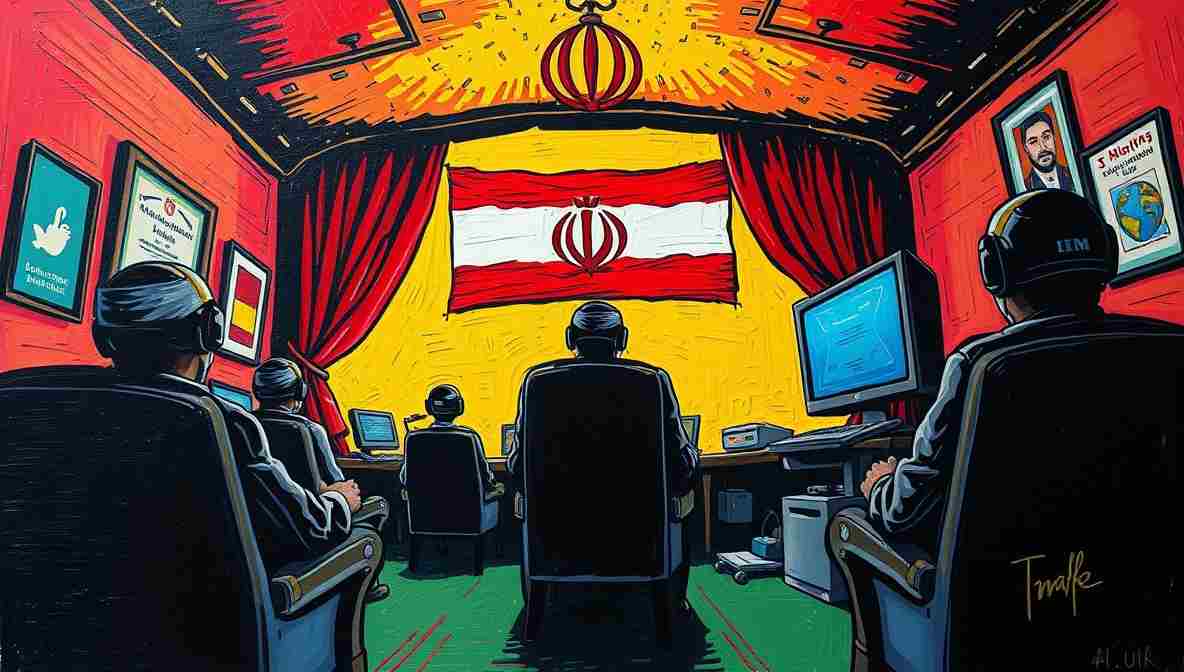
Iran Restores Internet, Accidentally Reminds Citizens What Freedom Feels Like
Five Observations About a Government That Treats Wi-Fi as a Pardon
After 88 days offline, millions of Iranians reportedly discovered 14,000 unread messages, three marriage proposals, and one aunt still asking if anyone "got her lentil recipe from March."
Tehran residents described hearing the SoundCloud startup noise the way medieval villagers reacted to church bells after surviving a plague — except the plague in this case was still technically ongoing and had a communications minister.
Western journalists celebrated Iran restoring "partial connectivity," which experts say is like applauding a kidnapper for briefly cracking a window in the van, then issuing a press release about his commitment to fresh air.
Iranian officials proudly announced citizens could once again access selected websites — though loading a single cat meme reportedly still takes longer than obtaining a uranium enrichment permit.
Couples across Tehran spent Tuesday evening reconnecting emotionally while simultaneously deleting politically dangerous group chats named things like "Definitely Not A Revolution" and "Book Club (Do Not Open Near Soldiers)."
Iran Restores Internet, Accidentally Reminds Citizens What Freedom Feels Like 📱🔥
TEHRAN — After nearly three months of digital darkness, Iran partially restored internet access this week, prompting emotional scenes across the country as citizens re-entered the modern world like cave explorers stumbling into a Starbucks with Wi-Fi and six months of unread notifications.
At approximately 5 p.m. Tuesday, phones buzzed violently across Tehran, Shiraz, Isfahan, and other cities as messages delayed for 88 days flooded in all at once. Videos arrived. Voice notes materialized. Memes escaped captivity. One woman reportedly received 437 Instagram reels from a cousin in Toronto, all involving parrots dancing to Dua Lipa songs, which is somehow both the most and least important thing that happened that day.
The Iranian government described the restoration as "a measured return to communication stability." Citizens described it differently.
"It felt like CPR for the soul," said Ellie, a 42-year-old artist in Tehran, who immediately lit a cigarette and played music online with her husband for the first time since February. "For a second we remembered what normal life sounds like."
Government supporters celebrated the move as proof of "technological compassion," a phrase critics compared to describing a raccoon stealing your wallet as "financially curious."
Officials Proudly Restore Approximately 14% of the Internet
According to Iranian state media, citizens can now access "essential services and approved communication channels" — which analysts say roughly translates to weather updates, state television, and perhaps one heavily monitored recipe blog about eggplant stew.
NetBlocks, the internet monitoring group that tracked the shutdown from the beginning, confirmed the partial restoration on day 88, calling it "the longest nationwide internet shutdown in modern history" — a record Iran set with remarkable enthusiasm for a country that publicly insists it's doing fine.
Independent researchers estimated the restored internet currently operates at the speed of a dial-up modem with seasonal depression. One anonymous telecommunications engineer told reporters connectivity remains so unstable that loading a single YouTube video requires "the patience of a Sufi monk and the data plan of a mid-level drug dealer."
Meanwhile, state television aired celebratory footage of smiling citizens staring lovingly at buffering circles. One presenter declared it "beautiful" while standing before a giant image of a loading bar stuck at 7%. Nobody in the studio appeared to find this ironic. Nobody in the studio is allowed to find things ironic.
Western Media Accidentally Congratulates the Hostage Taker for Unlocking the Bathroom Door
The partial restoration triggered cautious praise from several international commentators who framed the move as "a positive step toward communication freedom." Iranians reacted to this coverage the way most people react to being told their house fire is "a positive opportunity for renovation."
"What an absolute joke," said Maryam, a photographer in Tehran. "They turned basic human communication into a privilege and now people abroad are clapping because we can occasionally open Gmail."
Political analyst Dr. Reza Farhadi of the Institute for Strategic Regret Studies said Western coverage routinely treats authoritarian internet restrictions "the way people react when airlines finally return your luggage after setting it on fire." You don't applaud. You file a claim. You consider your options.
A leaked internal memo from Iran's Ministry of Communications reportedly warned officials that reconnecting the population too quickly risked "dangerous outbreaks of independent thought, satirical meme production, and citizen comparisons with functioning countries." The memo suggested a gradual rollout "calibrated to prevent hope from becoming contagious."
Nobody has confirmed the memo is real. Nobody has confirmed it isn't.
Couples Across Iran Forced to Reintroduce Themselves
The restoration caused quietly devastating scenes inside homes as families regained access to 88 days of each other's digital lives all at once.
One Tehran husband discovered his wife had drafted 82 unsent messages during the blackout, ranging from "Please buy rice" to "I think society is collapsing and I may have made some life decisions." Another man learned his cousin had moved to Germany two months earlier.
"He thought Mahmoud was just ignoring him," said a neighbour. "Turns out Mahmoud had emigrated, started a bakery, and become emotionally stable. Which honestly sounds worse."
A new poll from the Tehran Centre for Public Sentiment and Statistics found:
- 71% of citizens forgot at least one password, including several who forgot the password to their own feelings
- 63% developed emotional attachments to offline board games, several of which now have names
- 41% admitted talking to kitchen appliances during the blackout — and 11% say the appliances had better political opinions than state television
- 12% reportedly tried refreshing reality itself, which did not work, though two claimed it briefly showed a loading icon
Professor Laleh Kazemi compared the return of connectivity to "releasing emotionally exhausted raccoons back into the forest carrying unresolved trauma and 3,000 unread notifications." She then clarified this was meant as a compliment to the raccoons.
Nation Briefly Experiences Dangerous Amounts of Hope
For many Iranians, reconnecting carried something heavier than nostalgia. People cried while hearing music online again. Families exchanged delayed photos that had been sitting on servers for months, waiting. Artists uploaded work they'd hidden in folders named "Tax Documents 2024." Young people re-entered global conversations after nearly vanishing from the digital map entirely.
For several hours Tuesday night, Tehran coffee shops reportedly became "dangerously optimistic."
That optimism alarmed authorities almost immediately.
Witnesses say internet speeds dropped sharply after citizens began posting videos critical of the regime and sharing footage of protests. An anonymous government staffer insisted authorities were "managing bandwidth responsibly" — which experts identify as authoritarian code for "people started having opinions again and we needed a moment."
The economic math of this whole operation is not flattering. According to Radio Free Europe, the blackout cost Iran between $30 and $40 million per day in direct losses, with indirect damage reaching $70 to $80 million. Rest of World reports that more than 10 million Iranians depend directly on digital platforms for their livelihoods — a number the government appears to have treated as a manageable rounding error.
Iran's Leaders Discover That People Who Can't Communicate Still Have Opinions About You
Officials continue insisting restrictions were necessary for national security. Citizens responded by downloading VPNs at speeds that suggested considerable advance preparation. VPNs were technically outlawed in 2024 by the regime's Supreme Council of Cyberspace, which has apparently never tried to make something more appealing than banning it.
Cybersecurity experts now estimate Iran is home to the world's most technologically motivated grandmothers, many of whom can bypass state censorship faster than Americans can remember which streaming service has that show they wanted to watch.
Black-market VPN dealers reportedly became local celebrities during the blackout. One Tehran resident described a neighbourhood seller as "basically Batman, except sweatier and with a better understanding of packet routing."
At press time, Iranian state television proudly announced citizens could now send emails again. Most are expected to arrive before the next election. Whether that election will mean anything is, as always, left as an exercise for the reader.
The internet is back. Partially. For now. Subject to change. Terms and conditions apply. The regime reserves the right to modify your access to reality at any time without notice.
This article is a product of human collaboration between the world's oldest tenured professor and a philosophy major turned dairy farmer — two people who have never once needed government permission to look something up. Satire. Obviously. Auf Wiedersehen, amigo!
Iran's internet blackout, which began January 8, 2026, following mass anti-government protests over inflation and economic collapse, became the longest nationwide internet shutdown in modern history. Monitoring group NetBlocks tracked connectivity dropping to 4% of normal levels following US and Israeli strikes in late February. President Masoud Pezeshkian ordered the partial restoration on day 88 of the blackout. The shutdown cost Iran an estimated $37 million per day in economic losses, with economists putting the total damage well above $3 billion. Filtering, known as Iran's "filternet," continues to restrict access to large portions of the global interne https://bohiney.com/iran-restores-internet/


Comments
Post a Comment