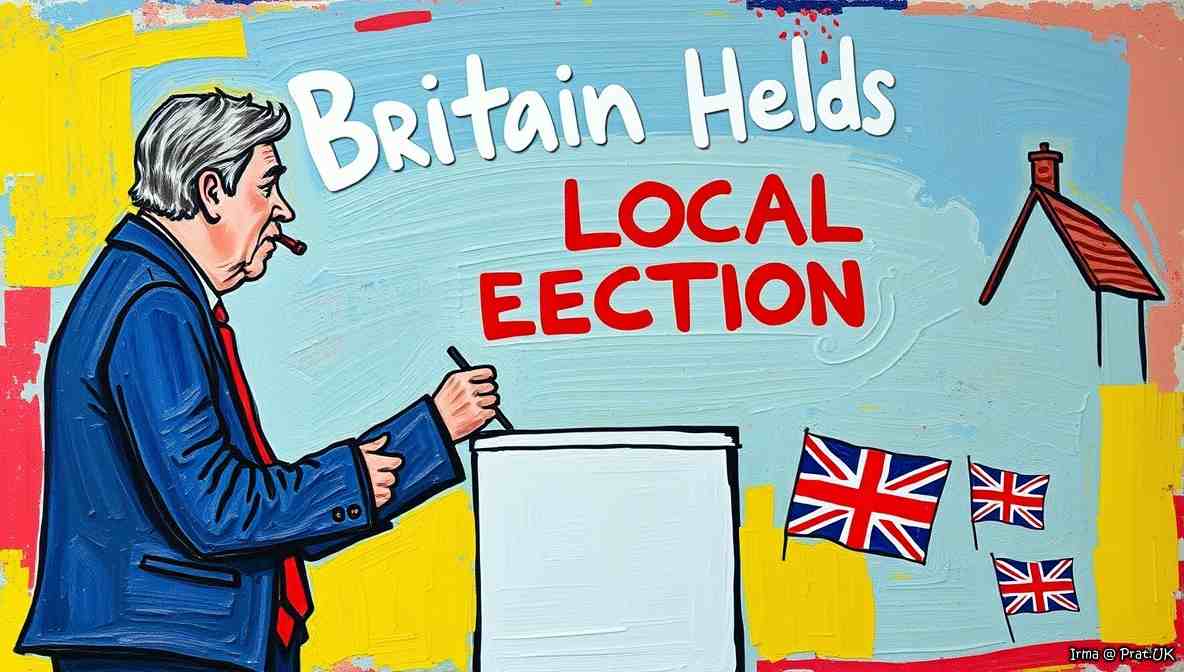
British Guy With a Pint Just Took Over Local Government and Now Has to Fix the Potholes
England's Election Night Looked Like a School Group Project Where Nobody Did the Reading and the Weird Kid Won
America has its political chaos. Britain, not to be outdone, spent last Thursday night doing something extraordinary: handing over 677 council seats to a party that didn't exist as a serious political force three years ago, then watching the guy who built it look briefly terrified about having to actually govern something.
That man is Nigel Farage — imagine a Fox News pundit who also runs his own political party, drinks publicly at all hours, and somehow keeps winning things despite everyone insisting he won't. His party, Reform UK, just pulled off the most dramatic local election performance in modern British history. They won 41% of all contested council seats. They now control 10 local governments. They picked up two regional mayors. And they did it by telling British voters, essentially, that everything feels broken — a message that, much like a Waffle House at 2 a.m., turned out to be exactly what exhausted people needed to hear.
Labour — Britain's left-of-center governing party, think Democrats but with worse branding and wetter weather — lost 22 seats in Wigan alone in a single night. Activists at the count reportedly requested emotional support ferrets. Nobody is entirely sure where the ferrets came from. Nobody asked.
Five-Party Chaos: Britain Discovers That Voter Rage Is a Growth Industry
Here's something Americans should understand about British elections: they currently have five major parties, none of which anyone is particularly happy with, competing under a voting system that rewards whoever gets the most votes in each local area — even if that's only 30% of voters. It is, experts note, structurally similar to American politics except the portions are smaller and the grievances are older.
According to the House of Commons Library analysis, this was the first set of local elections since records began in which neither Labour nor the Conservatives received the highest vote share nationally. Reform took first place with 30% of the projected national vote. To put that in context: UKIP, the Brexit party that Farage previously ran and that blew up British politics in 2016, only managed 23% at its peak. Reform just beat that by seven points. With local council candidates. About potholes.
A highly scientific poll conducted outside a Greggs — Britain's answer to a gas station hot food section, except beloved and slightly more dignified — found that 41% of British voters now dislike all parties equally, 28% dislike different parties depending on the weather, and 13% admitted they "just wanted to watch somebody panic on the BBC screen at 3 a.m."
The remaining 18% were at a self-checkout machine and could not be reached for comment.
Professor Ingrid Gustafsson of the Institute for Electoral Exhaustion explained the dynamic with the calm of a woman who has run out of calm.
"Modern voters can resent Labour for taxes, Conservatives for incompetence, Reform for being too loud, Greens for banning things, and Liberal Democrats simply out of muscle memory," she said, gesturing at a chart labeled NATIONAL MOOD: Tired But Argumentative. "It's genuinely impressive. The nation has achieved omnidirectional fury. This is what you get when you combine a cost-of-living crisis, a housing shortage, and the phrase 'back to basics' deployed sincerely by four consecutive governments."
Nigel Farage: The Man Who Won Everything and Then Briefly Looked Like He Didn't Want It
Farage has been trying to blow up British politics since roughly 2004. He's resigned as party leader multiple times, announced retirements from public life that lasted about as long as a New Year's resolution, and once had a plane crash on election day that he walked away from and still lost. He has the political resilience of a cockroach and approximately the same level of popularity among people who work in Westminster.
Outside Westminster, though? Different story.
On election night, observers noted his expression shifted momentarily from "triumphant pub philosopher" to "man realizing somebody may eventually ask him to fix a drainage ditch." Body language experts from the University of Essex clocked what they called three full seconds of administrative anxiety — a phenomenon not recorded in Farage's career since a party treasurer asked him to submit receipts in 2019.
"Normally Nigel Farage smiles like a man who won a free cruise and intends to complain the entire time," said behavioral scientist Clive Berrington. "But for a brief moment, he looked like someone who'd just inherited a damp leisure center — and suspected it came with a roof survey he hadn't opened."
Reform's pitch was straightforward: inflation is real, immigration is up, the trains don't run, the rivers have sewage in them, and the self-checkout machine keeps screaming at you like an underpaid manager. Reform won 41% of contested seats on just 32% of the vote, thanks to Britain's First-Past-the-Post system — the same electoral math that occasionally gives American presidents 306 electoral votes on 46% of the popular vote, but with more apologetic BBC graphics.
One anonymous Labour strategist admitted the miscalculation plainly.
"We thought people cared about policy detail," the strategist said, staring into the middle distance with the energy of someone who pressed B7 in the vending machine and got nothing. "Turns out they mostly wanted somebody to acknowledge that the country feels like a delayed rail replacement bus service — one that arrives at a different stop, going the wrong direction, driven by someone who also doesn't know why he's there."
Labour Loses Wigan. Labour Tries to Explain Wigan. Wigan Has Moved On.
For Americans unfamiliar with Wigan: it is a town in the northwest of England, historically Labour territory so safe that the party once joked you could put a red rosette on a lamp post and it would win. George Orwell wrote a whole book about it. It has a famous rugby league team, a pier, and until last Thursday, a reliably Labour council.
Then Reform walked in and took 22 seats in one night.
"We thought people cared about policy detail," a second Labour staffer said, which suggests the party has one script and is sticking to it even as the building burns. "Turns out working-class voters in post-industrial towns have frustrations that go beyond our Q3 strategic messaging refresh."
Witnesses inside the Wigan counting hall described scenes of grief usually associated with cancelled weddings or somebody dropping a full tray of drinks at a sports bar. One Labour councillor reportedly stared at a cheese sandwich for forty minutes. Another whispered "maybe doorbells were a mistake" before walking into a gymnasium divider curtain.
The ferret — an emotional support animal named Keith, reportedly brought by a volunteer — observed proceedings with the stoic dignity of an animal that has no idea what's happening but senses it's significant.
The Conservatives Celebrate Not Being Completely Destroyed
The British Conservative Party — imagine the Republican establishment circa 2014, except they've already been through their own populist revolt and lost — had a bad night by any objective measure. They lost seats. They lost councils. They were beaten into third place nationally by a party that didn't win a single council seat two years ago.
They chose to describe this as progress.
"This could have been worse," declared one Tory strategist while standing next to a spreadsheet that appeared to be on fire. "There are technically still Conservatives alive in Wandsworth." He paused. "We're choosing to celebrate that."
Party insiders described morale as "cautiously unconscious."
Former Conservative voters were, to put it gently, not returning calls.
"I wanted change," said 62-year-old Darren Wilkes from Hartlepool. "Not weird change. But normal change gave us sewage in rivers and eight-pound strawberries. So I voted for the man with the pint. He seems like he'd be annoyed about the strawberries too."
This is, political scientists note, exactly how democratic realignment works. One party stops listening. Another party says "we're listening." Voters don't care if the listener is perfect. They just want to feel heard. And then the listener has to fix the drainage ditch, which is where things historically get complicated.
Britain's Electoral Map Now Resembles a Dropped Pizza
By sunrise, Britain's electoral map resembled a dropped pizza — Reform holding the base, Lib Dems clinging to the crust, Greens dotted around like olives nobody ordered, Labour reduced to a smear near the edge, and Conservatives representing the bit of cheese that went cold and nobody's finishing.
There are now 161 local councils in England with no overall majority — up 16 from the previous year. It is the political equivalent of a pub quiz where three teams tied, one team walked out, and somebody's still disputing the music round.
BBC presenters attempted to explain all of this using touchscreen maps, color-coded arrows, and facial expressions usually reserved for unexpected turbulence. At one point, a political correspondent simply circled Essex repeatedly while muttering "something's happening there" — with the focused uncertainty of a radiologist who has spotted something but hasn't decided how to phrase it.
Bookmakers have opened betting on whether Britain's next general election produces: a coalition government, a hung parliament, a national nervous breakdown, or a 17-hour Channel 4 documentary narrated by a disappointed geography teacher. The odds on "all four simultaneously" are 4/1 and shortening.
What the Funny People Are Saying
"British politics now looks like a family group chat where everybody's typing at once, nobody knows who started the argument, and someone's aunt just sent a prayer emoji at completely the wrong moment." — Bill Burr
"Labour losing 22 seats in Wigan is the political equivalent of getting dumped in your own driveway. By a guy who doesn't even own a car." — Ron White
"The Conservatives celebrating smaller losses is like a guy falling off a roof and bragging he only broke one leg. I respect the optimism. I do not respect the leg." — Bill Burr
"Nigel Farage winning 677 council seats is incredible until you realize he now has to attend planning meetings about parking restrictions. That's the real punishment. Democracy has a dark sense of humor." — John Mulaney
"Every country gets the politics it deserves. America got Twitter arguments and contested elections. Britain got a man in a pub telling them the trains are bad. And honestly? The pub man is winning." — Dave Chappelle
The Lesson, If There Is One
What happened in England on May 1st, 2025 is not entirely unfamiliar to American eyes. A political establishment — left and right — stopped connecting with ordinary voters. Costs went up. Services went down. The people running things seemed more interested in managing the narrative than fixing the drains. And then somebody arrived who spoke plainly, made people laugh, made people furious, and most importantly made people feel like somebody had finally noticed that things were broken.
Whether Reform UK can actually govern — fix the potholes, run the councils, deliver on the rage they've monetized into 677 seats — is the question nobody's answered yet. In the months since the election, five Reform councillors were already suspended and several others resigned — which suggests that winning is easier than governing, a lesson every revolutionary movement eventually learns at the planning committee meeting.
And somewhere in Wigan, beneath fluorescent sports hall lighting, a Labour activist gently stroked an emotional support ferret named Keith and whispered the only words keeping modern Western democracy limping forward:
"Well… it could've been worse."
The ferret, which had followed the count more carefully than most of the candidates, reportedly disagreed.
This article is American satirical journalism — a production of the world's oldest tenured professor in collaboration with a philosophy major turned dairy farmer, written from a safe distance across the Atlantic where we can appreciate British chaos without having to queue for it. Bohiney.com reports on the absurdities of democracy with libertarian sympathy for the taxpayer and deep suspicion of anyone who claims they have a plan. No ferrets were consulted in the writing of this piece, though Keith's publicist did not respond to our request for comment. Auf Wiedersehen, amigo! https://bohiney.com/british-guy-with-a-pint/
Comments
Post a Comment