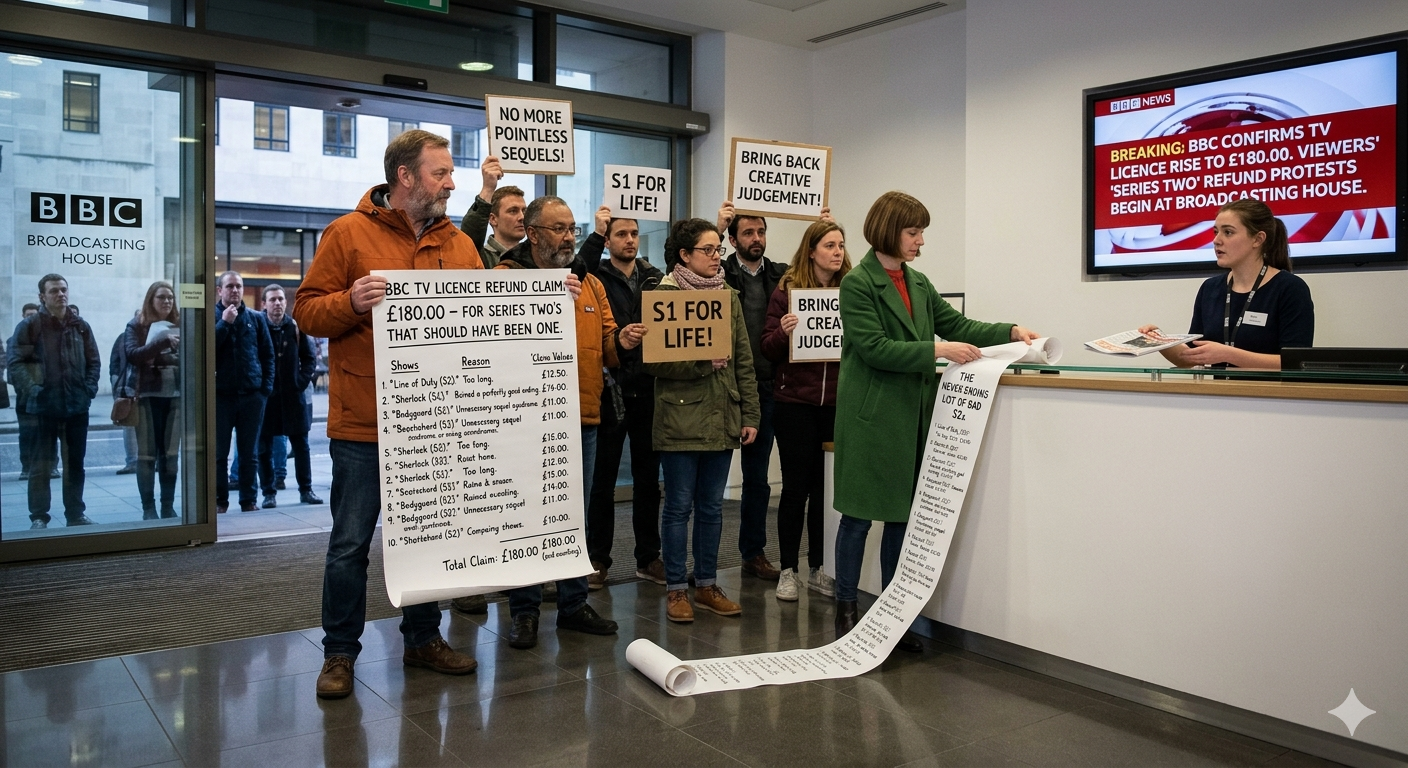
BBC Raises TV Licence Fee, British Viewers Demand Refund for Every Episode of Celebrity Bake Off
The BBC TV licence fee rose to £180 per year on 1 April 2026, in line with the inflation-linked settlement agreed in 2022, making Britain one of the few countries in the world where the legal obligation to fund a television broadcaster is tethered directly to the same inflation index that is currently being driven up by a naval war in the Persian Gulf. The fuel crisis that is making petrol unaffordable has therefore also made the right to watch EastEnders more expensive. The connection is indirect. It is nonetheless real.
The licence fee will increase in line with CPI inflation until the end of the current Royal Charter period in 2027, at which point the BBC's future funding model will be determined by a charter review launched in December 2025. The review is considering options including reforming the fee-setting process, a subscription model, direct government funding, and various hybrid arrangements. The government says it is committed to a sustainably funded BBC. The BBC says it supports public service broadcasting. The 94 per cent of UK adults who use BBC services monthly are waiting to find out how much this will cost in 2028.
The American Perspective on Mandatory Television Funding
From the outside, the TV licence is difficult to explain without extended context. It is a fee, currently £180 per year, which you are legally required to pay if you watch any live television or use BBC iPlayer, regardless of whether you watch the BBC. You can be prosecuted for not paying it. The fee funds an organisation that produces news, drama, documentaries, comedy, sport, and also Celebrity MasterChef. The American equivalent would be a mandatory annual fee to fund PBS, payable regardless of whether you watch PBS, enforced by a licensing authority, and rising with inflation. The concept does not exist in the US and generates significant incredulity when explained.
The BBC has 94 per cent monthly reach among UK adults, which is a remarkable figure that no commercial broadcaster anywhere in the world achieves. Whether this justifies the mandatory model, a subscription model, or some combination is the question the charter review is actively considering.
The Refund Demand, Itemised
The unofficial itemised refund request that circulates every time the licence fee rises includes: Celebrity Big Brother reruns, the television adaptation of a book that everyone agrees was better as a book, the third series of a drama that should have ended at two, the reality cooking programme where the format has not changed since 2009, and the studio discussion programme about the week's news that somehow takes forty-five minutes to say things that were available in seven minutes of reading. Reasonable people disagree about the contents of this list. Everyone has a version of it.
Comedians Weigh In
Jerry Seinfeld, watching from America with genuine bafflement, described the licence fee as "remarkable." "You're legally required to pay for television. In America, television pays you to watch it. I don't mean literally. But they try very hard to get you to watch. The BBC makes you pay and then decides what you watch. That's not a media model. That's a relationship."
Hasan Minhaj observed that the licence fee produces something that commercial television genuinely cannot: content that does not need to please advertisers. "The BBC can make a documentary about something important that has no audience. They make it anyway. That's worth something. Whether it's worth £180 is between you and your television set."
Sarah Silverman said she'd pay £180 just for David Attenborough. "Whatever he narrates. Whatever it is. I don't care. I'd pay it."
What the Review Will Produce
The charter review consultation closed in March. The government will consider the responses, publish proposals, and negotiate with the BBC over a funding model that will take effect from 2028. The options range from a reformed licence fee to a subscription model to direct government grant. Each has consequences for BBC independence, for reach among lower-income households, and for the BBC's ability to make things that would not survive a commercial test. The decision is significant. The deliberation will take as long as it takes. Meanwhile, the licence fee is £180.
The UK TV licence fee rose to £180 per year on 1 April 2026, in line with the inflation-linked settlement agreed in 2022. The fee applies to anyone watching live television or using BBC iPlayer. The BBC's Royal Charter runs to the end of 2027. The government launched a charter review in December 2025 to determine the BBC's future funding model from 2028. Options under consideration include reforming the licence fee process, introducing a subscription model, or direct government funding. BBC iPlayer and live BBC television are accessed by 94 per cent of UK adults monthly. The BBC's free licence for over-75s was means-tested in 2020 and is now limited to Pension Credit recipients.
Auf Wiedersehen, amigo! https://bohiney.com/bbc-raises-tv-licence-feebbc-raises-tv-licence-fee/


Comments
Post a Comment