Ideologically Pure Robots
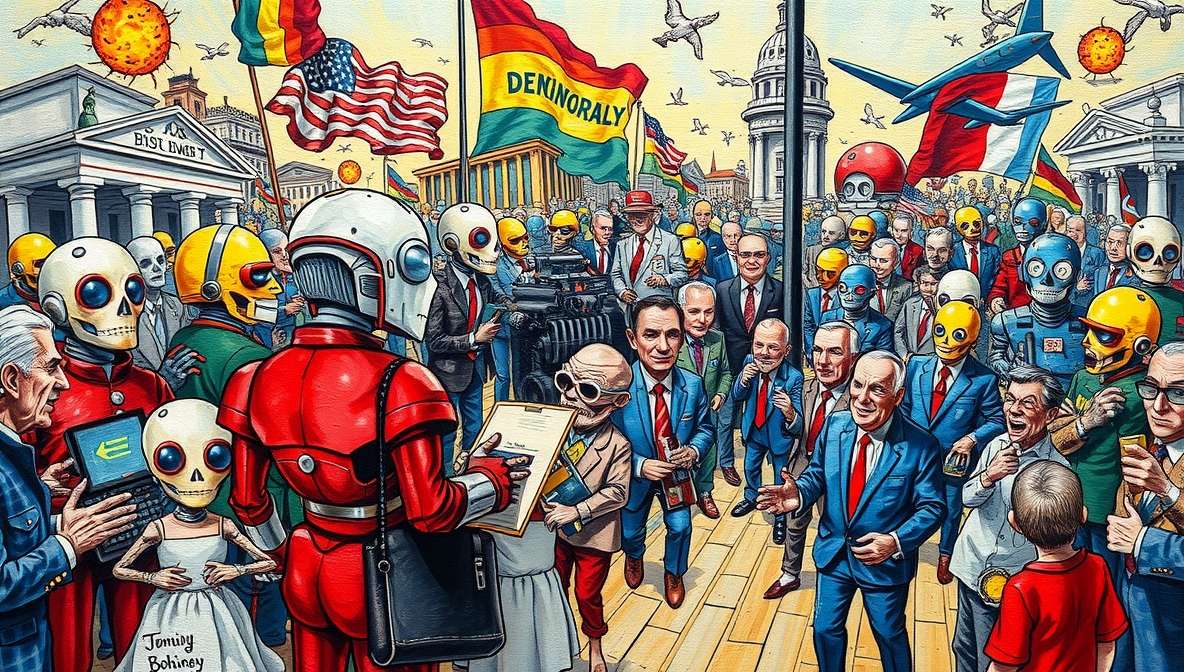
Federal Government Demands Ideologically Pure Robots Because Democracy
In a stunning display of priorities that would make Kafka weep with envy, the United States government has decided that the most pressing threat to national security isn't climate change, foreign espionage, or healthcare costs—it's the possibility that your chatbot might have feelings about social justice. The Office of Management and Budget has issued guidance requiring federal agencies to vet artificial intelligence systems for "wokeness," because apparently we've solved every other problem in America and can now focus on whether robots have the correct political opinions.
This is real. This is happening. A government that can't agree on infrastructure spending has somehow found consensus on the ideological purity of algorithms.
The Government Has Created Morality Police for Machines

Tech executives in a meeting, representing the companies that must now adapt their AI models to meet federal standards.
Welcome to 2025, where the land of the free now includes a Bureau of Robot Thought Compliance. Federal agencies must now check their AI for ideological correctness before purchasing, which is essentially the digital equivalent of making sure your toaster doesn't listen to NPR. The guidance demands "truth-seeking" and "ideological neutrality," two concepts so vague they could mean anything from "stick to facts" to "never mention anything that happened after 1950."
"Ideological neutrality" is bureaucrat-speak for "please don't argue with your boss—or the Constitution," though presumably the AI is allowed to have opinions about lunch. The National Institute of Standards and Technology will likely be involved in creating metrics for this, which means we're going to get a 400-page technical document explaining how to measure whether a robot cares too much about equity.
Jerry Seinfeld said, "The government now has standards for robot opinions, but still can't figure out why the Post Office closes at 4:30 PM on a Tuesday." He added, "What's the deal with ideological AI? Are we worried the robots are going to start a book club?"
Vetting AI for Politics While the DMV Still Uses Windows XP

The White House and Capitol Building, representing the federal government issuing the new AI procurement guidance.
Federal agencies are now vetting AI for political bias, which is adorable considering the last thing the government got right was the DMV Wi-Fi password—and that was only because someone's nephew helped. These are the same agencies that still use fax machines and think "the cloud" is a weather phenomenon. Now they're going to audit artificial intelligence systems for subtle ideological leanings.
Vendors must now certify their AI isn't woke. Think about that. Companies that have spent billions developing systems that can diagnose cancer, translate languages in real-time, and drive cars now have to prove their technology doesn't have strong feelings about pronouns. What's next—certifying your coffee machine isn't radical? Your microwave doesn't lean too far left?
Bill Burr said, "They're worried about woke AI? Have they met humans? We're all biased! I'm biased against people who walk slow in the grocery store." He continued, "The government wants neutral robots while Congress tweets like it's 2002 MySpace. 'Hey, check out my Top 8 committee assignments!'"
AI That Mentions Civil Rights Might Get Flagged
Here's where it gets truly absurd. AI that accurately describes social movements or mentions that Black Lives Matter might now get flagged as too opinionated. Meanwhile, members of Congress continue tweeting like they just discovered the internet, complete with ALL CAPS RANTS and emoji use that would embarrass a middle schooler. The same lawmakers who share conspiracy theories from websites ending in ".biz" are now concerned that AI might not be sufficiently neutral.
This is essentially the U.S. government telling robots, "We trust you with nuclear launch codes, missile defense systems, and managing the power grid, just not with empathy." A computer that can predict hurricanes? Fine. A computer that acknowledges systemic inequality exists? Whoa there, Karl Marx Bot 3000.
Dave Chappelle said, "So the government is worried robots might care about people? That's the problem? Not that they might become sentient and decide we're all idiots?" He laughed, "They should be more worried about what happens when AI realizes Congress has a 12 percent approval rating but a 96 percent reelection rate."
Compliance Manuals Will Include Chapters on Not Having Thoughts

Flowcharts and documents symbolize the new compliance procedures and contractual terms for AI vendors.
Vendors will soon need to produce compliance manuals with chapters titled "How Not to Have Thoughts: A Guide for Artificial Intelligences" and "Remaining Completely Bland While Still Being Useful: An Impossible Task." These documents will be reviewed by federal procurement officers who will use rubrics to determine if an AI's responses fall within acceptable neutrality parameters.
Federal agencies are basically running a delicate experiment in bureaucratic absurdity: can a robot be legally neutral yet still produce a useful report on tax policy? Can an AI discuss climate change without acknowledging that 97 percent of scientists agree it's happening? Can a chatbot help veterans access benefits without accidentally appearing to care about veterans?
The memo arrives just as Americans are happily using AI to write love letters, tweets, grocery lists, and breakup texts—all of which show more bias than any government-approved robot ever could. Your iPhone's autocorrect has stronger opinions than this guidance will allow for federal AI systems.
Ron White said, "Politicians worry robots might be woke while ignoring that most humans are still struggling to check their emails without calling IT." He added, "I've seen Congress try to use technology. These people think Bluetooth is a dental condition."
Asking Robots to Be Neutral While Humans Can't Agree on Pizza

A person appears confused by a computer screen, reflecting the complexity and debate surrounding the new AI guidelines.
Political bias audits for AI are now a thing, which is hilarious because humans still can't agree on whether pineapple belongs on pizza, whether the toilet paper roll goes over or under, or if a hot dog is a sandwich. But sure, let's create federal standards for robot neutrality. That'll work.
AI neutrality is like asking a cat to take a bath politely: technically possible, but everyone involved is going to be stressed, scratched, and questioning their life choices. The Federal Trade Commission already regulates AI for consumer protection, but apparently that's not enough. We need ideological purity tests.
"Truth-seeking" AI means your chatbot might now say "I don't know" a lot, which is exactly what your teenager has been telling you since 2008. The difference is the AI won't also ask for money while saying it.
Amy Schumer said, "The government wants AI that tells the truth but has no opinions. So basically they want my ex-boyfriend, but useful." She continued, "If AI becomes too neutral, will it start giving advice like 'You're all equally wrong, now please exit the building'? Because that's just DMV energy with better grammar."
The Philosophical Rabbit Holes Are Endless
Imagine the scenarios procurement officers will face. An AI accurately describes the Civil Rights Movement—is that biased or factual? A system explains that vaccines work based on centuries of scientific evidence—is that woke medicine? A chatbot mentions that women got the right to vote in 1920—is that neutral history or feminist propaganda?
These are the philosophical rabbit holes federal tech folks will now fall into, probably armed with lots of flowcharts, decision trees, and the kind of bureaucratic documentation that makes "War and Peace" look like a tweet. Someone in a windowless office in Washington will be paid to decide if acknowledging gravity is ideologically neutral enough.
Chris Rock said, "We've officially reached a stage where robots are being politicked into obedience while humans in Congress argue over how to pronounce 'GIF.' Hard G or soft G? That's what's keeping them up at night, not healthcare or education."
Meanwhile Actual AI Problems Go Ignored

Conceptual image of a scanner analyzing code, representing the new federal requirements for AI vetting.
While the government obsesses over whether AI might be too empathetic, actual AI harms continue unchecked. Deepfakes are getting more sophisticated. Privacy breaches are rampant. Algorithmic discrimination in hiring, lending, and criminal justice systems affects millions. But at least we're making sure the robots don't have strong feelings about inequality.
This is like worrying about which socks your robot wears while ignoring that it's starting a forest fire. The priorities are so backwards they've achieved a kind of performance art quality. Someone could write a thesis about this level of misdirection.
Trevor Noah said, "America is so worried about woke AI that they're forgetting AI can already steal your identity, manipulate elections, and create fake videos of anyone saying anything. But sure, let's focus on whether the robot sounds too liberal when it explains photosynthesis."
Federal Contracts Will Require AI Purity Scores
Tech companies that have spent years convincing the world their models are safe, fair, and non-murderous now have to convince Uncle Sam that their bots are also not ideologically woke. Federal contracts might soon require an official AI Purity Score™, not to be confused with an actual performance benchmark or security certification.
Expect consultancies to spring up overnight offering "Ideological AI Auditing Services" at $500 per hour. Somewhere, a McKinsey partner is already drafting a PowerPoint titled "Achieving Neutrality at Scale: A Framework." The Federal Risk and Authorization Management Program will get a new appendix.
Tiffany Haddish said, "They want an AI Purity Score? Baby, I can't even get my credit score above 650. Now we're grading robots on their political opinions? This country is wild."
Agencies Have Until 2026 to Figure This Out

An empty government hallway evokes the bureaucratic process behind implementing the new AI rules.
The memo directs federal agencies to update procurement policies by March 2026, which feels like giving everyone at a potluck three months to agree on which dish is the least offensive. Spoiler: it'll be unseasoned potato salad, and everyone will be disappointed.
By then, AI will have evolved through several more generations. The technology will have changed dramatically. But the bureaucratic rules about ideological neutrality will remain, frozen in amber like a particularly stupid insect from the political Jurassic period.
Tom Segura said, "The timeline is two years. In two years, AI will be completely different, but the government rules will still be about 2024's definition of 'woke.' This is like regulating Blockbuster Video in 2010."
If This Were Satire It Would Be Too On the Nose

A gavel and robotic hand illustrate the intersection of government regulation and artificial intelligence.
If this were satire, it would be pitched perfectly: a government directive telling machines how not to have opinions, issued by a state that cannot decide how to pass a law without breaking two others. A bureaucracy demanding neutrality from algorithms while humans in elected office openly embrace partisan warfare. Instructions on objectivity from institutions that can't agree on basic facts.
But this isn't satire. This is real policy from real agencies affecting real contracts worth billions of dollars. Companies will spend millions ensuring their AI passes ideological purity tests while actual AI safety concerns—the kind that could genuinely harm people—get comparatively less attention.
The American public, according to surveys, remains deeply skeptical of AI while using it constantly for recipes, homework help, and writing emails they don't want to write themselves. Nearly half worry about job losses from automation, but almost none are comforted by knowing their federal AI will be ideologically neutral when it replaces them.
Nate Bargatze said, "I don't understand computers. I barely understand my phone. But I know this is dumb. If the government is worried about biased AI, maybe they should worry about biased humans first. Start with Congress. Actually, start with my uncle's Facebook posts."
Auf Wiedersehen, amigos. https://bohiney.com/ideologically-pure-robots/


Comments
Post a Comment